STEMMING LOSSES:
Taiwan’s super-aged society has meant an increase in older passengers, who pay half fares, while some flights run with as few as four people
-
By Shelley Shan / Staff reporter
The government should allow domestic airlines to raise ticket prices, given a significant increase in operational costs and elderly passengers, Mandarin Airlines said yesterday.
The Civil Aviation Administration (CAA) sets the ceiling and floor fares of each domestic flight route based on a formula set in 1999, in which it reviewed the oil price and 13 cost items submitted by domestic carriers.
In 2014, it granted carriers the freedom to propose adjustments based on changes in oil prices.
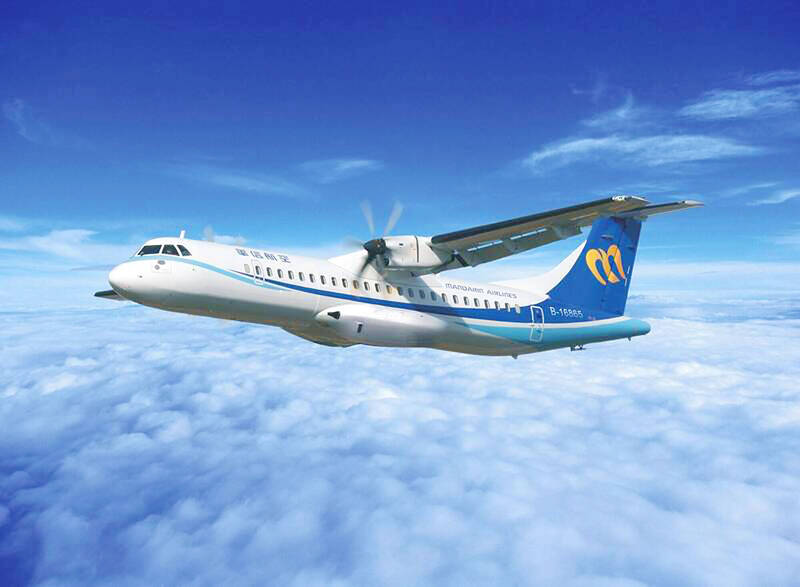
Photo courtesy of Mandarin Airlines
Mandarin Airlines operates 11 domestic flight routes departing from Taipei, Taichung and Kaohsiung.
Mandarin Airlines president Bryant Chuang (莊明哲) said the company’s operational costs have increased about 20 percent due to the acquisition of new aircraft, salary increases and a significant rise in the number of older passengers, who only pay half the ticket price.
The percentage of older passengers on domestic flights has risen from about 9 percent to nearly 14 percent, as Taiwan officially became a super-aged society last year, Chuang said.
The demographic change was more salient in tours to China via Kinmen and Lienchiang counties, also known as the “small three links,” Chuang said.
Through these links, tourists first fly to one of the two outlying counties and board ferries to China.
“We submitted our request for a ticket price adjustment in November and hope that we are allowed to increase the ticket prices by at least 10 percent,” Chuang said, adding that the even approved price changes would not fully cover its operational costs.
The CAA said it has received the submission and is currently reviewing it.
Chuang also proposed a variable pricing mechanism for the public, with fares adjusted for the seasons, adding that there would be separate fare schemes applicable to residents of outlying islands to ensure that their travel needs are taken into account.
Mandarin Airlines chair Chen Ta-chun (陳大鈞) said the carrier’s Kaohsiung to Hualien route is operating at just 20 percent capacity, while the Taichung to Hualien route averages 30 percent.
In one instance, a Kaohsiung to Hualien flight carried only four passengers, he said.
As for the Taipei to Hualien route operated by other airlines, the load factor stands at only 10 percent, he added.
International routes generally require a load factor of 60 to 65 percent to break even, while domestic routes need about 92 to 94 percent, he said.
Adjustments are needed for domestic routes with persistently low demand, he said, adding that shutting down the Taichung to Hualien and Kaohsiung to Hualien routes could reduce losses by an estimated NT$30 million to NT$40 million (US$949,067 to US$1.27 million) per month.
Mandarin Airlines’ revenue comes from international routes, domestic routes and ground handling services.
The company posted revenue of about NT$6.47 billion last year and expects revenue of about NT$6.6 billion this year, it said.
Based on domestic route revenue of about NT$3 billion, a 10 percent fare increase could generate an additional NT$300 million in revenue, it added.
Meanwhile, the airline said it would introduce two new ATR aircraft next month and in March, with the ATR 2.0 fleet upgrade scheduled to be completed in the first half of the year, bringing the total fleet to 13.
It would also continue to focus on outlying island routes, prioritizing additional flights to Penghu and Kinmen during peak travel seasons, it said.