On the Island Pride, the apprentice Glass’ face growing pale – the hallmark of seasickness. It’s an especially tough job for some.
As Glass sleeps off his symptoms, Green drops 16 large traps in deep water. He will leave them for hours – long enough for lobsters to find the bait. Then, Repetto steers for shallower water, where Green lowers hoop nets with which to snare lobsters in the underwater kelp forests. They haul these nets aboard every hour. Before heading back to harbour, they will retrieve their catch from the deeper traps set earlier.
Omnivorous and clawless, Tristan’s lobsters use their long antennae to navigate the rocky seabed, feeding at night on sea urchins, molluscs, and other kelp-consuming invertebrates. This helps to sustain the underwater forests that shelter many other marine species. Spiny lobsters are a vital link in the food web, scavenging dead animals and organic matter, recycling nutrients, and serving as prey for predators including octopus.

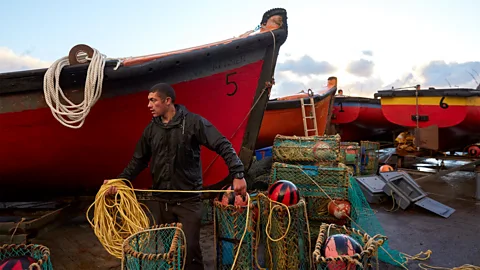 Julia Gunther
The people of Tristan da Cunha, all 229 of them, live in extreme isolation, surrounded by millions of square kilometres of open ocean. Their closest inhabited neighbour, St Helena – where Napoleon lived out the last of his days – lies 2,414 km (1,500 miles) to the north. Montevideo, Uruguay, is 4,023 km (2,500 miles) west. To the south, only a scattering of uninhabited islands separates Tristan from the icy wilderness of Antarctica.