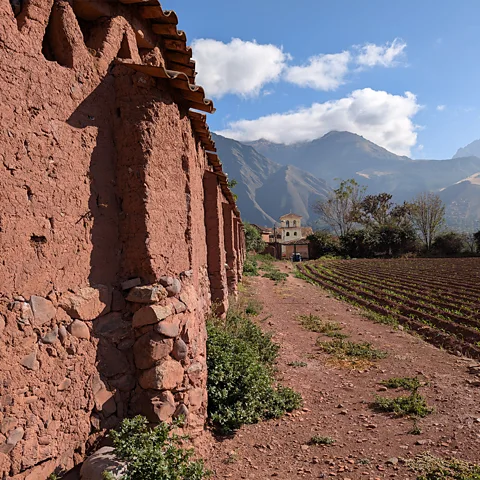
According to Luis Flores, a guide at Explora who grew up in the Sacred Valley, the region’s agricultural heritage is already at risk. Explora’s Sacred Valley lodge is located beside the tiny village of Urquillos, the self-proclaimed “world capital of corn”. Corn has grown here for centuries, in various sizes and colours – from tooth-enamel white to eggplant purple. Nearby, fields are terraced by original Incan stone walls, which preserved the rich soil. Since the airport was announced more than a decade ago, Flores says families around Chinchero have begun selling their farmland.
Much of that land has since been developed, and in place of small farms growing potatoes, corn, beans and quinoa for local markets, there are now “houses everywhere, everywhere” Flores says. The change has only just begun: “With dozens of airplanes landing and taking off, that area is going to be different.”
Flores expects this development will continue. “Different hotel companies are going to buy more land to build more hotels,” he says. “We’ll need more facilities for tourists. It means that we are going to lose a lot of crop fields.”
Lizbeth Lopez Becerra, a Machu Picchu guide based in Cusco, can see the potential benefits to the tourism sector, but not without a “proper analysis” of the impact – and a complete reimagining of the area’s infrastructure. (A heritage impact assessment was still incomplete as of 2025.) She echoes widely shared concerns that the region is already at capacity. The lone road in and out of Cusco is already “chaos” each weekend, she says. Some communities are facing water shortages. Waste management solutions are also overtaxed and recycling infrastructure is nonexistent.

 Alexandra Marvar

