In the 12 months to July 2025, the United States had 254 million international passengers, equivalent to 696,000 people daily. This information is from the country’s Department of Transportation, and is for all short, medium, and long-haul international markets. Such traffic rose by 2% compared to the 12 months to July 2024.
Only half of the 254 million passengers—some 128 million—flew on non-US carriers. The top 15 operators were Air Canada, British Airways, Volaris, Lufthansa, WestJet, Avianca, Air France, Aeromexico, Turkish Airlines, Virgin Atlantic, Copa Airlines, Emirates, Qatar Airways, LATAM, and Aer Lingus. Turkish Airlines’ US traffic was recently examined.
The US’s Top 15 International Carriers

Everyone will know that  Air Canada is comfortably the US’s leading international operator. It had 11.6 million passengers between August 2024 and July 2025. Its mainline unit had 6.2 million passengers (53% of the total), Air Canada Express had 3.0 million (26%), and Rouge had 2.4 million (21%).
Air Canada’s traffic was 10% lower than in the previous 12-month period (this will be explored properly in a separate article). All three units had fewer passengers, but particularly its regional jet-operating Express (-19%). It has ceased flying to multiple US airports.
All Canadian carriers had 6% fewer passengers year-over-year, while US operators grew by 5%. Perhaps the Canadian airlines’ overall reduction reflects the much-discussed trade tensions and anti-US sentiment. Did US airlines grow for strategic reasons or to better capture passengers originating in the US? For some of the operators, part of the reason seems to be using partners. While Air Canada’s traffic was down by a tenth, United Airlines grew by 12%.
|
Round-Trip US Passengers: August 2024-July 2025* |
Airline** |
Seat Load Factor |
Traffic Change Year-Over-Year*** |
|---|---|---|---|
|
11.6 million |
Air Canada |
81% |
-10% |
|
7.5 million |
British Airways |
85% |
+1% |
|
7.1 million |
Volaris |
77% |
-9% |
|
5.3 million |
Lufthansa |
83% |
+4% |
|
5.1 million |
WestJet |
85% |
-2% |
|
4.9 million |
Avianca |
81% |
+11% |
|
4.7 million |
Air France |
87% |
+7% |
|
4.3 million |
Aeromexico |
82% |
+13% |
|
4.1 million |
Turkish Airlines |
83% |
+12% |
|
3.8 million |
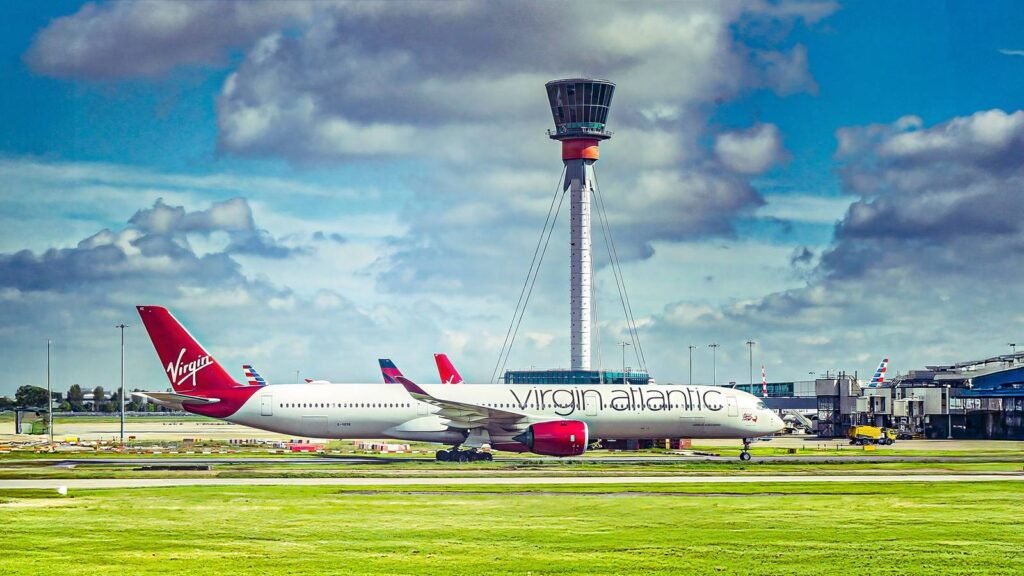
Virgin Atlantic |
79% |
+6% |
|
3.6 million |
Copa |
89% |
+9% |
|
3.3 million= |
Emirates |
75% |
0% |
|
3.3 million= |
Qatar Airways |
91% |
+3% |
|
3.1 million |
LATAM |
87% |
+3% |
|
2.7 million |
Aer Lingus |
77% |
+8% |
|
* Rounded |
** Including regional or other units |
** Versus August 2024-July 2025 |
A Look At Copa’s US Offering

Copa was the US’s 11th-largest international operator. It had 3.6 million passengers, up by 9% year-over-year. The introduction of the first-ever flights from Panama City to  San Diego in June 2025 contributed. This brought the Panamanian carrier’s US operation to 18 routes, including San Juan in the US territory of Puerto Rico. Other fairly recent additions include Raleigh/Durham in June 2024 and Baltimore in June 2023.
Copa’s route to San Diego covers 2,530 nautical miles (4,686 km) each way and is blocked at up to 6h 58m. It is the Californian airport’s longest narrowbody service. It is served four times a week, nearly always on the 166-seat Boeing 737 MAX 9. This has 16 lie-flat seats (2-2), along with 24 seats in EconomyExtra (3-3; 34″ pitch) and 126 in bog-standard economy (3-3; 30″ to 38.5″; the latter are in the emergency rows).
US DOT data for June-July 2025—just the first two months of the new long route—shows that 6,262 round-trip passengers were transported with an 86% seat load factor. Curiously, two other US routes had a lower load factor in those summer months: San Juan (85%) and Austin (85%). Without more information, including fares and yields, it is important not to read too much into these results. Booking data suggests that seven in ten San Diego passengers connected to another flight in Panama City, with San Jose, Costa Rica, being the top market.
Aer Lingus Pushes Korean Air From The Top 15 List

Between August 2023 and July 2024, Korean Air was the US’s 15th-largest international carrier, with 2.6 million passengers. As the US DOT shows that Korean Air’s traffic was flat year-over-year, it has fallen to 16th place. Helped by a growth of 8%, Aer Lingus has replaced it in 15th place.
The Irish flag carrier added three more US airports to its network. It began flying from Dublin to Las Vegas in October 2024 (A330-200/A330-300), Nashville in April 2025 (A321XLR), and Indianapolis in May 2025 (A321XLR). They are underpinned by significant financial incentives and perhaps other risk-sharing deals.
Data until July shows that Las Vegas only had a load of 70% (winter seasonal), against 81% for both Nashville and Indianapolis. As always, routes take time to develop, especially long-haul; it’ll be good to see how they develop.


