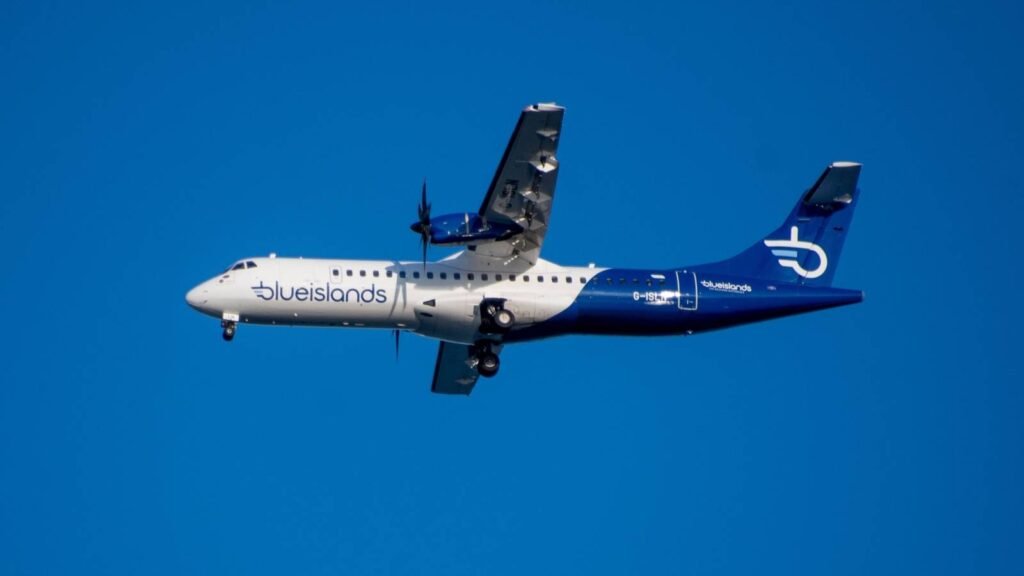
Blue Islands, the Jersey- and Guernsey-based regional airline, has elected to suspend operations with immediate effect after about 26 years of serving the Channel Islands. The ATR 72 operator has grounded its fleet and canceled all flights from November 14, 2025, after the Government of Jersey decided it could no longer provide the financing needed to support these low-demand routes.
The shutdown leaves thousands of overall bookings in limbo, and it removes a key lifeline carrier linking Jersey and Guernsey with cities such as Bristol, Exeter, East Midlands, and Southampton. Coming just a few weeks after the collapse of fellow UK regional carrier Eastern Airways, Blue Islands’ failure highlights the fragility of the United Kingdom’s regional airline sector. We analyze this development and its potential impact on the industry.
What Are The Key Developments In This Story?

Blue Islands announced late on November 14 that it would suspend all trading and flight operations immediately, and the carrier instructed passengers not to travel to the airport. Passengers can seek refunds from credit card providers or travel agents. The carrier itself has roots dating back to 1999, and it eventually adopted the Blue Islands name in 2006.
The airline had been operating a small fleet of ATR 72 aircraft on six scheduled routes in November. This included interisland services and links from Jersey and Guernsey to Bristol, Exeter, East Midlands, and Southampton. Management said that a constructive dialogue with the Government of Jersey ended with confirmation that no additional funding would be provided for the airline. This left the carrier unable to continue operations while it urgently evaluates options such as restructuring or a possible sale to another operator, according to a report on the matter published by Aviation Week.
What Does All Of This Mean For The United Kingdom’s Air Travel Market?

This suspension removes around 9,200 weekly seats from UK airline schedules, and it eliminates around 136 flights per month from the UK-Channel Islands market, an outsized hit in such a niche market segment where margins are incredibly thin. Low-density regional routes such as Jersey-Exeter or Guernsey-Southampton are difficult for larger low-cost or network carriers to serve profitably at higher frequencies, so the sudden loss of this capacity risks significantly lower connectivity and higher fares, especially for local residents and businesses.
This gap increases dependence on remaining operators like Aurigny, easyJet, Loganair, and  British Airways, and it may prompt schedule adjustments. The opportunity could also exist for a new market entrant, but this will likely take quite a while to eventually materialize. Here are some additional details for Blue Islands, according to airline figures:
|
Category: |
Blue Islands Specification: |
|---|---|
|
Fleet size: |
5 |
|
CEO: |
Rob Veron |
This collapse, following Eastern Airways’ recent failure and Flybe’s previous exits from the market, underlines how structurally fragile Britain’s regional airline ecosystem has become, with high fixed costs, volatile demand, and ultimately modest government support. The debate over more robust, long-term public service obligation-style funding for these kinds of peripheral air services will only continue to intensify.
What Should Passengers Keep In Mind?

Passengers with Blue Islands bookings should not travel to the airport unless they already hold confirmed alternative tickets. With operations completely halted, there will be no airline personnel present at check-in or customer service desks. Because the airline has suspended trading, customers will need to pursue refunds through credit or debit card providers, using chargebacks or other forms of customer protection when possible.
They can also request refunds from travel agents if their tickets were booked as part of a package. The Civil Aviation Authority (CAA) is publishing guidance for affected travelers, and they are encouraged to only consult official websites whenever possible.
Travel insurance may reimburse some costs if it includes scheduled airline failure cover. Passengers are encouraged to keep receipts for replacement flights, hotels and ground transport, and request reimbursement from banks or other issuers. Those with essential journeys between the Channel Islands and the UK’s mainland should move quickly to secure seats on Aurigny, easyJet or British Airways, as capacity is only expected to tighten.


