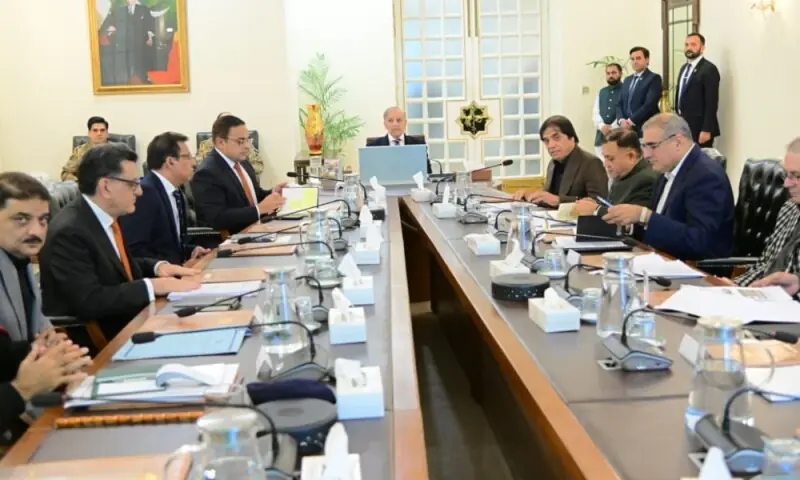
A crucial meeting on a spectrum of affairs related to Pakistan Railways, chaired by Prime Minister Muhammad Shehbaz Sharif, was held at Prime Minister’s House in Islamabad on Saturday.
During the meeting, PM Shehbaz was briefed on the plans to modernise the Pakistan Railways and its revenue generation sources among other things.
Addressing the participants, the prime minister stated that the railway system serves as the backbone of any country’s economy and communications. The PM Office said, he commended the steps being taken towards the revival of the railway system and praised Railway Minister Hanif Abbasi and his team for their efforts in the rehabilitation and upgrade of Pakistan Railways.
The premier instructed Pakistan Railways to acquire the services of international legal and economic experts, particularly concerning projects related to regional connectivity and international train links. He further directed that the Public-Private Partnership (PPP) model be adopted for handling railway properties and land matters.
The meeting received a detailed briefing on the ongoing measures to improve Pakistan Railways.
The forum was briefed that seven digital portals under the “RABTA” platform are operational for the digitalisation of Pakistan Railways. 56 trains have been transitioned to the RABTA system, and 54 railway stations have been digitised.
PM Shehbaz inaugurates upgraded waiting areas, lounges at Karachi Cantt Railway Station
Free Wi-Fi facility has been provided at railway stations in Karachi, Lahore, Rawalpindi, and Faisalabad. This facility will be extended to 48 more railway stations by December 31, the meeting was relayed.
A Freight Online Booking System has also been introduced to facilitate the masses.
A pilot project for a digital weighing bridge has begun at Karachi City Railway Station. This facility will be extended to Pipri, Karachi Cantt, Port Qasim, Lahore, and Rawalpindi railway stations in the next phase.
148 Artificial Intelligence (AI) surveillance cameras have been installed at Rawalpindi Railway Station. ATM machines of various banks are being installed at railway stations.
Moreover, outsourcing has been implemented to improve cleanliness and hygiene standards at railway stations.
High-quality waiting rooms have been built for passengers at large railway stations, and information desks have been established for passenger convenience.
Access has been granted to food authorities of all four provinces to improve the quality of food and beverages supplied at railway stations.
Four trains have been outsourced, and advertisements have been issued to outsource 11 more trains soon, which is expected to generate an additional revenue of Rs8.5 billion.
40 goods and brake vans have also been outsourced, which is expected to generate an additional revenue of Rs820 million.
Outsourcing is also underway for two cargo express trains, expected to generate an additional revenue of Rs6.3 billion.
Work is in progress to outsource railway hospitals in Lahore, Karachi, Multan, Peshawar, Quetta, and Sukkur, along with the outsourcing of railway schools, colleges, and rest houses.
Railway dry ports in Lahore, Islamabad, and Azakhel are also being outsourced. Whereas, 155 railway stations have been converted to solar energy.
Karachi-Rohri rail track upgrade, solarisation of stations announced
The meeting was told that Railway Constructions Pakistan Limited, Pakistan Railways Freight Transportation Company, and Pakistan Railways Advisory and Consultancy Service have been closed down.
A strategy is being finalised for the upgrade of the Karachi-Kotri section of Main Line-1 (ML-1) and Main Line-3 (ML-3).
Work on the Thar Rail Connectivity project will be carried out in collaboration with the government of Sindh.
On international connectivity projects, the forum was told that the Islamabad-Tehran-Istanbul train service will be launched soon. Initial work is also underway on the Kazakhstan-Uzbekistan-Afghanistan-Pakistan (KUAP) rail project.
The meeting was attended by Federal Minister for Railways Hanif Abbasi, Federal Minister for Economic Affairs Ahad Khan Cheema, and concerned senior government officials.


