While cats inhabit or live around most mosques in Istanbul, they haven’t been regular residents of the Topkapi Palace, the residence of the sultans for four centuries and center of the Ottoman Empire. If you’re ever in Istanbul, this is a must-visit place, where you can see the sultans’ jewels, the harem, and many accoutrements of the Empire, not to mention the lovely tiled architecture. However, until recently there were no cats—a woeful lacuna.
This has now been remedied, as the Daily Sabah reports:

An excerpt. The cat door mentioned in the article is shown in the title above (click to read):
The cat door in the Karaağalar Quarters of the Harem at Istanbul’s Topkapı Palace, originally built during the Ottoman period to allow palace cats to move freely, has been fully restored, bringing life back to the palace’s feline residents, including Şerbet, the granddaughter of Mülayim, a cat that had been missing for three years, and other palace cats.
The cat door, which opens into the Karaağalar Quarters, was restored according to its original design, allowing cats to move through the Harem as they did centuries ago. The historic passage has been part of palace life for centuries and serves as a symbol of the Ottomans’ care for pets.
The small door in the Karaağalar Quarters is in the section that once housed the Darüssaade Ağas, high-ranking officials. With the restoration complete, the silent footsteps of cats have again echoed through the palace’s historic stone floors.
Cats, which are among the palace’s silent witnesses, continue to roam the Harem’s stone floors as they did centuries ago, passing through the small door to reach different corners of the palace. After the restoration, Şerbet, the granddaughter of Mülayim, along with other cats, revived the historic passage by following their ancestor’s path, bridging the past with the present.
This small detail, hidden within the Harem’s elegant architecture, reflects the care shown to animals during the Ottoman period and serves as a living part of Topkapı Palace’s history.
. . . . . [Head of the Palace Ilhan] Kocaman emphasized that pets were an integral part of palace life, moving freely and living within the Harem. “Among the palace’s pets, cats stood out more prominently. As a sign of compassion and mercy, these animals were brought into the palace and allowed to stay close to humans. People kept them nearby. To allow easy access, a special door for cats was placed under the main door.”
He continued, “The Darüssaade Ağa held the highest rank among the Karaağalar. The rooms connected to this door were used by officials of lower rank before the Darüssaade Ağa. Since they brought pets with them, the cats personally used these rooms.”
. . .The restoration of the cat door on the second floor of the Karaağalar Quarters has been completed, he said. The ground floor is open to visitors, while the second floor is not yet accessible. Other floors will gradually open, but due to the historic structure, visitor access must be limited. Narrow stairways and the challenging architecture limit the number of visitors allowed on upper floors.
Mülayim, the cat that had lived in Topkapı Palace for many years but had been missing for three, had long used the quarters’ cat door. Now, Şerbet, her granddaughter and other cats continue to pass through it.
“Pets may leave certain areas temporarily, but others take their place. Our staff ensures the needs of cats in the courtyards are met, allowing them to live comfortably. We want to showcase this Ottoman practice and we believe it will attract interest,” Kocaman said.
Here’s a video showing the cats and their new cat door:
Read the Wikipedia article on Islam and Cats, A quote from that one:
The cat is considered “the quintessential pet” by many Muslims, and is admired for its cleanliness.
Unlike many other animals, Islamic Law considers cats ritually pure and that cats possess barakah (blessings), and allows cats to freely enter homes and even mosques. Cats are believed to be the most common pet in Muslim countries.
********************************
Here’s an article about “Bone Jovi,” a cat resident at the Bone Museum in Brooklyn. If you’re a New Yorker, you can go see him NOW.
Click to read:

An excerpt:
At first glance, a museum filled with human bones might not seem like the ideal home for a cat. But for Bone Jovi, the resident feline of the Bone Museum in Brooklyn, it’s a perfect match.
Originally from a shelter in Georgia, Bone Jovi made a 900-mile journey to the Best Friends Lifesaving Center in New York. The tuxedo-wearing cat immediately stood out.
Calm, confident, and unbothered by new environments. That unique temperament landed him an unexpected opportunity, a chance to become the next face of one of New York’s quirkiest museums.
Before Bone Jovi came along, a cat named Chonky Boy had been the beloved mascot of the Bone Museum for five years. Chonky Boy, now partially blind and mostly deaf, was ready for retirement. The museum team went in search of a worthy successor, and they found it in Bone Jovi.
Visitors can often find Bone Jovi curled up in a chair at the front desk or exploring exhibits like Phantom and Odd Fellow. Though surrounded by bones, he moves with ease and charm. He’s become more than just a museum cat. He’s a cultural ambassador, a social media darling, and a fan favorite.
If you want to see Bone Jovi (or visit the Bone Museum), you can find information here. And below is a video of the Museum’s “Head of Security”.
And another video (I think more people come to the Museum to see the cat than the bones, but Bone Jovi facilitates learning, too):
***********************
And Greycoat Research has some good news for cat owners, particularly those with senior cats. As you may known, older cats often die from kidney failure. But now there’s a potential therapy that can give extra years to your moggy. Click to read:

An excerpt:
After decades of research and rising hope, a potential cure for feline chronic kidney disease (CKD) is finally within reach. The long-anticipated AIM injection drug—designed to restore the kidney’s natural cleaning mechanism—is set to enter clinical trials in April 2025, with completion targeted before year-end. Applications for regulatory approval are planned for 2026, and if successful, the drug could be available to the public as early as spring 2027.
This marks a historic moment in veterinary medicine. The drug was developed by Dr. Toru Miyazaki, the Japanese immunologist who discovered the AIM (Apoptosis Inhibitor of Macrophage) protein in 1999 and revealed its critical role in clearing waste from the kidneys. Unlike other species, cats lack the ability to activate AIM, which leads to a gradual buildup of waste and eventual kidney failure. Dr. Miyazaki’s breakthrough was not only in identifying this process, but in formulating a method to correct it—culminating in the development of an injectable drug that delivers active AIM directly to the kidneys.
To bring the therapy to life, Dr. Toru Miyazaki established the Institute for AIM Medicine (IAM) in 2022 with the help of widespread donations from cat lovers who shared his vision of curing feline kidney disease. This public support allowed him to transition AIM research from academic theory into practical application.
The following year, he launched IAM Cat as a dedicated platform to accelerate feline-specific clinical development. Beyond the laboratory, Dr. Toru Miyazaki has worked tirelessly to raise awareness, build infrastructure, and push the treatment toward real-world use. A full production pipeline has now been secured, including a dedicated manufacturing base in Taiwan, ensuring that the drug can be scaled for broad distribution once approved.
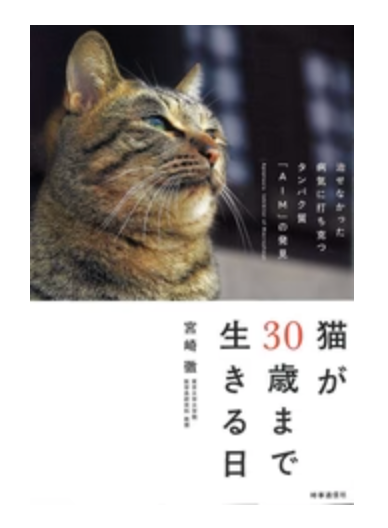
Here’s a photo of Miyazaki’s book, The Day Cats Live to Be Thirty:

The site already sells supplements in the form of pills, but the wonder cure is to be an injection. Check with your vet before trying any of this stuff.
***************
Lagniappe: A new short of Simon’s Cat and Simon’s kitten, who learns to use the scratching post:
And a second lagniapp: parrot and cat have a chinwag:
h/t: Erik, Merilee