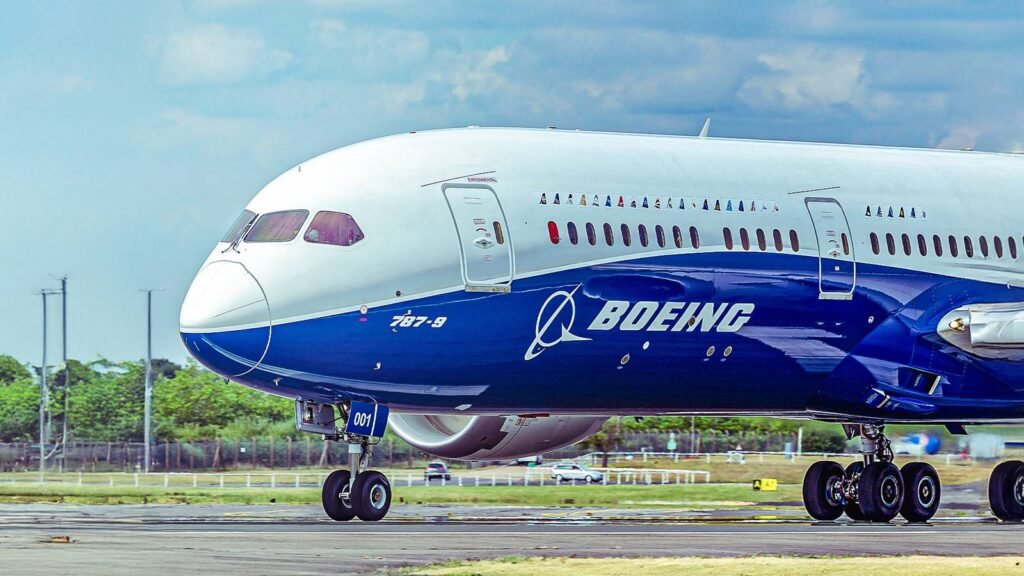
Boeing is currently constructing a new facility to ramp up its 787 Dreamliner production. Currently, the jet’s backlog is growing, and airlines have to wait for years to receive their jets, but, in 2025, Boeing has thus far experienced the second-best year ever for its 787 orders. As of early November, it has received orders for 321 Dreamliners in 2025. This is the second-most orders for the aircraft in history, only behind 2007 when Boeing received 369 orders.
However, this is also far above the number of Dreamliners Boeing is currently able to produce and deliver in a reasonable time frame. To address this program, Boeing is working to significantly expand its production, while Airbus is also working to ramp up production of its rival A350 airliner. Here is what to know about Boeing’s forecast Dreamliner deliveries in 2026.
Production Slashed Since COVID-19

Ramping up production of the Boeing 787 is as much about recovery as it is about anything else. On the eve of the COVID-19 pandemic, Boeing produced the Dreamliner at both its plants in Everett and North Charleston. The last ‘normal’ year for Boeing commercial airplane production was 2018, before the impact of the second Boeing 737 MAX crash in 2019. That said, in 2019, the fallout initially only impacted 737 deliveries, with 2019 being the 787’s final ‘normal’ year.
In 2019, Boeing delivered an impressive 158 Dreamliners, but then the pandemic arrived, and Boeing shut down its 787 assembly line in Everett. In 2020, delivered 787s dropped to 53 examples before cratering to just 14 in 2021. Following that, Boeing shipped 31 in 2022, 73 in 2023, and 51 in 2024. As of the end of October 2025, Boeing has delivered 68 Dreamliners this year, so 2025 is set to be a relatively good post-COVID year for the Dreamliner.
Indeed, its deliveries are likely to overtake the 73 units delivered in 2023. Boeing is targeting an increase to eight of these aircraft per month before ramping that up to 10 a month in 2026. In October, Boeing delivered seven Dreamliners (four 787-9s and three 787-10s). Another contributing factor to the low deliveries has been quality concerns and scrutiny following the Boeing 737 MAX crashes, with supply chain issues also playing a role.
Breaking Ground On The Production Site’s Expansion

It seems production will not be returning to Seattle. Instead, in November 2025, Boeing announced it had broken ground on its Boeing South Carolina (BSC) site expansion. The firm is doubling down on South Carolina being the home of Dreamliner assembly, and it company says BSC will enable the company to increase its production rate to 10 aircraft a month in 2026.
Boeing had announced the plans for the Charleston expansion in 2024, and it is investing over $1 billion in the infrastructure program. The site will include a new final assembly building that’s similar in size to the current one (1.2 million square feet). The facility builds on South Carolina’s history with the Dreamliner, which was first established in 2009, with the program employing over 8,200 people across its North Charleston and Orangeburg campuses.
|
787 Deliveries, 2019 To 2026 (per Boeing) |
|||
|---|---|---|---|
|
2019 |
158 |
2023 |
73 |
|
2020 |
53 |
2024 |
51 |
|
2021 |
14 |
2025 |
68 (to November), approx. 82 estimated |
|
2022 |
31 |
2026 |
84-96 (estimating 7-8 per month) |
10 per month will represent a doubling of Boeing’s target of just four to five per month that it had until early 2025. For now, production has stabilized at around seven per month. Given that the ground has just been broken on the new site, it won’t be until later in 2026 that production ramps up thanks to the new facility, and it is not expected to reach 10 per month until 2027. It is reasonable to assume 787 deliveries of at least 84 in 2026 (seven per month), but could rise to 96 if Boeing achieves eight per month.

787-8 Vs 787-9 Vs 787-10: How The Dreamliner Variants Differ
The three 787 variants are tailored to different market segments to fill niches and offer a placement for different previous-generation aircraft.
Post-2026 Planned 787 Deliveries

Still, even achieving a production rate of 10 per month will not match the high of 13 to 14 delivered per month in 2019, and a rate of 10 per month will take almost a decade to clear the current backlog. According to Leeham News writing in mid-2025, Boeing’s 787 production slots are currently sold out until around 2030. In 2006, Boeing had pondered ramping up production of the 787 to 16 per month, which would have represented 192 Dreamliners a year. However, it peaked at 13 or 14 in 2019.
Now, Boeing is once again considering producing the jet at a rate of 16 a month. This would be a substantial increase from its previously stated ceiling of 12 a month. The potential ramp-up aligns with Boeing’s growing optimism about the Dreamliner’s long-term prospects in the market. For now, it remains unclear if Boeing will raise its goal to 16 a month, but the long-term delivery rate for the Dreamliner is at least 12 per month. In any case, there is plenty of uncertainty in the world that could significantly impact the 787.
One major factor is the current US-China trade war, which has the potential to lock China, the second-largest aviation market, out for Boeing. Earlier in 2025, China briefly banned the deliveries of Boeing aircraft, although that didn’t last long. Another long-term factor is how the development of rival widebody aircraft, like the Chinese C929, progresses, or even next-generation aircraft like JetZero’s medium-sized blended-wing-body further down the line.
Boeing’s 787 Order Backlog

At the time of breaking ground on its South Carolina site expansion, Boeing said that “90 customers from around the world have placed more than 2,250 orders for the 787 Dreamliner family.” Of these, the Boeing 787-8 is the smallest and original variant of the Dreamliner. Initially, it proved popular and has attracted some 427 orders. However, as time has gone on, the stretched 787-9 has become much more popular, attracting 1,432 orders. The further-stretched 787-10 arrived in 2018 and has accumulated 418 orders.
The 787-8 appears to be on its way out with just 28 unfilled orders. Meanwhile, there are 733 outstanding orders for the 787-9 and 287 for the 787-10. Over half (15) of the remaining 787-8 orders are by Emirates. Of the 321 orders Boeing has received for the 787 family in 2025, only one was for the 787-8, which was bought by an unidentified customer.
Boeing’s current order backlog for the 787 stands at 1,048 jets. In all, Boeing says that “the commercial aviation industry is expected to need more than 7,800 new widebody airplanes over the next two decades.” Both Airbus and Boeing are racing to ramp up production to meet that demand. The rival Airbus A350 family has accumulated 1,447 orders, of which 682 have been delivered and 765 remain on order. Meanwhile, the European planemaker’s A330neo series has a total of 445 orders, with 283 in backlog.

How Many 787 Dreamliners Has Boeing Delivered Over The Past 5 Years?
Boeing’s 787 deliveries remain at a third to half compared to their pre-pandemic heights while Boeing’s overall deliveries are also down.
Boeing’s Commercial Aircraft Woes

Boeing is experiencing a cash shortage due to years of under-delivering commercial aircraft and not getting its new jets certified. In 2018, Boeing delivered 806 commercial aircraft, while, in 2024, it delivered just 348. As of the end of October, it has delivered 493 in 2025. New regulations are set to come into force at the beginning of 2027, and Boeing is rushing to deliver the final 767-300F and 777F freighters in 2026, as it will be unable to sell them in 2027. Production of these aircraft is thus expected to end in 2026.
At the same time, production of its next-generation aircraft has continually been pushed back again. The Boeing 737 MAX 7 and MAX 10 variants are now not expected to receive their type certificates until 2026. Until then, Boeing can only deliver the MAX 8 and MAX 9, which had their type certificates before the MAX crashes in 2018 and 2019.
At the same time, Boeing’s third-generation 777X has been pushed back to 2027. The final 777-300ER passenger aircraft was delivered in 2024, and the final 777F is expected to be delivered in 2026, meaning that Boeing is facing a 777 production gap. Emirates has just placed another order for 65 777Xs, pushing the backlog to around 630. However, until Boeing gets its type certificates, it can only ramp up production of the 787 as well as the MAX 8/9. Separately, the FAA has now raised the 737 limit to 42 a month.
Boeing & Airbus Are Both Scaling Production

Both Airbus and Boeing face a similar limitation in that their aircraft are popular, but scaling production is difficult for various reasons, which is made worse for Boeing by scrutiny from the FAA. Another factor is that engine manufacturers are similarly limited to how many engines they can deliver. Even so, Boeing is seeing its order book for the Dreamliner swell. Boeing has already ramped up 787 production from four to five per month since the start of 2025 to seven now.
It is working to expand its facilities to increase that rate throughout 2026 to ten per month sometime in 2027. Boeing is considering further expanding Dreamliner production to achieve a long-term rate of 16 per month, which would exceed its record set in 2019. Separately, future 787 Dreamliner production will likely be with the GEnx engine, as predictions by IBA suggest that Rolls-Royce’s fixes to its Trent 1000 engines are too little too late, and the engine will likely go out of production after 2030.
For comparison, Airbus is currently delivering its A350 at a rate of around six per month with plans to ramp up to 10 per month in 2026 and then 12 per month by 2028. Airbus delivered seven A350s in October and has managed a total of 40 so far in 2025.