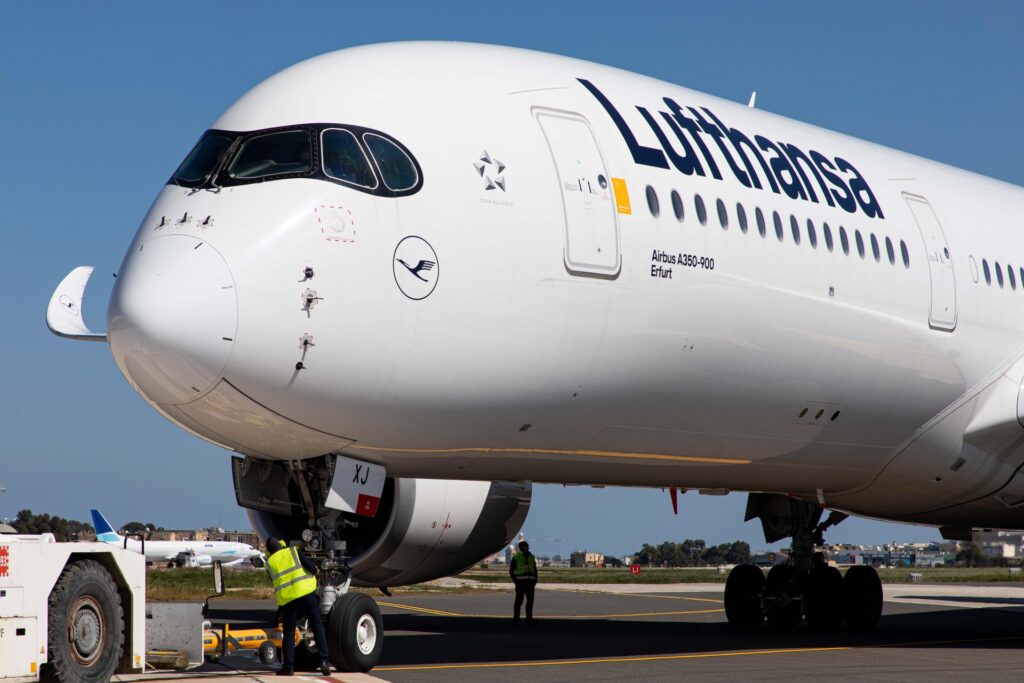
FRANKFURT- Lufthansa (LH) faced criticism after a German violin soloist was told at Helsinki Airport (HEL) that she could only board if she carried her 243-year-old instrument without its case. The musician was traveling to Leipzig (LEJ) and found herself choosing between safety and policy limits.
The incident involved a 1782 Guadagnini violin and an interpretation of cabin baggage rules that left the artist distraught. The situation highlighted how airline policies can clash with the practical needs of professional musicians.

Lufthansa Passenger Told to Carry Violin Without Case
Carolin Widmann was preparing to fly from Helsinki to Leipzig with a connection through Frankfurt (FRA) on Lufthansa when the check-in agents refused her violin case as hand luggage.
Her instrument had accompanied her at roughly sixty concerts a year without issue, yet this time staff said the case exceeded the size limits allowed on board.
She was offered three choices. Check the case with the violin inside. Purchase an extra seat. Or carry the violin without protection. She declined to place the instrument in the hold due to the risk of damage and attempted to buy an additional seat.
The first flight had space. The connecting flight did not. Lufthansa’s system also blocked a one-segment purchase, leaving her without a workable option.
Faced with the ultimatum, she checked the empty case and carried the violin wrapped in a sweater through security and onto the aircraft. Once on board, the cabin crew offered support and did what they could to help her place the instrument safely for the journey to Frankfurt, PYOK reported.
Lufthansa’s Published Policy For Musical Instruments
Lufthansa LH allows musical instruments on board as hand luggage if they meet the dimensions of 55 x 40 x 23 cm and weigh no more than 8 kg.
Larger instruments require an additional seat that must be booked at the same time as the primary seat. Oversized cases are placed on the floor in front of the reserved seat or strapped in.
Widmann’s case measured 80 x 27 x 16 cm. While narrower and slimmer than many standard pieces of carry-on luggage, the length prevented it from fitting within Lufthansa’s required cabin parameters.
The measurement issue meant the case would have occupied more bin space than a standard bag, which is why staff enforced the rule strictly.
Why Ground Handling Matters
Although the check-in agents at Helsinki applied the policy correctly, the situation raised questions about practical judgment.
Many airports allow musicians to proceed to the gate and let the crew determine whether the case can be safely accommodated on board. Gate checks are common and often avoid conflict while still respecting aircraft limitations.
In this case, no such flexibility was offered. A quick conversation between gate staff and the crew could have clarified whether the case could fit in an overhead bin or a closet on board, which often resolves issues without distress to the traveler.
Widmann, a frequent flyer with Lufthansa who holds Senator status, urged airlines to modernize their policies so musicians can travel without fear of losing access to their instruments. She noted that most conflicts stem from inconsistent enforcement at different airports rather than from the airline’s written guidelines.
Musicians rely on their instruments for their livelihood, and the lack of uniform handling increases the risk of missed flights, damaged instruments, or situations like this one.
Stay tuned with us. Further, follow us on social media for the latest updates.
Join us on Telegram Group for the Latest Aviation Updates. Subsequently, follow us on Google News