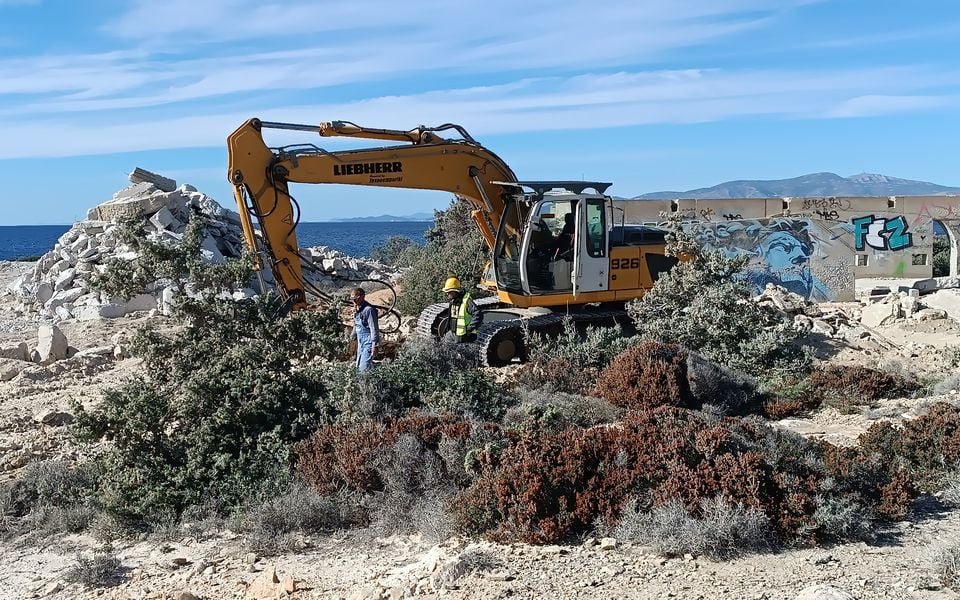

Bulldozers began their work in Alyko about week ago, with the walls easily collapsing due to the condition of the building. This is the only demolition of an illegal building that has taken place in the Cyclades and the Dodecanese in 2025.
For successive generations of residents and visitors to the Greek island of Naxos, the building in Alyko, located in the middle of the cedar forest, has always been there: dilapidated, eroded by the sea, full of graffiti. The unfinished hotel had been in this state since the mid-1970s, when its construction was interrupted. In this sense, its demolition, which began a week ago, will provide the only opportunity for a new, comprehensive vision of the protected area it was built in, which every year is subject to throngs of tourists.
This case, however, is a drop in the ocean, as it is the only demolition of an illegal building that has taken place in the Cyclades and the Dodecanese in 2025.
The bulldozers began their work a few days ago. “Most of the concrete has fallen. Now we are breaking it into smaller pieces to remove it,” explains the contractor’s project supervisor, Stathoula Mandilara. “The state of the building is such that the walls were falling apart like paper.” The project has a completion deadline of six months – a fairly long time for similar projects – and formally began in late October.

The demolition is the epilogue to a story that spans more than half a century. As literature and former PASOK MP Nikos Levogiannis records in his seven-volume work on the modern history of Naxos, the efforts to encroach on the cedar forest in Alyko began in the mid-1960s. “A Belgian company began in 1966 to buy land from encroachers, people who had illegal contracts which resulted from false wills or fictitious sales,” he tells Kathimerini. “During the military dictatorship, the Belgians obtained various permits that went against the law and began building. In fact, it is said that an ancient cemetery with 13 tombs was discovered during their work, which was looted and destroyed.”
Thanks to the persistence of three civil servants – the head of the ephorate of antiquities, the head of the forestry service, and the harbormaster – and the legal fight of Antonis Koutras, a lawyer from Filoti, the construction of the hotel was halted. “The civil servants constantly submitted objections to their agencies citing a 1946 decision, according to which the area is a public forest. Thus, the project was blocked and the state filed an eviction lawsuit against the Belgians, which, however, was never heard in court because of the junta. However, the Belgians lost patience and abandoned the project.”
Levogiannis, together with Koutras and other citizens, began a fight in the early 1980s to expel the encroachers and return the area to the state. “The first positive decision was issued in 2001, followed by the Court of Appeal’s decision in 2004, and the case was finally closed in 2010 by the Supreme Court. Therefore, the demolition should have been carried out two decades ago,” he says.
For the island’s residents, the news of the demolition of 11,000 square meters of concrete in Alyko is finally opening the discussion about how to protect the area. “The news of the demolition is great, as it has been a request for decades,” says Marios Vazaios, economist and executive director of the Naxos Festival, a cultural organization. “Now we need to see the next step. The fight to protect Alyko does not end with the demolition, but should have it as a starting point. The cedar forest is the only undeveloped spot on the entire western coast of Naxos. We therefore need a vision for the restoration of the area, as well as its management.”
The municipality, which has assumed the role of overseer of the demolition, also agrees with this view. “The demolition contract provides for a horticultural study for the reforestation of the empty spaces. However, because this is a special ecosystem, I believe that the area should be fenced off in collaboration with the forestry service and admission should be controlled, so that Naxos residents and visitors can freely enjoy the area and avoid destroying everything by cars,” says Mayor Dimitris Lianos.

Need for a comprehensive study
“For me, it was a lifelong dream. How could I not be happy?” says Levogiannis. “Now they need to let nature breathe. A horticultural study is not enough. The state needs to see Alyko as a whole.”
“We may be obligated by the contract to conduct a horticultural study after we complete the demolition, but I believe it would be better for OFYPEKA to conduct a comprehensive study for the wider area and for us to implement it,” says Mandilara, referring to the Natural Environment and Climate Change Agency. “The area is a jewel, but it is under great pressure from tourism.”
Τhe demolition of the illegal hotel in Alyko is the only one that has been carried out this year by the Decentralized Administration of the Aegean in the Cyclades and the Dodecanese – while some others were also carried out for minor irregularities by the owners of illegal structures or municipalities.
The only active contract for the removal of illegal buildings on Rhodes has not been fulfilled, while the Green Fund approved a very small amount – just 200,000 euros – for new demolitions on the islands. This fact is indicative of how the state’s interest in illegal construction on the islands has faded, two years after the wave of revelations about urban planning irregularities on the popular islands of Mykonos and Rhodes.


