During the cataclysmic eruption of Mount Vesuvius in 79 AD, the ancient Roman cities of Pompeii and Herculaneum were largely destroyed as debris produced by the massive stratovolcano buried them under large volumes of ash and pumice.
Beneath those several meters of debris, the remains of these ancient cities, including the remnants of many buildings, are still preserved. Ongoing excavations at Pompeii have revealed deep insights into how its ancient inhabitants lived, as well as what their ancient dwellings looked like.
Now, with the help of investigations employing advanced digital reconstructions, archaeologists say they are revealing “lost” portions of Pompeii’s ancient structures, offering an unprecedented glimpse at parts of the city destroyed during one of history’s deadliest volcanic eruptions.
Digital Archaeology Unveils a “Lost” Pompeii
Among the remnants of buildings at Pompeii is a dwelling known as the House of Thiasus, a large ancient home in the area known as Regio IX. There, excavations in the past have revealed the existence of features that include massive dining rooms, living spaces, and other features that offer a window into the lives of the city’s residents.
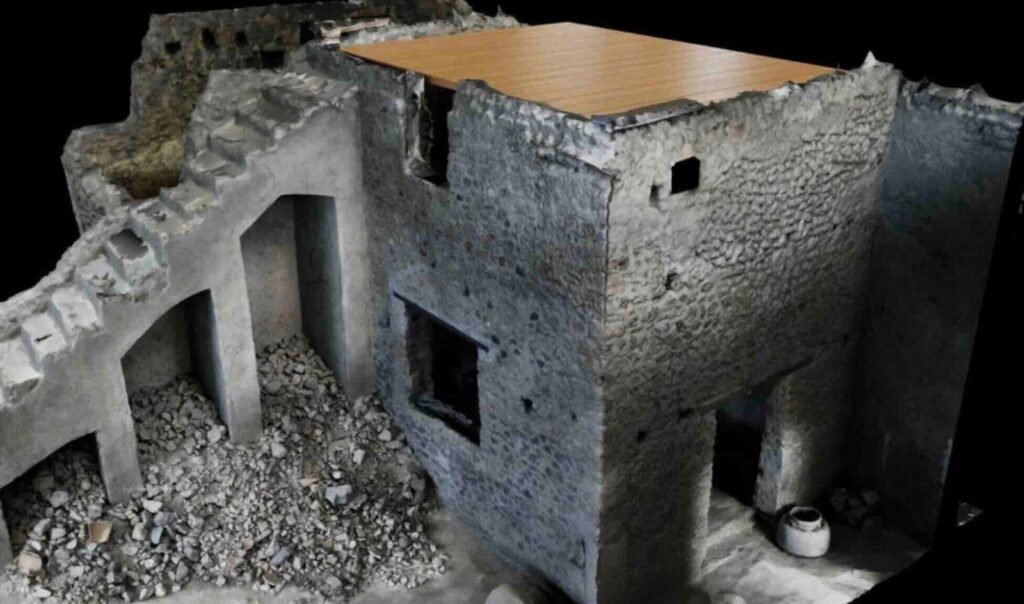
However, some questions remain about the ancient home, which include an oddity: a grand staircase that ascends toward an area above the home and, seemingly, leads to nowhere.
Now, according to recent research featured in the online journal eJournal of the Pompeii Excavations, archaeologists have employed advanced digital reconstructions to answer questions like those surrounding the mysterious staircase at the House of Thiasus, and other evidence of a part of Pompeii that was lost during the destruction that ensued in 79 AD.
Reassembling Ancient Structural ‘Ghosts’
As the volcanic material buried Pompeii beneath several meters of ash, in many cases the upper portions of buildings collapsed or were otherwise destroyed, while their lower floors became entombed and rediscovered centuries later by archaeologists.
Once excavations began in earnest during the eighteenth century, it became quickly evident that large portions of the city’s once elegant structures were missing, leaving historians and archaeologists with an incomplete picture of what the ancient city once looked like.
Now, a cooperation between researchers with the Archaeological Park of Pompeii and Humboldt University of Berlin, Germany, is unveiling this “missing” portion of Pompeii through an effort known as the Pompeii Reset project. Fundamentally, the project aims to use modern cutting-edge technologies like LiDAR, high-resolution close-range imaging, and scanning capabilities to reconstruct how these ancient buildings might have appeared.
The effort relies on structural clues within the remaining portions of the ancient buildings, which include fragmented portions of the upper structures, and in the case of the House of Thiasus, the orientation of a staircase that no longer leads anywhere. These clues left behind from the destroyed portions of Pompeii’s ancient structures allow the team to simulate their original appearance in advanced 3D renderings that offer a revealing look at the ancient world.
A Tower Emerges from Pompeii’s Ancient Remains
The House of Thiasus is a unique and important site in the ongoing excavations at Pompeii. There, past discoveries include a series of nearly 2000-year-old frescoes, one of which depicts a precursor to modern pizza alongside other ancient culinary delights.
Based on the team’s recent digital studies of the home’s architecture, the site’s elegant stone staircase likely once led to a tower above the villa, which it is suggested may have stood as tall as 40 feet. In addition to the tower, a space where an additional dining room may have once existed in the building’s upper floors can also be discerned.


The findings, according to the team, are good matches for other examples of ancient art found at Pompeii, which depict ancient Roman villas featuring towers in their upper levels. This, archaeologists say, was characteristic of the style of construction used for some of early Roman society’s most elite and luxurious residences, which offered their inhabitants excellent views of the surrounding region’s scenery.
Pompeii’s Architectural Elite
Such architecture, already known from other areas, was likely adopted by some of the wealthiest and influential residents of Pompeii, indicating that the appearance of the city before its destruction 2000 years ago would have differed significantly from how it looks today.
Through the team’s recent digital reconstructions, the House of Thiasus is now revealed as what may have been the home of an important political figure in ancient Pompeii, and suggests similar structures nearby would have helped compose a more architecturally complex ancient city than what scholars had previously been able to discern.
Going forward, additional digital reconstructions will hopefully reveal more about the “lost” portions of Pompeii and thereby help to bring into focus new insights into the lives of its ancient residents before its cataclysmic destruction.
The team’s work appeared in the online journal eJournal of the Pompeii Excavations.
Micah Hanks is the Editor-in-Chief and Co-Founder of The Debrief. A longtime reporter on science, defense, and technology with a focus on space and astronomy, he can be reached at micah@thedebrief.org. Follow him on X @MicahHanks, and at micahhanks.com.


