From the iconic Colosseum in Rome to Hadrian’s Wall all the way in England, there’s one question most people must ask themselves when gazing upon the enduring traces of one of the most beloved ancient civilizations: How the heck has it lasted so long?
In Pompeii, researchers have investigated building materials in partially constructed rooms that shed light on this very question by providing insight into ancient Roman cement. A study published today in Nature Communications provides further evidence that they used “hot mixing”—mixing quicklime (dry, heated limestone) with volcanic rocks, volcanic ash, and water, triggering a chemical reaction that produces heat.
In 2023 Admir Masic, a physical chemist at the Massachusetts Institute of Technology (MIT), and colleagues published a paper describing how ancient Romans created such long-lasting cement, deducing the process of hot mixing from the cement’s chemical composition. As the hot mixture solidifies, it locks highly reactive lime into small gravel-like components. When the concrete cracks, these components, called lime clasts, dissolve again and fill in the cracks, essentially healing the damage.
However, their study used samples from a wall that might not be representative of other concrete structures throughout the Roman Empire. What’s more, it challenged the process described by the famous ancient Roman architect Vitruvius, who in the first century BCE authored “De architectura,” the first known book on architectural theory. Vitruvius wrote that Romans mixed water into lime to produce a paste-like material before adding other ingredients.
Ancient construction zone
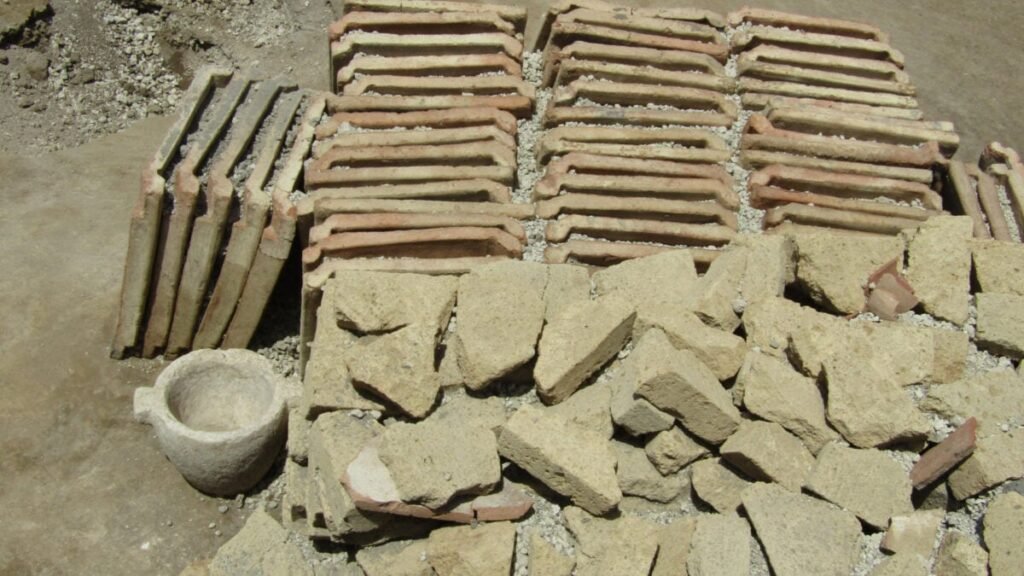
The recently discovered Pompeiian site consists of rooms under active construction, abandoned because of Mount Vesuvius’ activity in 79 CE—presumably when the volcano caused the most infamous tragedy in antiquity. The site preserved features including containers of concrete construction materials, raw material piles, and tools still sitting where they’d been left behind by workers almost 2,000 years ago.

“I expected to see Roman workers walking between the piles with their tools,” Masic admitted. “It was so vivid, you felt like you were transported in time. So yes, I got emotional looking at a pile of dirt. The archaeologists made some jokes.”
Masic and his colleagues studied samples from the pre-mixed dry material piles, a partially built wall, finished buttress and structural walls, and mortar fixes in a pre-existing wall. The concrete samples had the lime casts previously mentioned in Masic’s 2023 study, and a premixed dry raw material pile included intact quicklime fragments, an important early step in the creation process of hot-mixed concrete. They also identified volcanic ash and aggregates—in construction, they are mixed with cement or other materials to create concrete or mortar—further bolstering the hot mixing theory.
“We were blessed to be able to open this time capsule of a construction site and find piles of material ready to be used for the wall,” Masic said. “With this paper, we wanted to clearly define a technology and associate it with the Roman period in the year 79 C.E.”
The team’s analysis allowed them to differentiate hot-mixed lime from the slaked lime (heated limestone combined with water) Vitruvius had reported, he added. “These results revealed that the Romans prepared their binding material by taking calcined limestone (quicklime), grinding them to a certain size, mixing it dry with volcanic ash, and then eventually adding water to create a cementing matrix.” Romans in Pompeii in 79 CE, anyway.
Clearest evidence yet
The team also discovered weights and measurement tools, which they propose may have been used to maintain concrete pouring ratios and build straight, even walls. Furthermore, they found that the volcanic ash material mixed with the lime had a notably diverse range of reactive minerals that further contributed to the mixture’s long-term self-healing property. In short, the site revealed the clearest evidence yet of the ancient Roman use of hot-mixing in concrete, though direct archaeological evidence for its use is still missing.
According to the team, the study could inform the creation of more durable and sustainable concrete. “This is relevant because Roman cement is durable, it heals itself, and it’s a dynamic system,” Masic says. “The way these pores in volcanic ingredients can be filled through recrystallization is a dream process we want to translate into our modern materials. We want materials that regenerate themselves.” In fact, Masic started a company that uses the wisdom from ancient Roman concrete to create durable modern concretes.
It seems like Vitruvius won’t have reason to turn in his grave. Plus, Masic thinks the ancient architect might have been misunderstood, highlighting that he also references latent heat during the mixing process. So maybe Vitruvius was writing about hot-mixing the entire time.


