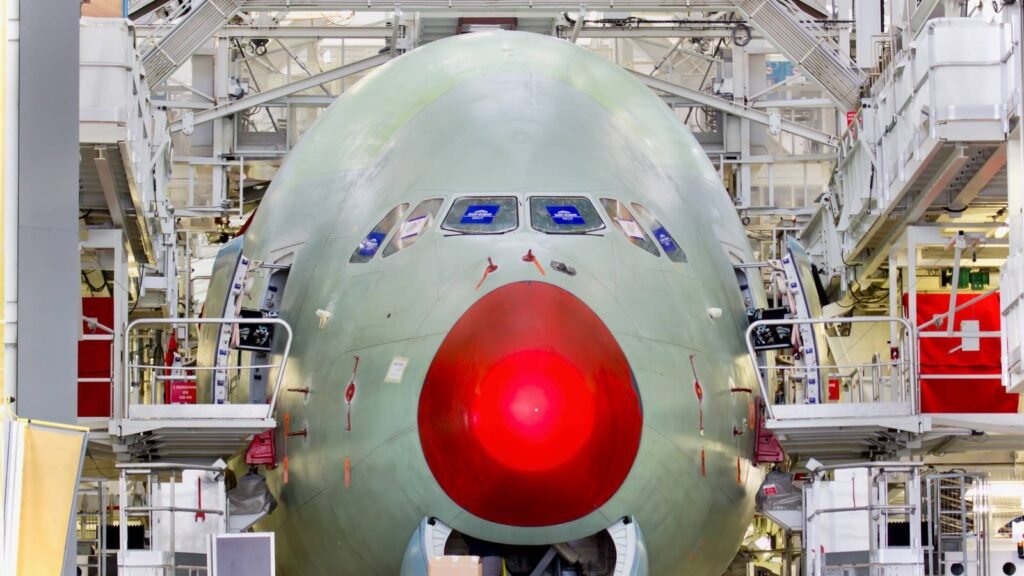
While the Airbus A380 may be one of the most iconic and loved jets ever produced by Airbus, its cancellation after only 12 years and only 251 deliveries (over half of which were to a single customer) is hard to read as anything else than a failure. As the BBC put it in 2019, “...the Airbus programme, long-delayed and over-budget, never really shook off predictions that it would be a white elephant of the skies.” The Independent put it bluntly, “…commercially it has been an abject failure, which has signally failed to recoup the original investment of around $25 billion.”
The problem is the engineers had done a wonderful job engineering a big passenger jet, but not an efficient jet. The A380 was able to compete with the Boeing 747-8, but it was unable to compete with the new twin-engined Airbus A350 or Boeing 787. Still, history is stranger than fiction and no one knows the future—after all, Airbus stated in mid-2024 that it hasn’t ruled out putting the SuperJumbo back into production (although for now, the likelihood is low).
An already dated design
Over 20% of the A380’s aircraft is composite materials

|
Airbus A350: |
53% composite materials |
|---|---|
|
Boeing 787: |
80% composite by volume (50% by weight) |
|
Former operators (as of 2025): |
Air France, China Southern, Hi Fly Malta, Malaysia Airlines, Thai Airways |
While the A380 may have been designed to compete with the world’s other quad-engined double-decked airliner—the Boeing 747, in reality, it competed with the Boeing 787 Dreamliner. The Boeing 747-8 never attracted many buyers and its passenger variant went out of production before the A380. The SuperJumbo’s real challenger was the new, composite, efficient, twin-engined jets, much cheaper to operate. As of 2025, five airlines have already retired their fleets of A380s (a process often accelerated by COVID-19) due to the high costs of operating the jet.
As Aviation Week reflected in 2021 as the final A380 was delivered, “In hindsight, the writing may have been on the wall for the A380 even before its own entry into service—even as early as four years before. In December 2003, Boeing decided to launch the 787, a revolutionary aircraft in many ways, particularly in its use of lightweight composites for structural weight savings. By contrast, “Airbus’ achievement in the A380 was mainly to be able to build something that big,” says Buchholz. Other than that, the A380 was structurally fairly conventional.”
The engines
Beoing 787 had engines 15% more fuel efficient

|
A380 engines: |
Engine Alliance GP7200 or Rolls-Royce Trent 900 turbofans |
|---|---|
|
Thrust: |
78,000 lbf (Trent 900) |
|
A350 engines: |
Trent XWB turbofans |
One of the biggest issues with the A380 was that its engines (built by Rolls-Royce and GE Aviation) didn’t deliver on promised savings while new engines were developed for the Boeing 787 and A350 that did. Former Airbus sales chief John Leahy stated, “Airbus was blindsided by the engine manufacturers in 2000, when we were getting ready to launch it. Our program people had assurances [from] the engine OEMs that there was nothing on the horizon with better specific fuel consumption [SFC] for years to come. And three years later, when we had not even delivered the first aircraft, GE and Rolls had engines with 15% better SFCs that they were bringing out for the 787. That left Airbus at a commercial disadvantage that was very unfortunate.”
In other words, just as the A380s were getting ready to roll of the production line, Rolls-Royce and GE were offering a new generation of engines for widebody twin-engine aircraft that would render the A380’s engines inefficient. This was a major issue that led to Emirates turning its back on the program. Emirates Airline President Tim Clark once lamented, “I regret that [the A380] was not reengined, and the weight was not taken out.“
No more quad-engines
A380 was the last new-design quad-engine passenger jet

|
Quad-engined passenger jets: |
A380, A340, Boeing 747, Ilyushin Il-96 |
|---|---|
|
Final quad-jet: |
Boeing 747-8F (January 2023) |
|
Highest ETOPS rating: |
370 (A350), 350 (Boeing 787 and Boeing 777) |
Advances in engine design have rendered widebody quad-engined aircraft a less efficient design compared to smaller (but still large) twin-engine aircraft. Again, this was something happening as the A380 appeared on the scene. The only quad-engined passenger jets were the Boeing 747-8, Airbus A380, and A340—all three are now out of production. That said, the quad-engined passenger jet may yet have an epilogue, as sanctioned Russia is looking to put the obsolete quad-engined Ilyushin Il-96 back into production. Currently, the only airline operating a passenger variant of the type is Cuba’s Cubana de Aviación.
Twin engines have continued to erode other advantages quad-engines once had. For example, a major limiting factor of long-haul twin engines was the rule that a twin engine could never fly more than 60 minutes from the nearest usable airstrip (in the event that an engine failed). However, improving engines and reliability led to the introduction of ETOPS that relaxed the rule. Now the A350 has an ETOPS 370 rating while the Boeing 777 and Boeing 787 have an ETOPS 350 rating (in practical terms, it means these jets are now free to roam essentially anywhere in the world).
The failure of the ‘hub and spoke’
Atlanta is the world’s largest hub and spoke airport

|
Hub and spoke pioneer: |
Delta Air Lines (in 1955 in Atlanta) |
|---|---|
|
Trend: |
Towards point-to-point |
|
Low-cost carriers: |
Tend to prefer point-to-point |
The massive A380 had been planned about the ‘hub and spoke’ model to feed passengers to major hub airports like London-Heathrow and Dubai. Airbus had hoped the jet would prove popular with airlines like British Airways that operate at congested airports like Heathrow already running at maximum capacity. The rational was that if you can’t increase the number of passengers by including more airplanes, you can increase the number of passengers by increasing the size of the airplanes. But significant orders from airlines like British Airways didn’t materialize (it ordered 12 examples).
In the end, aircraft like the Boeing 787 and, even more recently, small aircraft like the A321XLR have made point-to-point travel more viable. These smaller aircraft have the range to operate direct flights between smaller destinations. Being smaller means it is easier for airlines to fill them up and not fly half-empty aircraft on the routes. The huge number of seats on the A380 is also an Achilles heel. Airlines struggle to fill it up and finding enough passengers to fill it mostly condemns it to the more popular routes. This isn’t the end of the hub-and-spoke (after all the ‘hub buster’ Boeing 787 spends most of its time at connecting hubs, but it is a shift away from the hub-and-spoke model.
Unsuccessful because unsuccessful
Only 251 Airbus A380s were delivered

|
Dates produced: |
2003 to 2021 |
|---|---|
|
Total canceled orders: |
107 (including failed freighter variant) |
|
Final delivery: |
December 2023 |
Another aspect to keep in mind is that all airlines and companies are made up of people. And people are influenced by the choices of other people in a phenomenon known as groupthink. As airlines saw that other airlines weren’t interested in the jet, that may have helped convince them that it was a lemon. This is likely to be a somewhat overlooked factor. Many decision-makers may have been influenced by their counterparts in other companies. For example, if an airline’s rivals didn’t have any interest in the A380, then it could seem like a bold and risky move for them to order the jet. Whereas, if every other airline purchased it, then the other airline could feel more confident in purchasing it (safety in numbers, also applies to decision making).
With low orders, the A380 failed to achieve economies of scale to drive down the costs of building them and developing the infrastructure at airports needed to maintain and operate them. Put another way, part of the reason why the A380s became unsuccessful was because it was unsuccessful (in other words, a vicious and self-fulfilling cycle).

Singapore Airlines’ Airbus A380 Fleet: Everything You Need To Know
Currently, the flag carrier has already retired 11 examples, including its first-ever A380, registered as 9V-SKA.
Emirates’ final nail
Emirates canceled 39 orders in 2019

|
Total Emirate orders: |
162 |
|---|---|
|
Total Emirate deliveries: |
123 |
|
Remaining in service: |
116 (96 active, 20 parked) |
On 14 February 2019, Airbus and  Emirates came to an agreement to cancel the orders for 39 A380s (reducing Emirates’ orders from 162 to 123). By this stage, few other airlines were interested in purchasing the A380, meaning that the program had become dependent on Emirates. Emirates wanted to diversify its fleet (made up exclusively of A380s and Boeing 777s). Airbus and Emirates reached an agreement that Emirates would replace its order with 30 A350s and 40 A330neos.
Later, Emirates’ order for the A330neos was canceled, while the order for A350-900s has grown to 65 jets ( Emirates has just received its first A350s). Emirates’ cancellation of many of its outstanding orders for the A380 was not really a leading cause for the cancellation; it was more the final nail in the coffin that led to the decision to be made when it was. It is likely that if Emirates hadn’t canceled its orders, it would just have delayed the inevitable cancellation.