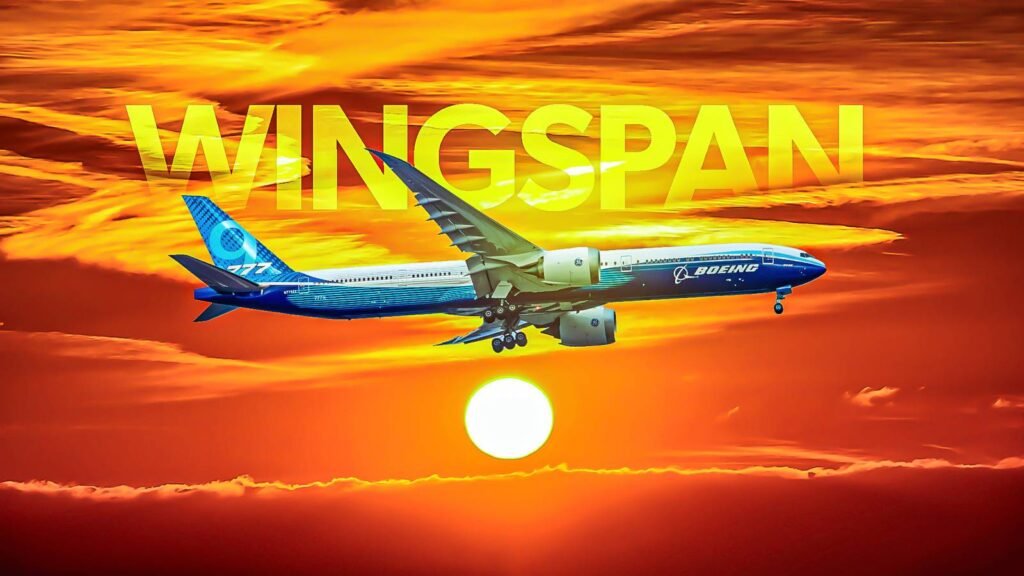
In the post-quadjet era, Boeing’s largest twin-aisle twinjet is designed to be the successor to the legendary 747 ‘jumbo jet.’ The Next Generation wide body that will assume the mantle of the legendary planemaker’s flagship is the 777X. The colossal jetliner will have one of the widest wingspans of any airplane ever built and feature industry-first folding wingtips to make that possible.
The incredible folding wing tips are roughly 11.5 feet (3.5 meters) long on each side. The 777X has a total wingspan of 235 feet and 5 inches (71.75 meters) with each wingtip folded down. That makes it the widest wingspan of any commercial aircraft ever made by Boeing, and even greater than the Airbus A380 ‘superjumbo’ double-decker. The reason is very simple: fuel efficiency.
An Unprecedented Successor

The 777X isn’t just a new aircraft: it’s a generational leap in widebody design that merges the desire for maximum capacity and extreme range with fleet commonality and airport infrastructure compatibility. Unlike the incremental improvements of many 20th-century models, which typically involved stretching a fuselage or adding raked wingtips, the 777X combines several disruptive technologies in one update.
While the Boeing 787 introduced extensive composite use in the fuselage, the 777X leverages fourth-generation composites for the entire wing structure. The wing design is an integrated system including advanced high-lift systems, gust-load alleviation for a smoother ride, and a dedicated cockpit display for the folding mechanism. The 777X’s approach represents an unprecedented blend of maximizing aerodynamic potential and solving real-world airport constraints.
The 777X allows airlines to operate a highly efficient, high-capacity aircraft on existing routes without massive infrastructure costs. The folding wingtip is a unique solution that resolves a core conflict that has historically constrained airliner evolution: maximizing in-flight efficiency while maintaining compatibility with existing airports. With the tips folded upward on the ground, reducing the wingspan to 212 feet (64.8 m), it fits within standard ICAO Code E gates at airports worldwide.
Previous generations of airliners, such as the  Boeing 747, achieved efficiency gains through sheer scale but often required airports to invest in expensive infrastructure modifications. The 777X avoids this dilemma by pioneering an elegant engineering solution in commercial aviation. It sets a new standard for how future large airliners might balance performance and practicality.

Boeing 777X Vs. Airbus A350-1000: Who Will Win The Battle For Tomorrow’s Flagship?
The 777X is nearly ready for service, how will it fare against Airbus’ A350?
All About Saving At The Pump

The 777X is expected to have a 20% lower fuel consumption than the legacy widebody jets that it replaces, like the 747. It will also have a 10 to 12% lower fuel burn rate than direct competition like the 787 Dreamliner and the Airbus A350. On top of its lower fuel consumption, the jet is expected to be around 40% quieter than previous-generation twin-aisle airliners.
The key to the jet’s excellent fuel consumption is aerodynamic performance. Its exceptionally high aspect ratio, namely the wing length compared to its width, is the crucial aerodynamic element that creates a more efficient wing. The Liebherr-manufactured folding wingtips give the 777X a 10:1 aspect ratio, compared to 9:1 for the legacy 777.
Advanced carbon-fiber composites make the wing stronger and lighter than a comparable aluminum wing, further contributing to overall weight savings and efficiency. The highly flexible composite wing is designed to provide optimal lift and airflow, allowing the aircraft to fly higher and faster using less fuel. This revolutionary wing design will make the 777X the most aerodynamically efficient jetliner on the market when it debuts.

How Many 777Xs Has Boeing Already Started Building?
Boeing’s 777X program faces delays and challenges, but how many aircraft have they built so far?

The superior aerodynamics of the exceptionally long composite wing, with its very high lift-to-drag ratio, make it capable of flying further than legacy designs with a higher payload of passengers and cargo at the same time. That translates to extra network options as more destinations are possible with ultra-long haul routes, and the jet can fly existing routes over some of the longest distances with a heavier load than its predecessors, making it more profitable.
As the 777X executes these incredibly long-haul missions, it can do so while cruising at higher altitude and higher speed than most of its competition. At high altitude, the aircraft becomes even more fuel efficient, and naturally flying at a higher speed means that it is more efficient from an operational standpoint. There is the obvious benefit of shorter flight times than customers are used to, making it a much more desirable option for travelers.
The enormous wing also means that less thrust is required for the aircraft to achieve similar performance as in other widebody designs. Pairing that with the world’s most powerful turbofan commercial jet engine ever made, the General Electric GE9X, yields the highest performance combination in its market segment of twin-aisle airliners.

Which Airlines Have Ordered The Boeing 777X? A Complete List
Around a dozen airlines have placed orders for around 500 Boeing 777X, with the first set for delivery in 2026.
Making The First Of Its Kind

The Airbus A380, with its massive 262-foot (79.8 m) wingspan, is a Code F aircraft, limiting its access to many airports and gates not built for its size. Boeing wanted the 777X to access the same gates as the current 777 models, and found that a folding wingtip design uses less fuel compared to a design with winglets that would fit the Code E wingspan limit. The efficiency gains of the longer wing in the air outweighed the added weight and complexity of the folding mechanism on the ground.
Unlike the 787 Dreamliner, where the composite wings were outsourced, the 777X composite wings are manufactured largely in-house by Boeing using advanced automation. The key components for the folding wingtip actuation system, including the locking mechanisms and actuators, are manufactured by the aerospace supplier Liebherr Aerospace.
Boeing confirmed the aircraft’s compatibility through extensive documentation, simulations, and coordination with airports, airlines, and government agencies. The system underwent extensive structural and reliability evaluations, including fatigue testing, to ensure its integrity and safety. The FAA required strict safety assurances, such as mechanisms to prevent unfolding in flight and alert systems for pilots if the wings are not correctly configured for takeoff.
Boeing significantly incorporated airline customers into the 777X’s design process through a collaborative approach inherited from the original 777 program. This deep collaboration ensured the final product met specific performance, operational, and passenger experience requirements dictated by the airlines’ business strategies.
Boeing formed a core group of key customers and potential launch airlines that provided continuous feedback and requirements throughout the development cycle up to the crucial ‘firm configuration’ milestone. Airlines needed the efficiency of a massive new wing but required the aircraft to operate within existing airport gate sizes, and thus, the folding wingtip became the solution.
The Smoothest Ride In The Sky

The 777X has some of the most advanced fly-by-wire avionic controls Boeing has ever installed on a commercial jetliner. That system incorporates an innovative new dust suppression design referred to as ‘Smooth Ride Technology.’ The flight control system can automatically compensate with control surfaces to counteract turbulence while flying.
There are also enhancements to the cabin environment thanks to its predominantly composite construction. The more aerodynamically clean wing design, combined with the quieter-running GE9X engines, contributes to a noticeable reduction in cabin noise levels, making for a calmer in-flight environment and reducing passenger fatigue on long flights.
The use of composite material didn’t stop at the wings, with the fuselage being stronger than aluminum-constructed predecessors. That allows for the cabin altitude to be lowered to 6000 feet compared to the typical 8,000 feet of previous-generation widebody aircraft. Combined with higher humidity, this significantly reduces dehydration during the flight and mitigates jet lag effects for every passenger, regardless of cabin class.

The Boeing 777X interior, known as the ‘Horizon’ cabin, is designed to enhance the passenger experience by combining popular features from the 787 Dreamliner with a wider fuselage, offering a more spacious and comfortable environment for long-haul travel. One of the more unique aspects of the 777X program is that it is the first commercial aircraft that was not conceived as a clean sheet design to feature larger windows than the predecessor on which it is based.
Inspired by the 787 Dreamliner, which was the first clean sheet design for Boeing’s commercial division in decades, the windows measure 162 square inches. This is approximately 16% larger than those on the previous 777 models and 29% larger than those on the Airbus A350.
The windows are installed higher on the fuselage sidewall. This strategic placement allows passengers seated in the middle rows of the cabin to see the horizon and the outside view, making the entire cabin feel more open and less claustrophobic. Airlines have the option to install advanced electronic dimmable windows, similar to the 787 Dreamliner.
The cabin also features immersive and customizable LED lighting systems, including various scenes like sunrise, sunset, and even the northern lights. The overhead bins are designed with a concave shape that integrates seamlessly into the ceiling architecture, creating a more open and spacious feel. These features work together to provide a more comfortable and modern long-haul experience for passengers.


