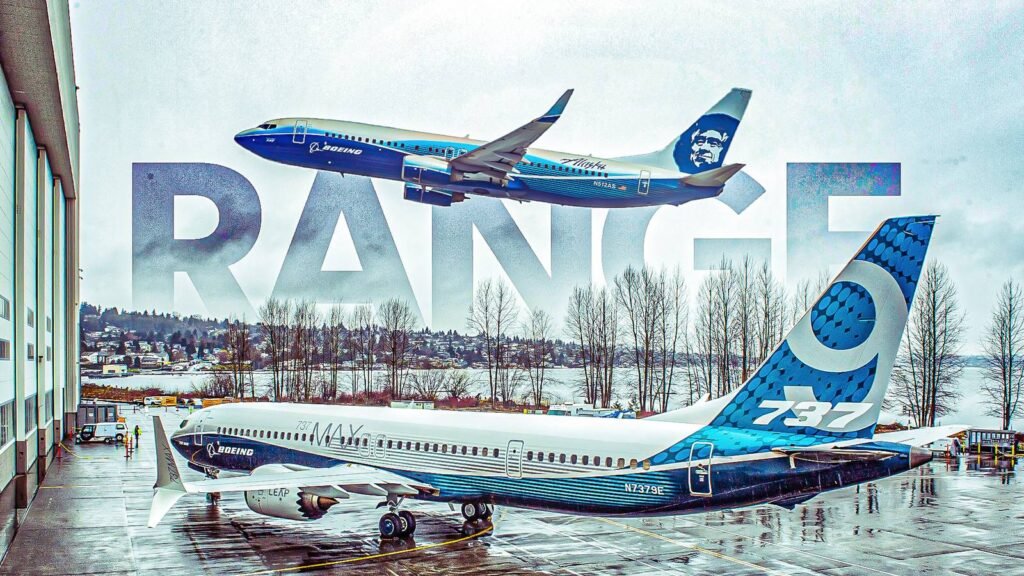
The Boeing 737 MAX is the latest stage in the continuous development of the 737 family, an aircraft line that has shaped short and medium-haul flying for more than half a century. While the MAX and its predecessor, the 737 Next Generation (737NG), share a familiar outline, the newer variant incorporates major aerodynamic, structural, and systems upgrades. Among the most consequential is its increased range. Airlines often describe this improvement as one of the MAX program’s defining advantages because it expands the number of viable city pairs and improves fuel planning flexibility on existing routes.
Understanding how much additional range the MAX offers, and why, is essential for anyone studying or working with commercial fleet strategy. Range drives decisions about aircraft deployment, crew planning, ETOPS capability, and the economic viability of thinner long-distance markets. In this guide, we break down Boeing’s official performance data, examine the engineering changes behind the MAX’s extended reach, and incorporate pilot perspectives that highlight differences between the NG and MAX in operational use. By the end, readers will have a clear picture of the MAX’s real performance gains, the factors that enable them, and the ways these improvements shape the modern narrowbody landscape.
Understanding The Boeing 737 Family Evolution

The Boeing 737 has been a fixture of global commercial aviation for more than six decades, and the 737 Next Generation (NG) marked one of the program’s most significant leaps. The NG series introduced refined aerodynamics, more capable CFM56 engines, digital avionics, and structural changes that allowed airlines to push the aircraft deeper into medium-haul missions with improved reliability and fuel economy.
The 737 MAX family builds on that foundation with a new generation of performance-driven upgrades. Its CFM LEAP-1B engines, advanced split-scimitar winglets, and weight-saving structural work all contribute directly to a measurable increase in range across the MAX lineup.
 Boeing designed the MAX to extend range while keeping operating economics central to the program . Fuel burn reductions, lower noise output, and compatibility with existing 737 infrastructure were essential goals. The flight deck remains immediately familiar to NG pilots, yet incorporates larger displays, modernized avionics, and improved automation logic. This continuity helps airlines transition crews efficiently, while the updated systems support longer stage lengths, more complex diversion planning, and higher-utilization schedules.
In a broader sense, the shift from NG to MAX reflects Boeing’s answer to evolving airline demands and sharper competition from Airbus, particularly after the strong market reception of the A320neo family. By the early 2010s, carriers increasingly wanted narrowbodies capable of crossing oceans, linking secondary cities on opposite coasts, or replacing older widebodies on thin long-range routes. The MAX family addresses those needs by delivering a greater range without the higher acquisition and operating costs associated with twin-aisle aircraft. This extended reach has become one of the MAX program’s most important selling points and a defining factor in how airlines deploy the aircraft today.
Key Design Improvements That Boost Range

One of the most significant differences between the 737NG and the 737 MAX lies in the engines. Boeing equipped the MAX series with the CFM LEAP-1B, a high-bypass turbofan designed to deliver double-digit gains in fuel efficiency and performance. Compared to the NG’s CFM56-7B engines, the LEAP-1B provides up to 14 percent lower fuel burn thanks to a combination of composite fan blades, a larger fan diameter, and a more efficient core. These improvements contribute directly to range increases across the MAX family. The MAX 8, for example, can reach about 3,550 nautical miles, while the comparable 737-800NG typically achieves around 3,115 nautical miles, a direct improvement of roughly 435 nautical miles.
Aerodynamics also plays a decisive role. The MAX’s most visible upgrade is its advanced technology winglets, which use a split-tip design to reduce induced drag and smooth airflow around the wing. Unlike the NG’s blended Winglets, which provide a single upward surface, the MAX version incorporates both upward and downward extensions to recapture energy normally lost in wingtips vortices. Together with subtle fuselage refinements and weight reductions in selected airframe components, these changes allow the MAX to carry similar payloads over longer distances without requiring additional fuel.
|
Model |
Typical Max Range (NM) |
Max Payload |
Engines |
Key Feature |
|---|---|---|---|---|
|
737-800 NG |
3,115 |
45,000 lb |
CFM56-7B |
Standard blended winglets |
|
737 MAX 8 |
3,550 |
45,000 lb |
CFM LEAP-1B |
Advanced technology winglets |
|
737 MAX 9 |
3,300 |
45,000 lb |
CFM LEAP-1B |
Stretched fuselage for more seats |
These figures highlight how even a few hundred extra nautical miles can reshape airline networks. While the MAX 8’s increase over the 737-800 NG is about 435 nautical miles, the broader NG-to-MAX family comparison spans roughly 340 to 570 nautical miles, depending on variant and configuration.
On paper, these increments may seem modest, but in commercial aviation, they unlock meaningful opportunities. Airlines can operate transcontinental routes in the US without payload restrictions, link deeper parts of Asia with a single aircraft type, or eliminate technical stops on longer Caribbean and Latin American flights. In an industry where operational efficiency and route versatility can make or break a business case, the MAX’s extended range gives carriers a meaningful competitive edge.

Why Can’t The Boeing 737 MAX Be Powered By Any Other Engine Type?
Why the 737 MAX uses only the LEAP-1B: Boeing’s design limits, certification rules, and engine geometry make any other powerplant impossible.
Pilot Perspective: Flying The MAX Vs The NG

Pilots transitioning from the 737NG to the MAX notice subtle but significant differences in handling and operational flexibility. According to pilot reports, the MAX benefits from more responsive thrust management and optimized climb performance, which allows the aircraft to reach cruising altitude more efficiently. These improvements mean pilots can exploit fuel burn advantages during climb, cruise, and descent phases, directly contributing to increased effective range.
Flight operations also benefit from updated avionics and flight displays. The MAX integrates lessons learned from the 787 program, including better horizon displays and improved flight envelope monitoring, which enhance situational awareness. In practical terms, this reduces workload during long sectors and improves safety margins, especially on transoceanic or high-density routes.
Additionally, airlines have reported operational flexibility improvements with the MAX’s range. While the NG might require payload restrictions on certain long sectors, the MAX can operate at full passenger and cargo capacity over similar distances, making it a more versatile aircraft for both domestic and international schedules.
Operational Impacts For Airlines

The extended range of the 737 MAX gives airlines measurable flexibility that the 737NG family could not always provide. With longer nonstop capability and improved fuel burn, the MAX allows carriers to schedule routes that were at the edge of the NG’s performance envelope, especially when operating at full passenger and cargo loads.
For many US operators, this has meant flying transcontinental sectors with fewer or no payload restrictions compared with the 737-800 NG. As a result, airlines can maintain commercial performance across the entire cabin without trading fuel for freight or seats, which directly improves yield per flight.
A key advantage comes from how airlines can use the MAX to restructure networks. Low-cost carriers have been among the most visible adopters, using the MAX’s range and fuel efficiency to reach secondary airports and thinner markets that were previously uneconomical on the NG.  Southwest Airlines,
  flydubai, and Norwegian (before restructuring) all leveraged these capabilities to extend route maps into new regions or reduce reliance on intermediate stops.
For full-service carriers, the MAX offers useful flexibility on medium-haul international routes, particularly seasonal services where widebody capacity would be excessive or cost-ineffective. Because the MAX shares a type rating with the NG, airlines can integrate it into mixed fleets without disrupting crew scheduling, which further enhances its operational utility.
|
Airline Use Case |
737-800NG |
737 MAX 8 |
|---|---|---|
|
US domestic (full pax) |
Occasional payload limits on long sectors |
Full payload on most routes |
|
Europe–Mediterranean |
Some routes require tech stops in hot/high conditions. |
Expanded nonstop coverage |
|
Intra-Asia |
Constrained by fuel burn on longer sectors |
Full-range capability across the region |
Quieter engines also support operations at noise-restricted airports, allowing carriers to maintain slot access or operate early-morning and late-evening services more easily. Together, these benefits make the MAX not only a longer-leg aircraft but also a more profitable and sustainable one for high-frequency operators.

The Striking Differences Between The Boeing 737 MAX 8 & MAX 8-200
The MAX 8-200 is a special edition of the MAX 8 developed for ultra-low-cost carriers that seek to maximize the workhorse’s seating capacity.
Maintenance, Reliability, And Economic Considerations

Beyond range improvements, the 737 MAX delivers measurable advantages in maintenance planning, reliability, and long-term operating economics. The CFM LEAP-1B engine introduces a new generation of materials and manufacturing technologies, including ceramic matrix composites and 3D-printed fuel nozzles, which were designed to increase durability and reduce maintenance requirements. While real-world overhaul intervals depend on airline operating conditions, CFM and early operators have reported that the LEAP family generally offers longer time-on-wing compared with the CFM56 series, helping reduce lifecycle maintenance costs.
Fuel efficiency also plays a central economic role. With Boeing citing up to 14 percent lower fuel burn than the 737NG, airlines benefit from reduced operating costs on both short and long sectors. When combined with the MAX’s higher dispatch reliability after post-2020 software and wiring updates, the aircraft supports stronger day-to-day utilization, which is a critical metric for low-cost carriers and high-frequency operators.
The 737 MAX introduces more advanced health monitoring and predictive maintenance tools compared with the NG. Operators can access greater volumes of real-time system data, enabling maintenance teams to detect early signs of component wear and plan interventions before they lead to unscheduled groundings. This predictive approach reduces operational disruptions, shortens maintenance cycles, and improves aircraft availability across the network.
Updated avionics architecture also contributes to improved reliability. Enhanced flight deck systems, more efficient electrical components, and modernized onboard diagnostics simplify troubleshooting and reduce the risk of recurring technical issues. For airlines operating dense schedules or international sectors where recovery options are limited, these reliability improvements translate directly into fewer delays, better on-time performance, and stronger return on investment across the fleet.
Future Prospects And MAX Variants

Boeing continues to expand the 737 MAX family with variants such as the MAX 7, MAX 8 High-Capacity, MAX 9, and MAX 10. Each variant provides incremental range and payload flexibility, allowing airlines to select models tailored to specific route structures. For instance, the MAX 10 offers additional passenger capacity while maintaining a competitive range, making it suitable for high-demand, long sectors.
The MAX’s range improvements, combined with the entire family’s operational efficiency, position the aircraft as a backbone of narrowbody fleets globally. Airlines planning new long-haul routes without shifting to widebodies can rely on the MAX to deliver profitability while maintaining environmental compliance. Looking forward, continuous software updates, engine efficiency enhancements, and aerodynamic tweaks will likely further optimize the range-performance equation.