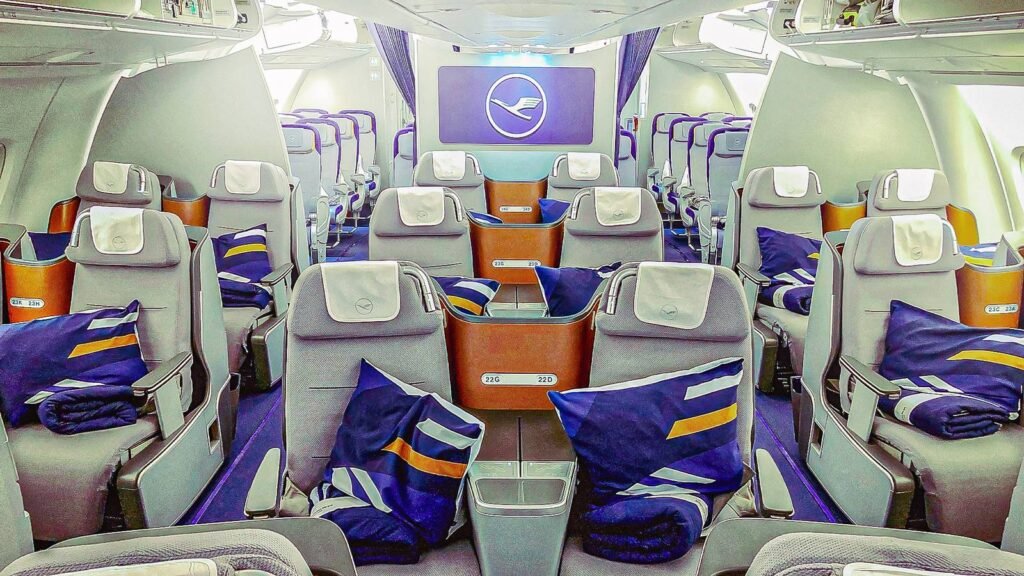
Airbus describes the A380 as having the quietest cabin in the sky, calling it ‘whisper-quiet’. The four-engined long-haul favorite is popular with passengers and crew alike and is reported to be so quiet in the cabin that passengers don’t even realize that the aircraft has taken off. Why does the A380 have such a quiet cabin, and why are some people unhappy about it?
Cabin noise varies by aircraft type, and newer widebody aircraft are often much quieter than older models, such as the Boeing 747. The Airbus A380 is well known for being quiet, whereas a regional turboprop like the Dash 8 (Q400) is known to be noisy. Where you are seated in the cabin also affects sound levels. Let’s also find out how different aircraft compare in terms of noise in the cabin.
An Unusual Problem To Have

It has been reported by numerous publications and media that pilots at Emirates, the largest operator of the A380, find the aircraft too quiet to sleep during their rest periods. They reported being kept awake by passenger noise, such as babies crying, the flushing of lavatories, and crew call bells. Normally, the sound of the engines drowns out cabin noise, but on the A380 with its Engine Alliance GP7200 or Rolls-Royce Trent 900 engines, it is no longer the case. Added to that, the crew rest area is in the rear cabin instead of near the cockpit, and passengers mistake it for a lavatory and pull the door handle.
A NASA study named Crew Factors in Flight Operations XII: A Survey of Sleep Quantity and Quality in On-Board Crew Rest Facilities showed that 91% of pilots slept well at home, but only 71% could sleep onboard an aircraft. One solution was to insulate the crew rest area on the Emirates A380 fleet, but this would add weight to the aircraft, so ambient noise from lightweight generators is being used instead.
“You may recall media reports earlier this year making a lot of noise about how quiet it was aboard the A380. In stories about the A380 passenger experience, we read that even seated by a window, you could hear conversations on the other side of the airplane, or even several rows away. In some reports, when passengers mentioned that this might be a bit disconcerting, they were told that one might have to “get used to eavesdropping on an airplane… You’d probably agree that the most disturbing background noises are the random ones — talking, coughing, lavatory doors closing. How disturbed you are during a flight is a function of the degree to which the random noises rise above the background noise.”
Randy Tinseth, Boeing Vice President of Marketing, as quoted in Wired.
What Creates Aircraft Noise In The Cabin?

Aircraft noise in the cabin not only comes from the engines (turbofan or propeller) but is also created by airflow over the fuselage, wings, and landing gear. Internal systems such as air conditioning, hydraulics, and the auxiliary power unit (APU) also add to cabin noise. The engines are the primary source of noise from high-velocity exhaust, combustion and compressor fans. Vibrations and aerodynamic noise radiate throughout the cabin.
Unsurprisingly, seats near the engines are exposed to more noise than those at the front of the aircraft and in the premium cabins. Window seats are 50% noisier than middle or aisle seats. A 2018 study in the Journal of Exposure Science and Environmental Epidemiology found that where you sit in the cabin shapes how you perceive cabin noise, and it depends on the aircraft type.
Surprisingly, both passengers and crew were somewhat unsettled by how quiet the Airbus A380 cabin was, instead of hearing the usual hum of the engines. Airbus introduced ambient noise (similar to light white noise) to create a more comfortable and familiar sound in the Airbus A380. Noise levels are still similar to those of a library.

Why Might The World’s Quietest Widebody Aircraft Cabin Have Boeing Worried?
Boeing’s historical dominance in the widebody market is under threat.
Improvements To Lower Cabin Noise

Noise levels have decreased because of Federal Aviation Administration (FAA) regulations and advances in engine design, including high-bypass ratio and geared turbofans, which have resulted in a much quieter cabin. The FAA mandated that aircraft designed after January 1, 2018, be compliant with new, quieter decibel restrictions.
Engines with high bypass ratios (the amount of air that bypasses the engine core to the amount that flows through the core) give lower exhaust speed and less noise. Most jet aircraft have high-bypass-ratio engines. Geared turbofan engines are quieter; there is a gearbox between the fan and the front of the engine, with the compressor behind it. The fan can be slowed down to make it quieter. These engines can be found on the Airbus A220, A320neo, and Boeing 737 MAX.
The previously mentioned study noted that: “Aircraft noise has been significantly reduced by the evolution of noise-reducing engine technology (e.g., the Pratt and Whitney PurePower Geared TurboFan engine reduces noise footprint by 75%) combined with the introduction of newer aircraft models and airframes with a lower noise profile (e.g., Boeing 787 and Airbus A380).”
Measuring Sound In The Cabin

Sound is measured in decibels, and every increase of ten decibels means a ten times increase in the intensity of sound. Silence is measured at zero decibels; a standard office is around 60 decibels, and the aircraft cabin can be above 80 decibels (according to data at The Points Guy). This is perceived as being twice as loud, making the aircraft cabin four times louder than an office. Of course, takeoff is the noisiest time in the cabin, and, in general, cabin noise can be measured between 80 and 100 decibels.
A study on the assessment of noise in the airplane cabin environment from the Journal of Exposure Science and Environmental Epidemiology measured noise levels on 200 flights and over 24 aircraft types. Sound levels were measured across different phases of flight and at varying distances from engine noise.
|
Aircraft group: |
No. of flights: |
Mean dB |
Max dB |
|---|---|---|---|
|
A319, A320, B767-300, MD-90 |
14 |
82.7 |
109.8 |
|
B737-300/400/500/700/800 |
20 |
83.6 |
> 110 |
|
B757 |
71 |
81.5 |
109.9 |
|
CRJ-100/200/700/900 |
15 |
80.8 |
109.6 |
|
E-135, E-145, E-170, E-175, E-190 |
15 |
78.7 |
107.4 |
|
B737, DC-9, MD-80, MD-88 |
63 |
83.2 |
>110 |
Data from The Points Guy
Although the decibel levels did not differ dramatically between aircraft types, the loudest aircraft was the Boeing 737, which is 4.9 decibels louder than the Embraer group, meaning that the 737 is 50% louder. In comparison, the 737 is 0.9 decibels louder than the Airbus A320 or 10% louder. The study did not include long-haul aircraft such as the Boeing 747, the 787 Dreamliner, the Airbus A350, or the A380. The newest single-aisle jets, like the A220, A320neo, and Boeing 737 MAX, were also not in the study.

What Are The Loudest & Quietest Seat On A Plane?
Noise levels in the cabin vary depending on where you are sitting.
More About The Airbus A380

The Airbus A380 is the largest commercial passenger aircraft in the world and the only fully double-decker aircraft. It has the largest wings ever built for an aircraft. It has four engines and a range of 8,000 nautical miles (14,800 kilometers). Passengers love the spacious cabin, and the aircraft is one of the most iconic aircraft and is instantly recognizable. However popular it was, production ceased in 2021.
There are two engine types on the Airbus A380: the Rolls-Royce Trent 900 and the Engine Alliance GP7200. These were specifically designed to reduce noise. They have advanced fan blade technology and optimized airflow management that reduces engine noise. The Airbus A380 wing design is optimized for maximum aerodynamic efficiency, which reduces drag and the need for engine thrust, so there is less noise on takeoff, landing, and during cruise.
The aircraft is also designed to minimize turbulence. The landing gear and flaps are engineered with noise reduction in mind. There is noise insulation in the cabin with advanced soundproofing to dampen external noise. The cabin experience is improved during takeoff and landing, whether you are seated on the upper deck or next to the engines. Specially tuned panels in the cabin walls absorb sound.
On approach, the Airbus A380 has a lower noise footprint than much smaller jets. The double-decker aircraft’s sheer size means that passengers are physically farther from the engines and the ceiling and floor, naturally dampening noise.
How Aircraft Compare

The Boeing 787 has noise-reduction features, including chevrons on the engines that combine hot and cold air flows to reduce noise. The Airbus A350 is five decibels quieter than the Boeing 787 and nine decibels quieter at the front of the cabin. Both the 787 and A350 also have reduced noise levels compared to previous types, which reduces their environmental impact as technically advanced aircraft.
The Airbus A380 and A220 are the quietest aircraft with low noise levels inside and outside the cabin. The narrowbody Airbus A220 has Pratt and Whitney PW1500G geared turbofan engines, which have low noise levels and produce fewer emissions. The lower fan speed maintains thrust whilst reducing noise. Special nacelles and acoustic treatments have been used on the engines and airframe, making it quieter inside and outside.
Noise pollution has been very much in focus over the last two decades. The quieter performance of both the A380 and A220 has both environmental and operational benefits. There is less noise pollution. Many airports have noise regulations, especially at night, and these quieter aircraft can be scheduled without exceeding the noise limits.