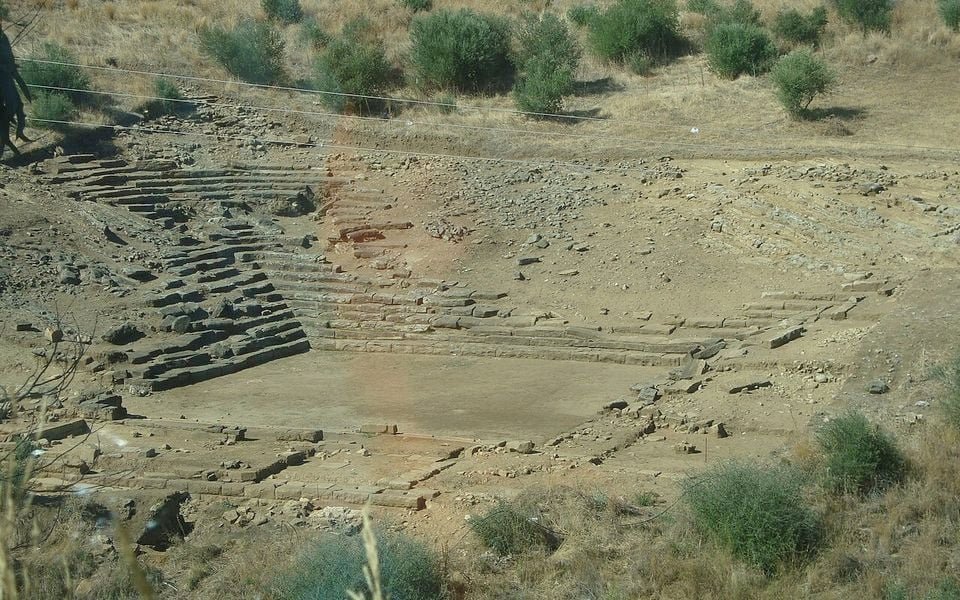
A €700,000 project for the restoration, protection and enhancement of the ancient theater of Calydon, one of western Greece’s most important archaeological monuments, got under way last week, co-financed by the European Regional Development Fund (ERDF), according to an official decision published this week.
The ancient theater is located near modern-day Messolongi and forms part of the wider archaeological site of Calydon, a major religious and urban center of ancient Aetolia. The approved plan focuses on stabilizing the monument, addressing long-standing structural issues and improving visitors’ understanding of the theater’s form and layout.
Planned interventions include the conservation and reinforcement of all vulnerable architectural elements, the repositioning of recovered seating blocks in their original locations, and the reconstruction of seat foundations in the central section of the cavea, using additional natural stone where required. The works aim to improve both the monument’s structural integrity and its visual legibility.
Further measures will upgrade the existing entrance, enhance visitor access, and unify walking routes between the three main monuments of the site: the ancient theater, the Heroon of Leon and the Sanctuary of Artemis Laphria. New informational signage will be installed, including panels in Braille, along with directional signs and infrastructure required by fire protection and evacuation studies to be carried out as part of the project.
The theater was first revealed in 1967 during construction work on the Antirrio-Ioannina national highway, while the excavation was completed in 2014.
Built on the lower slopes of a hill crowned by the Sanctuary of Artemis Laphria, the monument has a rare quadrilateral ground plan, with a cavea forming a squared, open-ended layout without a horizontal diazoma – unlike any other known ancient theater.
Archaeological evidence indicates that the seating consisted of elongated sandstone blocks, resting either directly on bedrock or on a substructure of rough stones. The stage building, added at a later phase, dates to the Hellenistic period and includes side ramps.
The theater was in use from the 4th century BCE through Roman times. Calydon itself was among the oldest settlements along the right bank of the Evenus River and the largest religious center of coastal Aetolia, closely linked to the myth of the Calydonian Boar and to Homeric tradition.


