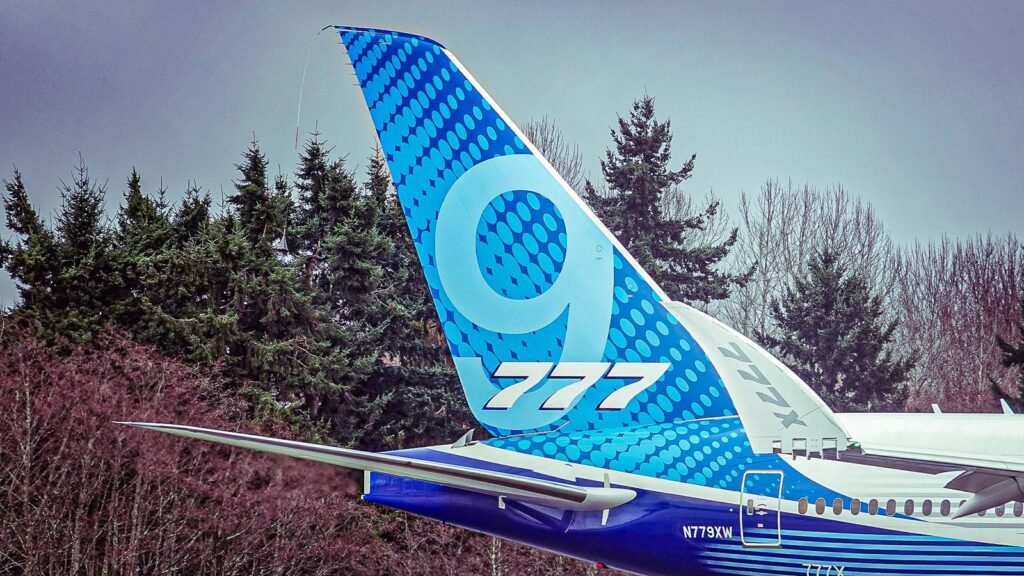
The Boeing 777X family is one of the most anticipated airplanes of the decade, with one very special and innovative feature setting it apart from other aircraft: its foldable wingtips. This innovative technology allows the aircraft to access existing airport infrastructure without expensive infrastructure changes by folding the wingtip upward on the ground.
The reason the 777X needs a foldable wingtip to access airport infrastructure has to do with its massive wingspan. This one-of-a-kind wingtip, built from advanced composite materials, is an engineering milestone for the commercial aviation industry. Today, we’ll take a look at how this unique feature works and the general status of the Boeing 777X program.
How Does The 777X Folding Wing Actually Work?

During the Dubai Air Show in November, a Boeing test pilot explained to Flightradar24 how the Boeing 777X wingtip works. From the flight crew’s perspective, the wingtips are part of their pre-departure configuration checks, similar to setting the flaps. Obviously, pilots must extend the wingtips, and to ensure this, the aircraft’s system provides escalating levels of alert. In the worst-case scenario, the aircraft instructs the crew to reject the takeoff.
Pilots can control the wingtips via a dedicated overhead switch in the cockpit, and when extended, a clear visual “extended” confirmation is displayed on the aircraft’s systems. Once extended, the wingtips are electronically isolated and mechanically locked using a large physical locking bolt to provide fail-safe protection, ensuring the wingtips cannot be folded inflight. After landing, the wingtips automatically fold at 50 knots ground speed, removing additional workload from the flight crew while clearing the runway.
The reason Boeing opted for folding wingtips on the 777X has to do with the design of the aircraft’s wings. The 777X has much larger wings with a high aspect ratio to support its weight during flight. Furthermore, the large wings improve the lift-to-drag ratio, which results in better fuel efficiency and longer range. Without folding wingtips, the aircraft’s wingspan would exceed the limits of many airports’ infrastructure, such as parking positions and taxiways. As a result, Boeing developed an innovative wingtip design to avoid problems with airport access or expensive airport infrastructure upgrades, similar to what Airbus faced with its A380.
The Characteristics Of The 777X

Since the Boeing 777X is a re-developed version of the regular Boeing 777 family, it appears very similar to its predecessor in terms of flight deck and fuselage design. Although characteristics vary across 777 variants, the 777X will generally offer increased capacity and more extended range. The new Boeing 777X family is currently being developed in two variants: the smaller 777-8, with a two-class seating capacity of 395 seats, and the larger 777-9, with a capacity of 426 seats. Additionally, Boeing is developing a 777-8 Freighter version, which will have a revenue payload capacity of 112 tonnes. Looking at the program’s order backlog, the 777-9 is by far the most popular version of the family, followed at a considerable distance by the -8F and -8.
Perhaps the most notable characteristic of the 777X is its massive wingspan of 235 feet, 5 inches (71.75 meters) when extended and 212 feet, 9 inches (64.85 meters) on the ground. This wingspan is similar across all variants of the 777X family. Furthermore, the 777-8 has a length of 232 feet, 6 inches (70.86 meters) compared to 251 feet, 9 inches (76.72 meters) for the 777-9. In addition, both variants have a similar height of 64 feet (19 meters). In terms of technical range, the 777-8 can cover distances up to 8,745 nautical miles (16,190 km), allowing this variant to compete with Airbus’ A350 family. However, its larger brother, the 777-9, only has a range of 7,285 nautical miles (13,500 km), comparable with the Boeing 747-8i. This is significantly less than, for example, the Airbus A350-1000, which features only a slightly smaller but similar capacity.
|
Specification |
777‑8 |
777‑9 |
|---|---|---|
|
Typical two‑class passengers |
395 |
426 |
|
Range |
8,745 nautical miles (16,190 km) |
7,285 nautical miles (13,500 km) |
|
Length |
232 feet, 6 inches (70.86 meters) |
251 feet, 9 inches (76.72 meters) |
|
Wingspan (extended – in flight) |
235 feet, 5 inches (71.75 meters) |
235 feet, 5 inches (71.75 meters) |
|
Wingspan (ground / folded) |
212 feet, 9 inches (64.85 meters) |
212 feet, 9 inches (64.85 meters) |
|
Height |
64 feet (19 meters) |
64 feet (19 meters) |
|
Engines |
2 × GE9X |
2 × GE9X |
Although the Boeing 787 family allows airlines to choose between two engine types, the 777X family will be similar to its predecessor and will offer only one engine type: the GE9X, produced by General Electric. The original Boeing 777 series still allowed airlines to choose between different engines from a number of manufacturers. However, the second generation (-200LR and -300ER) was already limited to a single engine type, the GE90, as aircraft manufacturers have increasingly adopted this approach in their product offerings for commercial airlines over the years.

Why Can’t The Boeing 777X Be Powered By Any Other Engine Type?
GE Aerospace was always favored to be the exclusive OEM for the 777X’s bespoke ultra-large engines.
Which Airlines Ordered The Boeing 777X?

As of writing, there are 619 Boeing 777X aircraft on order, with 521 orders for the 777-9, 63 for the 777-8F, and 35 for the 777-8. With 521 orders, the 777-9 has already secured itself a second position behind the 777-300ER in terms of orders across all Boeing 777 variants. Emirates makes up almost half of the total 777X order backlog with 270 outstanding orders for the 777-9. Together with Middle Eastern colleague Qatar Airways, which ordered 90 777-9s and 34 777-8Fs, this represents the vast majority of orders for the aircraft type.
Considering the size of Emirates’ order for the aircraft, it is no surprise that the airline is extremely satisfied with the delays Boeing is facing with the 777X program. The program was originally announced in 2013 with the expectation that deliveries would start in 2020. Today, however, the first 777X is not expected to be delivered before the beginning of 2027 due to certification and production delays. A delay has been costing Boeing billions in charges, totaling $15 billion at the end of October 2025, according to Reuters. For Emirates, the delay has meant re-adapting its fleet strategy by renewing its aging Airbus A380s and Boeing 777-300ERs.
|
Airline |
Orders |
|
|---|---|---|
|
#1 |
Emirates |
270 |
|
#2 |
Qatar Airways |
124 |
|
#3 |
Cathay Pacific |
35 |
|
#4 |
Singapore Airlines |
31 |
|
#5 |
Lufthansa |
27 |
Other airlines that have placed orders for the 777X include Cathay Pacific (35), Singapore Airlines (31), and Lufthansa (27). Due to the delays surrounding the 777X, these airlines are also forced to adapt their fleet strategies. For the German flag carrier Lufthansa, this means keeping its 747 fleet flying for longer, as the airline will replace its relatively large and aging Boeing 747 fleet with the aircraft. Also, Cathay Pacific, the current third-largest customer of the 777X, has had its patience tested by the 777X as the airline placed its first order for the aircraft back in 2013. Singapore Airlines placed its 777X order in 2017, aiming to replace its aging 777-300ERs and Airbus A380s.

Emirates Orders 65 Boeing 777-9s & Pushes For 777-10 Feasibility Study
130 GE9X engines will power Emirates’ new jets.
The Feasibility Of A Potential 777-10

At the aforementioned Dubai Air Show in November, Emirates announced an order for an additional 65 Boeing 777X aircraft. This order includes options to convert between the different variants, including a potential 777-10. At the time of the order, Emirates stated that a larger 777-10 variant has the potential to replace a part of its Airbus A380 fleet upon retirement. Emirates’ strong interest in the 777-10 comes as the airline is seeking larger, more efficient aircraft to handle long-term growth amid increasing congestion and capacity constraints at major airports.
The larger 777-10 would add 50 passengers compared to the 777-9, resulting in a stretch of around 16 feet (5 meters) in the fuselage, with the total length reaching 268 feet (82 meters). This increased length poses certain technical challenges that require feasibility studies.
Boeing’s key concern is whether the aircraft can meet engine-out certification requirements. This type of certification pertains to the aircraft’s performance after an engine failure during takeoff, focusing primarily on controlability. To mitigate these potential issues, the study will examine structural weight increases, payload-range trade-offs, and overall takeoff and climb performance. Regarding a potential increase in structural weight, Boeing states that the main technical risk is not rotation clearance, but performance impacts from increased weight. The existing electronic tailskid protection system would help prevent over-rotation during takeoff using the current landing gear configuration. The
In addition to technical feasibility studies, Boeing must assess whether developing an even larger 777X variant is commercially viable. The question centers on whether interest from a few airlines and potentially only Emirates can justify the investment. However, with the massive interest Emirates has shown in the 777X program, it would likely commit to many 777-10 aircraft. The question remains whether this would be sufficient demand for Boeing.


