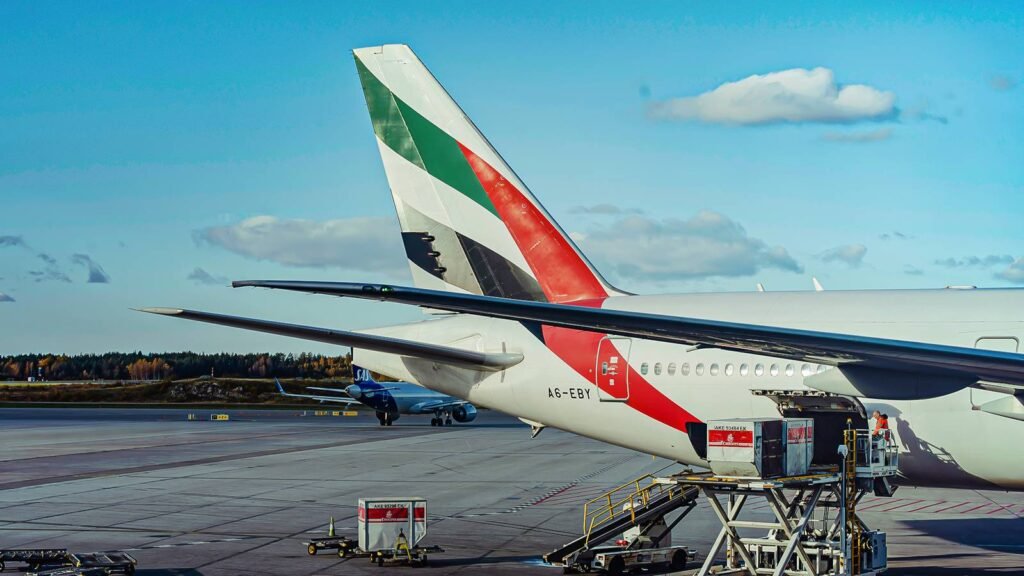
 Emirates is the flag carrier airline of the United Arab Emirates, headquartered in the city of Dubai. Since its founding in 1985, the airline has grown from a small operation with just two aircraft into one of the most recognized names in global aviation. Known for its focus on long-haul international travel and premium service, Emirates has built a reputation for reliability, luxury, and innovation. Its strategic location in Dubai allows it to connect passengers efficiently across Europe, Asia, Africa, and the Americas, making it a key player in global air travel.
The airline operates an all-widebody fleet, including iconic aircraft such as the Airbus A380 and Boeing 777, allowing it to carry large numbers of passengers on long-haul routes. Emirates continues to invest in modern aircraft and innovative technology to enhance the travel experience, from advanced in-flight entertainment to onboard connectivity options. With a commitment to quality, global connectivity, and passenger comfort, Emirates remains a leader in international aviation while expanding its network and modernizing its fleet for the future.
Introduction To Emirates

Emirates is the national airline of the United Arab Emirates, based in Dubai. Since its launch, it has become one of the most prominent airlines in the world, playing a key role in connecting destinations across continents and serving as a bridge between Eastern and Western markets.
Established in 1985 with a fleet of just two aircraft, Emirates experienced rapid growth by continuously expanding its route network and investing in modern aircraft. Its location in Dubai positioned the airline as a major global hub, allowing seamless connections between Europe, Asia, Africa, and the Americas.
Today, Emirates is widely recognized for its extensive long-haul operations and premium onboard experience, delivering high levels of comfort in every cabin class. The airline operates the world’s largest widebody fleet, featuring Airbus A380s and Boeing 777s, which support efficient operations on high-demand international routes.
Headquarters And Hub

Emirates’ main hub is  Dubai International Airport (DXB), one of the busiest and most modern airports in the world. Strategically located between Europe, Asia, and Africa, Dubai serves as an ideal connecting point for travelers from around the globe. Its geographic position allows Emirates to operate efficiently across long-haul routes while providing convenient connections between multiple continents, helping the airline maintain its reputation as a leading international carrier.
The airport features state-of-the-art facilities and terminals, designed to handle millions of passengers annually with ease and comfort. From advanced baggage handling systems to modern lounges and spacious boarding gates, Dubai International Airport combines efficiency with luxury. Emirates has leveraged these facilities to enhance its operations, ensuring smooth transfers for connecting passengers and maintaining a high standard of service across all classes.
Dubai International Airport has played a central role in Emirates’ rapid growth and global expansion. By using Dubai as its hub, the airline can efficiently link high-demand destinations, expand its international network, and optimize flight schedules. This strategic hub has not only enabled Emirates to dominate long-haul travel but also helped Dubai establish itself as a global aviation center, attracting travelers, businesses, and tourism from every corner of the world.

Which Aircraft Will Emirates Use To Replace Its Airbus A380s?
The sun is setting on the A380’s reign at Emirates. Discover the fleet reshuffle set to redefine the airline’s future.
Fleet Overview

Emirates currently operates the world’s largest widebody fleet, dominated by the Airbus A380 and Boeing 777 families. The airline has a total of 118 Airbus A380-800 aircraft, with 97 active and 21 inactive, reflecting the continued importance of the type on high-demand, long-haul routes. The A380 remains central to Emirates’ network strategy, particularly on trunk routes where high capacity and premium offerings are essential.
Alongside the A380, Emirates is gradually introducing the Airbus A350-900 as part of its long-term fleet evolution. At present, 14 A350-900s are active, with a significant 59 aircraft still to be delivered. This order book highlights the airline’s shift toward newer-generation aircraft that provide improved fuel efficiency, lower emissions, and greater flexibility compared to older widebody types.
The Boeing 777 continues to form the backbone of Emirates’ operations, especially the Boeing 777-300ER variant. The airline operates a total of 119 777-300ERs, with 116 currently active, supporting its extensive global long-haul network. In addition, Emirates maintains a strong cargo presence with 11 active Boeing 777-200F freighters and 10 more on order, reinforcing its role in global air freight. All fleet figures cited above are based on data from ch-aviation.
Global Network

The airline operates flights to more than 130 cities across six continents, making it one of the most globally connected carriers in the world. This extensive network allows passengers to reach major international hubs, business centers, and popular leisure destinations with ease. Whether traveling for work, family, or vacation, passengers benefit from convenient access to an extraordinary range of destinations, from bustling metropolitan cities to remote holiday spots. By continually expanding its route network, the airline ensures it remains at the forefront of global connectivity.
From Dubai, the airline operates thousands of weekly flights, providing passengers with high-frequency service and flexible scheduling options. Its hub in Dubai serves as a central gateway connecting the East and West, enabling travelers to move seamlessly between continents. The airline’s operational strategy emphasizes efficiency, comfort, and convenience, with modern aircraft and state-of-the-art facilities designed to enhance the travel experience. This robust flight schedule supports both short-haul and long-haul journeys, meeting the needs of a diverse passenger base.
With a strong presence in Europe, the Americas, Asia, Africa, and Oceania, the airline prioritizes high-demand international routes, particularly long-haul connections that link major global markets. By focusing on these strategic routes, it maximizes passenger access while maintaining a competitive edge in the global aviation industry. This approach also allows the airline to provide premium services, extensive in-flight options, and tailored travel experiences for frequent flyers, business travelers, and tourists alike. Its commitment to quality, reliability, and connectivity has cemented its reputation as a leading international carrier, trusted by millions of passengers worldwide.

Largest Non-Emirates A380 Fleets In 2026: The Top Airlines And Routes
The superjumbo will see plenty of action in the first quarter of next year, even away from its top operator.
Passenger Experience And Cabins

The airline offers a range of travel classes designed to meet the needs of all passengers, including economy, business, and first class, with premium economy. Each cabin is thoughtfully designed to provide comfort, convenience, and a superior travel experience, ensuring that every journey meets the expectations of leisure and business travelers alike. Whether passengers are looking for affordable travel, extra space and amenities, or the ultimate in luxury, the airline provides options tailored to every preference.
Passengers can enjoy award-winning in-flight entertainment through the airline’s ICE system, offering an extensive selection of movies, TV shows, music, games, and more. The entertainment platform is regularly updated to ensure a fresh and engaging experience for travelers of all ages, making even the longest flights enjoyable and relaxing. This commitment to in-flight entertainment has earned the airline numerous accolades and is a key part of its reputation for excellence in passenger experience.
Onboard, the airline offers a range of luxury features designed to enhance the travel experience across all cabins. First class on the Airbus A380 features private suites with personal showers, while business class offers lie-flat seats and advanced comfort amenities for a restful long-haul experience. High-quality catering and attentive service are delivered across all cabins, ensuring that passengers enjoy gourmet meals, fine beverages, and personalized care throughout their journey. These features, combined with meticulous attention to detail, create a travel experience that is both comfortable and memorable, reinforcing the airline’s position as a leader in premium international aviation.
Innovation And Future Plans

The airline’s fleet modernization strategy centers on introducing next-generation aircraft such as the Boeing 777X and the Airbus A350. On order are 35 Boeing 777-8s and a substantial 235 Boeing 777-9s, forming the core of the future long-haul fleet, alongside 59 Airbus A350-900s scheduled for delivery. In addition, the airline has ordered 30 Boeing 787 Dreamliners, split evenly between 15 787-10s and 15 787-8s, adding further flexibility and efficiency. These aircraft offer significantly improved fuel efficiency, longer range, and enhanced passenger comfort, allowing the airline to progressively replace older widebody jets while improving operational reliability.
A key part of the passenger experience upgrade is the implementation of Starlink high-speed satellite internet across the Airbus A380 and Boeing 777 fleets. This technology enables faster and more reliable connectivity at cruising altitude, supporting streaming, messaging, and productivity throughout the flight. When combined with new-generation aircraft deliveries and updated cabin products, this initiative reflects a broader effort to deliver a consistently modern and connected onboard experience.
Sustainability remains a central pillar of the airline’s long-term strategy, particularly in reducing emissions on long-haul operations. The introduction of aircraft such as the 777X, A350, and 787, each designed with lower fuel burn and reduced emissions, supports these goals, alongside operational efficiencies and the use of sustainable aviation fuel. Expansion plans to new global destinations will be closely tied to these efficiencies, enabling network growth while maintaining a strong focus on environmental responsibility.


