Premium Economy is the newest travel class in commercial aviation. It slots between economy and business class, essentially acting as a middle ground for passengers wanting a more premium travel experience without breaking the bank for business class. Essentially, the experience is just as the name suggests, offering a seat visually similar to an economy seat but with more legroom, a greater recline, a larger seat, a larger screen, and upgraded soft product.
Premium economy was first introduced by EVA Air in 1992, on the airline’s inaugural flight from Taipei to Los Angeles. Today, most major airlines offer it with a relatively similar experience onboard; however, one of the rare amenities offered by only a handful of carriers is lounge access. On most airlines, this is reserved for business class passengers or elite members, so which carriers offer it to premium economy passengers?
All Nippon Airways At Select Airports

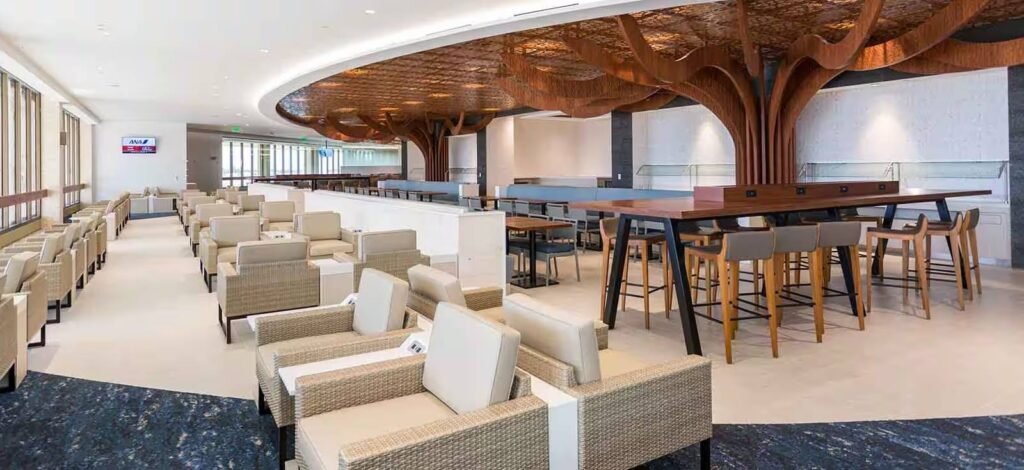
All Nippon Airways offers premium economy passengers free access to its lounges at three airports. These are the “ANA Lounges” at Tokyo Narita International Airport, Tokyo Haneda Airport, and Honolulu Daniel K. Inouye International Airport. Additionally, premium economy passengers formerly had access to the ANA Lounge at Osaka Kansai International Airport; however, this lounge is no longer operational. ANA premium economy passengers can no longer access any lounge at Osaka.
Additionally, ANA passengers receive access to partner lounges, some of which admit premium economy customers. In Southeast Asia, these are the Thai Airways Lounge, EVA Air Lounge, and Miracle Lounge in Bangkok, the Garuda Indonesia and Sapphire-Plaze Premium lounges in Jakarta, the Malaysia Airlines Golden Lounge in Kuala Lumpur, the Le Siagonnair Lounge in Ho Chi Minh City, and the SATS Premier Lounge in Singapore, along with most airports in Europe and North America.
Premium economy passengers must have at least one segment operated by ANA or an ANA Group airline. Throughout ANA’s network, premium economy passengers have access to most lounges, and these are the same lounges used by business class passengers. Some lounges available to business class customers do not permit premium economy, but most of these airports have another lounge that can be accessed by passengers in both classes.
ANA’s Competitor: Japan Airlines

The Japanese airline market is essentially a duopoly between All Nippon Airways and Japan Airlines. These are the two largest carriers in the nation. Both airlines are based in Tokyo, and they fly similar routes, often directly competing with one another. Japan Airlines is the smaller of the two airlines, but is often considered Japan’s flag carrier. Both airlines are also in competing alliances, as ANA is a member of Star Alliance, whereas JAL is part of oneworld.
Japan Airlines offers premium economy on its Airbus A350-1000s, Boeing 777-300ERs, and Boeing 787-9s. As for lounge access, JAL grants premium economy passengers access to Sakura lounges at Tokyo Narita, Tokyo Haneda, Osaka Kansai, and Nagoya Chubu Centrair International Airport. Additionally, JAL also operates Sakura lounges in Honolulu, Frankfurt, Bangkok, and Manila. These lounges also grant access to premium economy passengers.
For its other long-haul destinations, JAL often uses third-party lounges or facilities operated by a partner airline. Premium economy passengers receive access to  oneworld lounges, but are typically restricted from lounges not affiliated with the alliance. This is not available to passengers who receive a same-day upgrade or those traveling on a codeshare flight.

American Vs. Delta Vs. United: Which Carrier Has The Best Premium Economy?
These three airlines offer the most prominent premium economy offerings in the domestic aviation market.
The Only Airline Offering This Benefit In Europe, Technically

Scandinavian Airlines offers three travel classes: SAS Business, SAS Plus, and SAS Go. In essence, this is business class, premium economy, and economy. SAS Plus passengers are granted access to the carrier’s lounges in Copenhagen, Oslo, Stockholm, and Gothenburg, along with partner lounges in Europe and European lounges operated by SkyTeam alliance members. SAS Plus passengers cannot access lounges in other parts of the world.
The reason lounge access is only granted to SAS Plus passengers traveling within Europe is that, while SAS Plus is the carrier’s branding for premium economy on long-distance flights, it is also its highest cabin class for these operations. Therefore, while these passengers are technically ticketed in premium economy, this is essentially SAS’s equivalent of intra-European business class.
Worldwide, lounge access for premium economy passengers is the exception rather than the norm. SAS Plus passengers on intra-European flights receive an experience equivalent to other airlines’ regional business class, and often connect to SAS Business on long-distance flights. SAS Plus customers on long-haul flights, meanwhile, are prohibited from entering SAS lounges unless they’ve either purchased access or hold elite status.
South America’s Largest Airline

Whereas SAS only grants lounge access to premium economy passengers traveling within Europe, LATAM only grants this privilege to passengers traveling internationally, similarly to Japanese carriers. Unlike the Japanese carriers, however, LATAM does not offer premium economy on its widebodies, but rather on its Airbus A320 family aircraft. These consist of standard economy seats with a blocked middle seat, similar to intra-European business class.
LATAM grants premium economy passengers access to its lounges in Santiago, Bogotá, São Paulo, Buenos Aires, and Miami. Additionally, LATAM partners with third-parties to provide lounge services at other airports that permit access for premium economy passengers. In essence, premium economy is equivalent to LATAM’s long-haul business class, differing largely in the onboard experience, due to the disparity in the hard product between the carrier’s A320s and its widebodies.
|
LATAM cabin class |
Aircraft type offered |
Seat model |
Layout |
|---|---|---|---|
|
Business |
Boeing 767-300ER, Boeing 777-300ER, Boeing 787-8, Boeing 787-9 |
Thompson Vantage XL (B767, B777, B787-9), Safran Aura Lite (B787-8), Recaro R7 (B787-8) |
1-2-1 staggered (B767, B777, B787-8, B787-9), 2-2-2 lieflat (B787-8 with Aura Lite) |
|
Premium economy |
Airbus A319-100, Airbus A320-200, Airbus A321-200, Airbus A320neo, Airbus A321neo |
Collins Meridian |
3-3 with blocked middle seat |
|
Economy |
Airbus A319-100, Airbus A320-200, Airbus A321-200, Airbus A320neo, Airbus A321neo, Boeing 767-300ER, Boeing 777-300ER, Boeing 787-8, Boeing 787-9 |
Collins Meridian (A320), Collins Pinnacle (B767, B777, B787) |
3-3 (A320), 2-3-2 (B767), 3-3-3 (B787), 3-4-3 (B777) |
While both Japan Airlines and ANA provide premium economy customers with lounge access, LATAM is the only South American carrier that offers this benefit. Avianca, notably, does not grant premium economy passengers lounge access, despite offering a comparable product on its Airbus A320 family aircraft. For Avianca, these planes are also the only ones to offer premium economy, in the form of a standard row with a blocked middle seat. Avianca’s 787s do not offer premium economy.

Cathay Pacific Airbus A350-1000 Economy Vs Premium Economy: Features Compared
How to decide whether to splash out on Premium Economy or stick with Economy on Cathay A350 long haul routes.
Overview Of Premium Economy Class

Lounge access is not typically granted with premium economy tickets. Japan’s two largest airlines compete fiercely for market share, and are regarded as two of the world’s best airlines. Therefore, if one offers lounge access as a point of differentiation, the other must also. In other areas of the world, however, market dynamics mean that this simply isn’t required. SAS and LATAM offer it because their premium economy offerings are short-haul equivalents to long-haul business class.
Worldwide, long-haul premium economy is largely similar. Almost every airline offers the same seat width and legroom, along with a larger screen. A handful of airlines configure Airbus A350s with seven-abreast premium economy, while most configure them with an eight-abreast layout, but layouts on other aircraft types are largely identical from airline to airline. Additionally, some carriers install hard-shell seats, while most prefer recliner-style models.
Although premium economy slots in between economy and business class, the experience is closer to economy than business class. Business class often includes lounge access, along with upgraded service and a lie-flat seat. Premium economy serves as a more comfortable alternative to economy, while business class is closer to a luxury experience.
Premium Economy Today

Despite being the newest class of travel, premium economy has quickly become popular with passengers, and has transformed from a novelty to mainstream. Several airlines quote premium economy as their most profitable cabin on a per square foot basis, and there has been a noticeable trend to increase the size of these cabins. While airlines differentiate heavily in higher travel classes, differences in premium economy are more subtle.
Lounge access is a rare benefit provided by only a handful of airlines. In reality, LATAM uses this to differentiate itself from its smaller competitors, but its premium economy cabin is essentially a short-haul business class. For  SAS, SAS Plus is its business class cabin on intra-European flights, and the carrier provides the same benefits that competitors provide for short-haul business class. SAS Plus is simply its branding for this service class.
Given that access to lounge facilities when traveling in premium economy on a widebody is limited to two airlines worldwide, it’s unlikely that other carriers will follow. Several of the world’s top airlines, such as Emirates and Singapore Airlines, do not allow this, as other airlines don’t. Due to the intense competition between Japan’s leading airlines, they essentially have to offer the same experience or risk losing market share, making them unique in the premium economy world.


