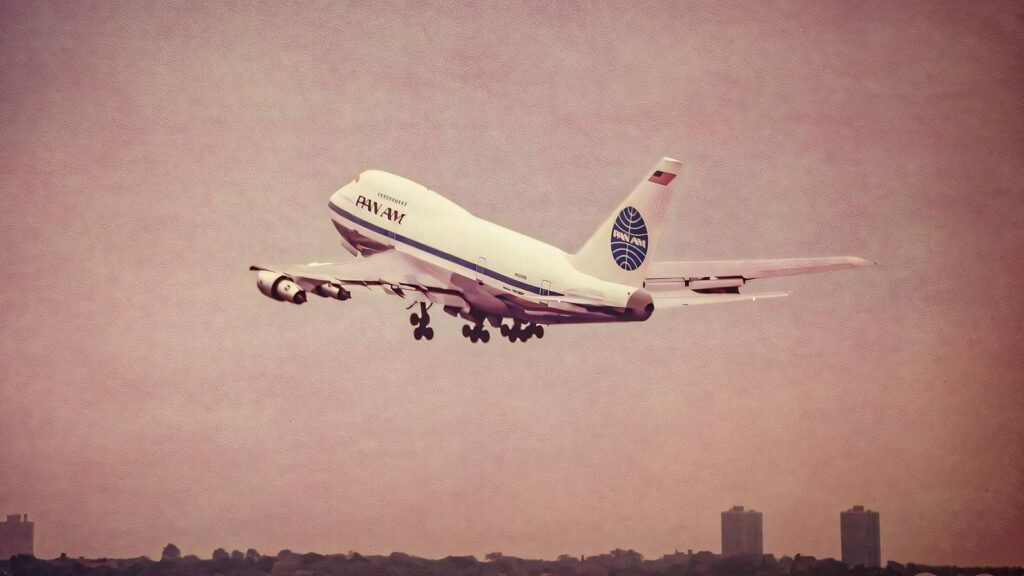
In the world of exceptionally large widebody jetliners, there are a few odd outliers that beg the question: why was this made? The Boeing 747-400 was the definitive, best-selling variant of Boeing’s iconic double-decker, jumbo jet. On the other hand, the 747SP (Special Performance) is a very rare and strange variant of the famous jetliner family tree with a truncated fuselage.
In fact, the airframe’s smaller size gave it greater range, which was specifically requested by Boeing’s first 747 customer, helping make the world’s first twin-aisle widebody a possibility. Pan American World Airways (Pan Am), after enjoying the exceptional success of the first 747-100 sought to create an even longer range variant to fly ultra-long-haul to places like the Middle East and Asia.
Making The Mini 747

The 747SP was introduced in 1976; its first flight was in 1973. That was 12 years ahead of the development of the 747-400. The -400 did not begin work on the drawing board until 1985, and did not enter service until 1989. It was Pan Am that specifically requested the 747SP to be developed alongside Iran Air and collaborated to establish a route from New York to Tehran.
The 747SP features a significantly shortened fuselage. It is roughly 47-48 feet shorter than standard 747 airframes. It typically carried 230–330 passengers, whereas the 747-400 can accommodate 412-524 passengers. The 747-400 typically has 10 main deck doors (five per side), whereas the 747SP has only eight doors (four per side) due to its reduced length.
The 747-400 features a Stretched Upper Deck (SUD) as standard, a design change originally pioneered by the engineering research done for the 747SP. The 747SP uses the shorter upper deck found on early models. The 747-400 was built to support early personal inflight entertainment (IFE) screens, whereas the 1970s-era 747SP originally relied on shared cabin projectors and main screen cinema systems. The 747-400 introduced a flexible cabin interior, allowing airlines to relocate galleys and lavatories within 48 hours and rearrange seating overnight.
The Short & Long Of It All

Developing the 747SP wasn’t as simple as chopping off the tail-end cabin section of a 747-100 and bolting the impingement back on. Although it may look that way on the outside, the engineering complexities of changing such an enormous airplane required nuanced technological solutions. It also helped Boeing free an airframe that could compete with the competing McDonnell Douglas DC-10 and Lockheed L-1011 trijets being introduced in the long-range class.
When the 747SP was developed, there were only two airframes that it could be derived from: 747-100 or the 747-200. Surprisingly, the 747SP is taller than the 747-400. To compensate for the shorter fuselage and resulting loss of leverage (yaw moment), Boeing increased the height of the vertical stabilizer by five feet. Notably, the latest and greatest iteration of the 747 series, the 747-8, was slightly larger than the 747-400 but slightly shorter. That also makes the 747SP the tallest 747 passenger variant in the series.
|
Feature |
Boeing 747SP |
Boeing 747-400 |
|---|---|---|
|
Overall Length |
184 feet, 9 inches (56.31 meters) |
231 feet, 10 inches (70.66 meters) |
|
Wingspan |
195 feet, 8 inches (59.64 meters) |
211 feet, 5 inches (64.44 meters) |
|
Tail Height |
65 feet, 10 inches (20.06 meters) |
63 feet, 8 inches (19.41 meters) |
|
Wing Area |
5,500 square feet (511 meters²) |
5,650 square feet (525 meters²) |
|
Fuselage Width |
21 feet, 4 inches (6.50 meters) |
21 feet, 4 inches (6.50 m) |
The aerodynamic differences between the 747SP and 747-400 are profound, reflecting a shift from “brute force” performance in the 1970s to sophisticated efficiency in the late 1980s. The 747-400 has a wider wingspan due to six-foot winglets and wingtip extensions that were not present on the SP. The 747SP lacks winglets and uses simplified single-slotted flaps on the trailing edge of the wings, unlike the complex triple-slotted flaps found on other 747 variants.

How Long Will The Boeing 747 Remain Flying?
With deliveries of the jumbo jet having only ceased in recent years, the type looks set to continue flying for several decades to come.
Two Eras Of Engineering

The 747SP was the “hot rod” of the 747 family, offering several unique performance capabilities that even the more advanced 747-400 could not match. The 747SP achieved its “special performance” by using the powerful engines intended for the 747-100 and 200 on an airframe that was roughly 81,500 lbs (37,000 kg) lighter. The SP could operate from much shorter runways than the 747-400. This was the primary reason Qantas purchased it for routes out of New Zealand, which had a short runway and challenging weather.
The 747SP holds the record for the highest routine cruising altitude of any subsonic passenger airliner. The 747SP could cruise at 45,100 feet, meanwhile the 747-400 tops out at 41,000 feet, and many are not routinely flown higher than 35,000 feet. That would make the supersonic transport (SST), the Concorde, the only commercial aircraft that could beat out the special performance 747 in altitude.
Massive power surplus allowed the SP to climb faster and reach its cruising altitude significantly sooner than other variants. It was once the fastest subsonic (cruise Mach 0.86) airliner in production, famously setting world records for nonstop flights between New York and Tokyo.
|
Feature |
Boeing 747SP |
Boeing 747-400 |
|---|---|---|
|
Primary Engines |
Pratt & Whitney JT9D-7J |
P&W PW4056 / GE CF6-80C2 / RR RB211-524 |
|
Thrust per Engine |
46,500 – 50,000 lbf |
56,000 – 63,300 lbf |
|
Total Thrust |
186,000 – 200,000 lbf |
224,000 – 253,200 lbf |
|
Technology |
Analog, early high-bypass |
Digital (FADEC), modern high-bypass |
The 747-400 is a significantly more powerful and higher-capacity aircraft than the 747SP, reflecting nearly 15 years of engine and structural evolution. The 747-400 achieved both greater range and massive payload through technology. The 747-400 engines are roughly 15–20% more powerful than those on the 747SP, while also being significantly more fuel-efficient.
Inside the 747SP was antiquated with a three-person cockpit (pilot, co-pilot, and flight engineer). The 747-400 introduced a modern two-crew glass cockpit, eliminating the need for a flight engineer. Both the 747SP and its base airframe, the 747-100, use analog dials and gauges with physical switches for all instrument controls on the flight deck. The 747-400 utilized six cathode-ray tube (CRT) displays and a digital Flight Management System (FMS), eliminating the flight engineer position.

The 747SP In Action

The 747SP was a highly specialized aircraft designed to open up new, ultra-long-haul routes that were previously impossible for fully loaded commercial airliners. These routes often bypassed traditional refueling stops, such as Anchorage, Alaska. Only 45 of these aircraft were ever built, primarily serving niche long-haul markets or VIP and government transport.
The 747SP’s long range made it a preferred choice for world leaders and wealthy private owners who needed to travel across the globe without refueling stops. Las Vegas Sands Corp. previously operated two 747SPs as ultra-luxury private transports for high-rolling guests and corporate use. For decades, the 747SP was used by the governments of Oman, Saudi Arabia, Qatar, Yemen, and the United Arab Emirates for royal and presidential transport. The last aircraft in active governmental use, operated by the Royal Flight of Oman, was stored in 2020.
|
747SP Operator |
Description |
|---|---|
|
Pan American World Airways |
The primary launch customer, heavily involved in the aircraft’s design. |
|
Iran Air |
Operated several aircraft, including the very last commercial passenger flight of a 747SP in 2016. |
|
South African Airways |
Used the SP extensively for long-haul routes to Europe and North America. |
|
Qantas |
Utilized the aircraft for trans-Pacific and trans-Tasman routes. |
|
United Airlines |
Acquired Pan Am’s Pacific Division fleet, including their 747SPs, in 1985. |
|
Others |
American Airlines, TWA, Korean Air, Air China, and Saudia also operated the 747SP at various points in its history. |
Thanks to its high-altitude performance and long-range endurance, the 747SP survived much longer in specialized roles than it did as a commercial airliner. In 2025, the only remaining active 747SPs are dedicated to engine research. Today, the only remaining active 747SPs are two aircraft used as engine testbeds for Pratt & Whitney.
The aircraft feature a special fifth engine mount on the upper right side of the fuselage, just behind the cockpit hump. This allows engineers to test experimental engines in real-world flight conditions without relying on them for the aircraft’s own power. One of these 747SPs (registration C-GTFF) was a featured attraction at the EAA AirVenture Oshkosh 2025 event in July to celebrate Pratt & Whitney’s 100th anniversary.

Inside Pan Am’s 1986 Boeing 747SP Cabin
Pan Am’s Boeing 747SP featured luxurious cabins and dining, reinforcing its legacy.
Flying With SOFIA

The most famous scientific use of the 747SP (N747NA, Clipper Lindbergh) was NASA’s Stratospheric Observatory for Infrared Astronomy (SOFIA), a joint project with the German Aerospace Center (DLR). A massive 15-foot-high door was cut into the rear fuselage that could be opened in flight to allow a 2.5-meter reflecting telescope to view the stars. The 747SP was chosen because it could cruise between 38,000 and 45,000 feet, placing it above 99% of the Earth’s infrared-blocking water vapor.
During its 12 years of science flights, from 2010 to 2022, SOFIA made several major breakthroughs. SOFIA famously discovered water on the sunlit surface of the Moon and was used to study the atmosphere of Pluto. It helped confirm that Pluto has a hazy atmosphere during a daring flight that “chased” Pluto’s shadow. It was the first telescope to measure the direction of magnetic fields across entire galaxies. SOFIA also detected the first type of molecule to have formed after the Big Bang.
SOFIA’s mission officially ended in September 2022. Now, the aircraft is a permanent exhibit at the Pima Air & Space Museum in Tucson, Arizona. As of March 2025, the museum began offering public tours inside the aircraft, allowing visitors to see the mission control consoles and the telescope bulkhead. The telescope’s primary mirror was returned to Germany for display at the German Optical Museum in Jena.


