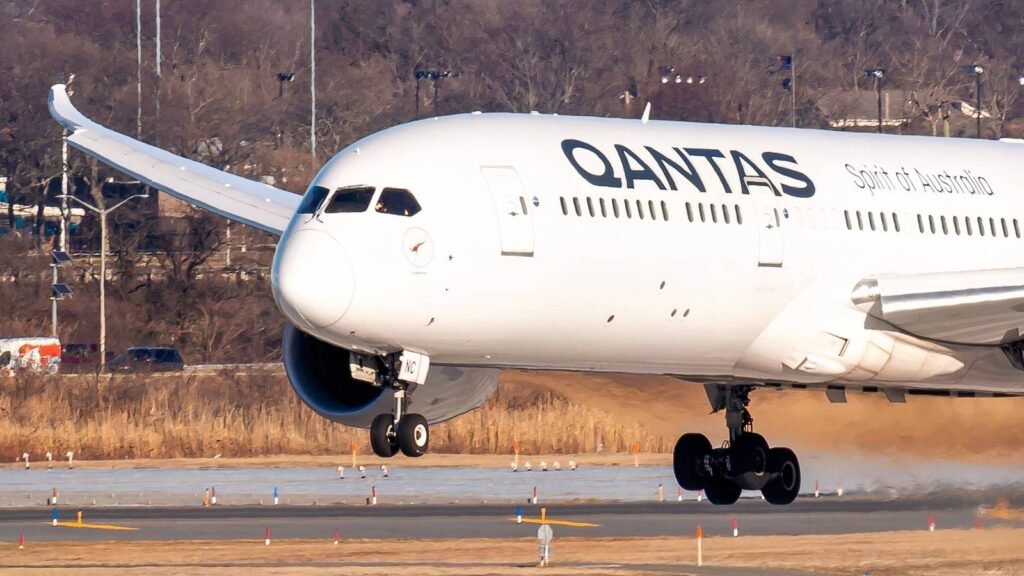
The Boeing 787 is Australia’s top aircraft on long-haul routes. When its three variants are combined, the Dreamliner (as referred to by Boeing’s marketing team) operates 30% of the country’s longest services.
Some 25 airlines use the 787 to Australia. The type’s dominance is, of course, influenced by Jetstar and Qantas’ deployment of it. China Southern ranks first among the foreign carriers, followed by United Airlines, which has just started flying the equipment to Adelaide.
Australia’s Ten Longest Nonstop 787 Flights

Using OAG data to examine all 787 operators to Australia shows the following very long commercial routes. As usual with such topics, the list is based on the maximum block time, which is measured as chocks-off-to-chocks-on. It is for the first ten months of 2026 and may vary. United’s brand-new San Francisco to Adelaide route only just made the cut.
It is based on nonstop flights only. Thus, Qantas’ fifth-freedom operation from Sydney to New York JFK via Auckland does not count. The same is true of  British Airways from London Heathrow to Sydney via Singapore, which will see the 787-9 again from the end of March. Notice Perth to Paris CDG and Rome Fiumicino in the table, both of which begin in Sydney. They are included as legs from Western Australia are nonstop and long enough in themselves.
|
Max. Block Time: January To October 2026* |
Direction Of Route With That Time |
Airline & 787 Operations Only** |
|---|---|---|
|
17h 50m |
Perth to London Heathrow |
Qantas. Daily year-round 787-9 |
|
17h 45m |
Dallas/Fort Worth back to Melbourne |
Qantas. Three weekly to daily year-round 787-9 |
|
17h 35m |
Houston Intercontinental to Sydney |
United. Daily seasonal 787-9 |
|
17h 30m |
Perth to Paris CDG |
Qantas. Three weekly year-round 787-9 |
|
17h 35m |
Dallas/Fort Worth to Sydney |
Qantas. Limited service in March only. A380 the rest of the time |
|
17h 15m |
Dallas/Fort Worth to Brisbane |
American. Daily seasonal 787-9 |
|
16h 25m |
Perth to Rome Fiumicino |
Qantas. Three to four weekly seasonal 787-9 |
|
15h 55m |
San Francisco to Melbourne |
United. Daily year-round 787-9 |
|
15h 55m |
Los Angeles to Melbourne |
United. Three weekly to daily year-round 787-9. Qantas. Five weekly year-round 787-9 |
|
15h 55m |
San Francisco to Adelaide |
United. Three weekly seasonal 787-9 |
|
* Even if just once |
** Known as of January 5, and subject to change. Some of the stated frequencies are very time-limited |
Australia’s Longest Nonstop 787 Operation

At up to 17h 50m, Perth to  London Heathrow remains Australia’s longest 787-operated nonstop market. In fact, when all equipment is considered, it is both Australia’s and the UK’s longest nonstop scheduled commercial service. This should not come as much of a surprise.
Perth-Heathrow is a standalone service, as the flight number is not extended to Sydney or Melbourne. However, depending on the day, Flightradar24 shows that the operating low-capacity, 236-seat 787-9 operates a separate flight to/from Sydney.
On a great circle basis, Perth-Heathrow covers a considerable 7,829 nautical miles (14,499 km) each way. OAG shows that Qantas has operated nonstop since 2018. In January 2026, QF9 will depart from Western Australia at 7:15 pm and arrive in Heathrow at 5:05 am the next day (17h 50m). QF10 will leave the UK at 11:50 am and get back at 12:30 pm local time the next day (16h 40m).

Up To 17-Hour Nonstop Flights: Delta Air Lines’ 10 New Ultra-Long Routes In 2026
Three of them are new this year. Find out which they are.
Perth To Heathrow Had An 89% Load Factor

According to UK Civil Aviation Authority data for January to October 2025, the most recent period available, Qantas carried 127,843 Perth-Heathrow-Perth passengers. Relating this traffic volume to available capacity shows that it filled 89% of seats, which is very strong in itself. Unsurprisingly, the best months were September (96%), August (93%), and January (91%). The worst month was March (81%).
Booking data estimates that 47% of passengers connected to another flight in Perth or Heathrow or at both airports. The rest of the traffic was local between the capitals of Western Australia and the UK.
When all airlines are considered, Qantas had approximately 45% of the Perth-Heathrow market, and 40% for Perth-London generally. Naturally, many passengers transferred en route, particularly changing planes in Doha, Dubai, Hong Kong, Kuala Lumpur, and Singapore.


