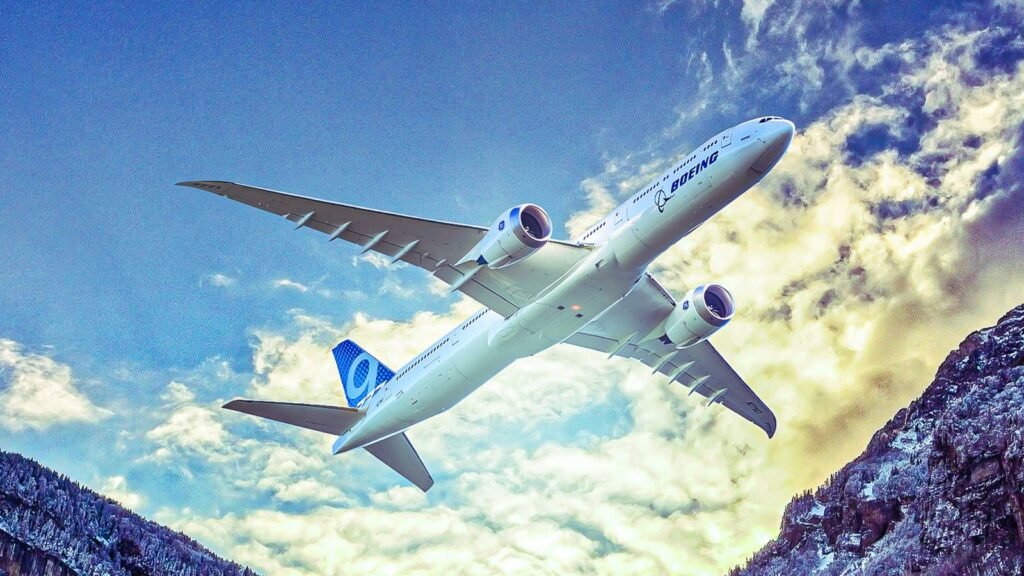
The Boeing 777X is a long-awaited successor to the iconic Boeing 777, or “Triple Seven” family. In general, the most successful variant of the legacy lineup is considered to be the 777-300ER. This iconic Long Haul jetliner is one of the most successful twin jets in history as well. The success of the original 777 laid the foundation for the 777X through a number of historic firsts.
One of the main selling points of the next-generation 777X is its enormous wingspan. That gigantic wing will make it the most fuel-efficient commercial aircraft in the sky when it debuts. With many of the preceding widebody jets having decades left in their service lives, we will commonly see them sharing the ramp for some years. So the question is just how much longer are the 777X wings?
First Of Their Kind Folding Wingtips

To get directly to the point, the 777X will have wings that are 7 meters (23 feet) wider than the 777-300ER. That is a total wingspan of 71.75 meters (235.5 feet) compared to 64.8 meters (212.6 feet). That is a 10% increase over the Legacy aircraft. Most of that extra wingspan is found in the length provided by the industry-first folding wingtips. If it were not for the wingfold mechanism made by Germany’s Liebherr, the 777X would be too large for standard airport gates.
By folding the last 11 feet (3.4 meters) of each wing upward, the 777X reduces its span to 64.8 meters on the ground, or the exact same width as the 777-300ER. The tips are moved by a hydraulic-driven hinge system. Once extended for flight, they are secured by electrical locking mechanisms and large bolts that mechanically prevent them from any folding power during flight. Pilots use a dedicated overhead switch. The tips automatically fold upon landing when the aircraft slows below a safe speed.
|
Compared to the 777-300ER, the 777-9X is: |
|---|
|
Overall length is 2.9 m (9.4 ft) longer |
|
Folded wingspan same, unfolded wingspan is 7 m (22.8 ft) wider |
|
Horizontal stabilizer is 3.0 m (9.9 ft) wider |
|
Wheelbase is 1.1 m (3.6 ft) longer |
|
Distance from the nose to the nose landing gear remains the same |
|
Engine to fuselage centerline is 1.0 m (3.3 ft) further outboard |
|
Vertical tail max. height is |
|
Main landing gear width is 0.2 m (6 in) narrower |
The enormous wingspan gives it the ability to carry a payload like a jumbo jet while using the same amount of fuel as existing twinjet widebodies. In fact, those wings are nearly as wide as the 747 with the tips extended. Unlike the Airbus A380 and Boeing 747-8, which required airports to spend millions upgrading to Code F infrastructure, the 777X remains a Code E aircraft on the ground. This allows it to fly into any airport already serving the 777-300ER without modification.
Innovation Unlike Any Airliner

Specifically, Boeing estimates that the 777X will achieve a 10-13% improvement in block-hour fuel burn compared to the 777-300ER. Owing to its greater seat capacity, the per-seat fuel efficiency gain is even more significant, at 15-20%. Its incredible wings working in conjunction with new engines that will not only provide a 10% better fuel burn rate but will also be the most powerful turbofan power plants ever installed on an airliner.
While the 777-300ER uses traditional aluminum wings, the 777X uses carbon-fiber composite wings. These are thinner, lighter, and more flexible, allowing the wing to bend up to 26 feet in flight to optimize airflow. The 777X features advanced “gust suppression” systems that detect and automatically adjust for turbulence. This smooths out the ride, making it more comfortable for nervous flyers.
The increased span also creates a higher aspect ratio, 10:1 compared to 9:1 for the 777-300ER. That increases lift and reduces induced drag. This allows the 777X to climb faster and cruise at higher altitudes (above 40,000 ft) where air resistance is lower.
The giant wing made of composite materials will give it a lower weight overall, and, thanks to advanced design, also less drag, producing an improved lift to drag ratio. The use of composite materials throughout the airframe will reduce the huge jet’s dead weight and give it a better payload capacity relative to legacy aircraft.
A Palace In The Sky

When it comes to improvements for passengers, the 777X has also claimed a historic first in commercial aviation. It is the first evolution of an existing airframe to be redesigned with larger windows. Windows are 29% larger and positioned higher for better views. Also, building on the success of the 787 Dreamliner features, the cabin altitude is lowered to 6,000 feet (from 8,000 feet in the 777) with higher humidity, reducing jet lag and fatigue.
Advanced filtration systems maintain significantly higher humidity levels than the 777-300ER, preventing dry eyes, scratchy throats, and dehydration common in older jets. A full-cabin LED system can mimic natural light cycles, such as sunrise and sunset, to help passengers’ internal clocks adjust to new time zones more easily.
Redesigned sidewalls make the cabin 4 inches wider. This extra width allows for 10-abreast seating with 18-inch-wide seats, which is wider than the industry standard and provides more shoulder room than the 777-300ER. But the cabin also features the same design elements pioneered by the Dreamliner, which has enjoyed an extremely successful career since its debut. Redesigned bins nearly double the capacity of previous models, holding up to four bags each. They are also much easier to close, reducing boarding jams and the need to gate-check carry-on luggage.
The composite construction of the fuselage not only made a higher cabin pressure level possible, reducing the simulated cabin altitude, but also made the cabin quieter. Despite the walls being thinner, their construction and materials have made them more soundproof. Adding to that, the GE9X engines are significantly quieter, reducing cabin noise levels even further. Plus, it reduces the enormous twinjets’ sound footprint at the airfield, which is better for communities.

Why The Boeing 777X Will Evolve Long-Haul Flying
The aircraft features many new innovations from the older generation 777s.
The Champion Of A New Twinjet Era

The Boeing 777X is designed as the primary successor to “jumbo” and “superjumbo” aircraft like the Boeing 747-8 and Airbus A380. By 2025, it will have established itself as the leading high-capacity twinjet for operators seeking the scale of these iconic jets without their prohibitive operating costs. That is only possible thanks to its enormous wingspan and the groundbreaking folding wingtips that give it that impressive length.
The 777X achieves 20% lower fuel use and emissions than the 747-8 it replaces. Its two massive GE9X engines deliver 10% better fuel efficiency than their predecessors, nearly doing the work of four older engines with significantly less fuel. Aside from the pure fuel cost, the 777X essentially delivers the flexibility that the 787 Dreamliner gave airlines in a smaller widebody repackaged into a high-capacity platform.
A 400-seat 777X is easier to fill profitably than a 500 to 600-seat A380. If an airline sells 300 seats, a 777X is nearly full and profitable, whereas an A380 would likely be flying at a loss. This is the key selling point that has made the 787 Dreamliner so popular since its debut in 2011. The 777X has superior cargo capacity compared to the A380 and 747-8, allowing airlines to supplement passenger ticket sales with high-value belly cargo on long-haul routes.

The Aircraft Set To Replace The Iconic Boeing 777-200ER
The 777-200ER’s legacy lives on through its high-tech successors.
By The Numbers: Boeing 777X

The nuts and bolts are that the 777-300ER offers comparable seat capacity to the smaller 777-8X, and the cabin comfort is dramatically better, as is the fuel efficiency of the aircraft. Looking at the larger 777-9X, not only is its seat capacity increased while comfort remains consistent, but fuel burn relative to seat count makes it even more efficient.
Then we have to look at the range. The Next Generation 777-8X has a dramatically superior range than the 777-300ER, which was the first aircraft in aviation history to be certified for ETOPS-180 upon entry into service (EIS) in 1995. During certification testing, a 777-300ER performed the longest single-engine demonstration flight ever recorded, flying for 330 minutes (5.5 hours) with one of its two engines intentionally shut down.
In 2011, the 777 series (led by the -300ER) became the first to receive FAA approval for 330-minute ETOPS. This effectively eliminated almost all “no-fly zones” for twinjets. The next-generation 777X will take that even further. Below is a side-by-side comparison of some key specifications to highlight the differences between the three widebody Boeing jets:
|
Specification |
777-300ER |
777-9X |
|
|---|---|---|---|
|
Seats (Typical 2-class) |
396 |
395 |
426 |
|
Range |
7,370 nautical miles (13,649 kilometers) |
8,745 nautical miles (16,190 kilometers) |
7,285 nautical miles (13,500 kilometers) |
|
Length |
242 feet, 4 inches (73.86 meters) |
232 feet, 6 inches (70.86 meters) |
251 feet, 9 inches (76.72 meters) |
|
Wingspan |
212 feet,7 inches (64.80 meters) |
On ground: 212 feet, 9 inches (64.85 meters) Extended: 235 feet, 5 inches (71.75 meters) |
“ |
|
Engine |
General Electric GE90-115B |
General Electric GE9X |
“ |
The 777-9 is approximately nine feet longer than the 777-300ER, making it the longest commercial passenger jet in the world. It has even edged out the 747-8I by about 1.5 feet and the A380 by over 13 feet. Though the Airbus A380 remains the world’s largest passenger aircraft in terms of weight, height, and total wingspan. Yet the 777X now has the widest wingspan of any Boeing airliner ever made.


