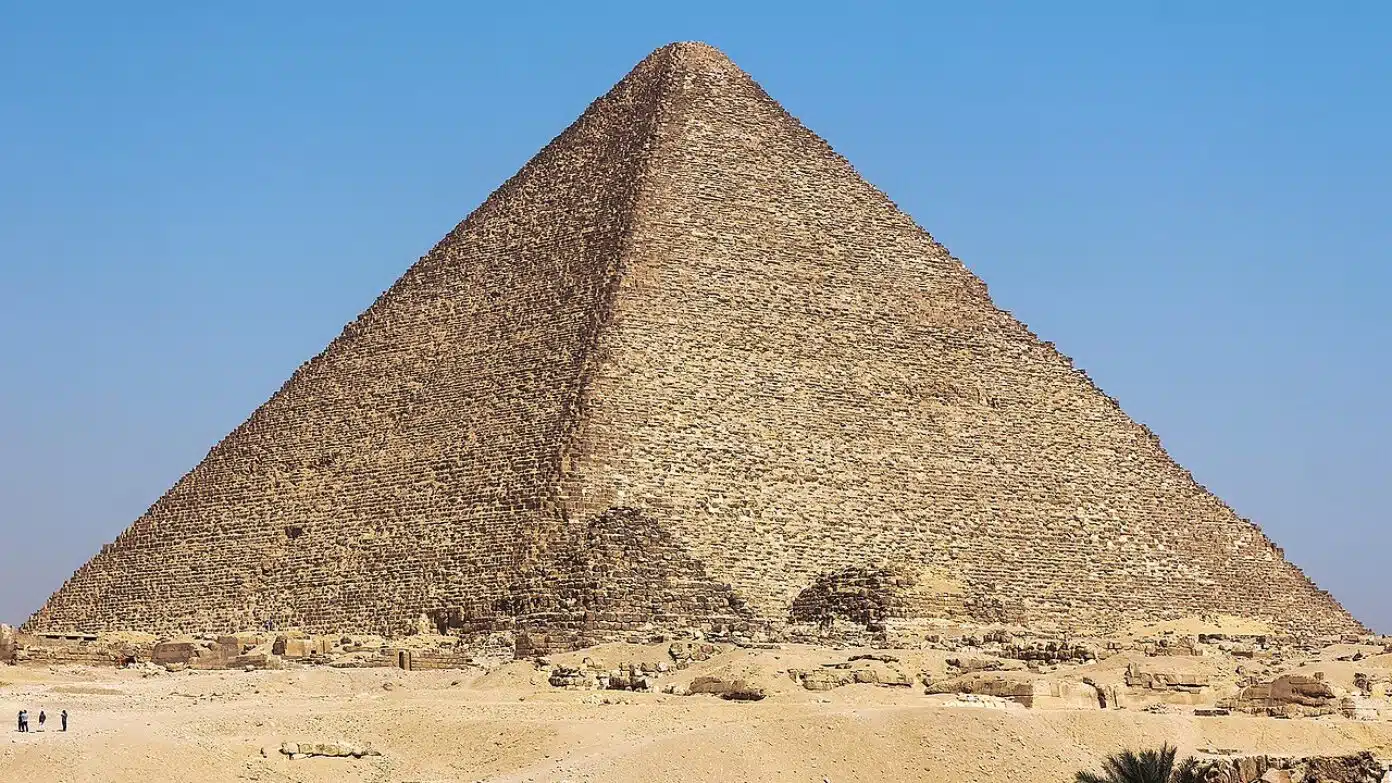
A new preliminary study is reopening debate over one of archaeology’s most firmly established timelines: the age of the Great Pyramid of Giza.
The research, released in January 2026, was authored by Italian engineer Alberto Donini. It proposes an alternative method for estimating when the pyramid was built by examining erosion patterns in its stonework. The approach challenges the widely accepted view that the monument dates to around 2560 B.C., during the reign of Pharaoh Khufu.
Rather than relying on inscriptions, historical texts, or radiocarbon dating, Donini focuses on how limestone surfaces at the pyramid’s base have weathered over time. He calls his approach the Relative Erosion Method, or REM.
How the relative erosion method works
The method compares erosion on adjacent limestone surfaces made from the same material and exposed to the same environment, but for different lengths of time. At Giza, this distinction comes from the pyramid’s original casing stones.
Ancient sources indicate that smooth limestone blocks once covered much of the structure. Those stones were later removed and reused in Cairo, particularly after major earthquakes such as the powerful quake of A.D. 1303 and during the Mamluk period.
As a result, some stone surfaces near the pyramid’s base have been exposed for only about 675 years. Others may have remained exposed since the monument’s original construction. Donini argues that comparing erosion between these surfaces provides a way to estimate how long the older stone has been weathering.
Measuring erosion at the pyramid’s base
The study analyzes twelve measurement points around the pyramid’s base. At each location, Donini examined either pitting erosion—small cavities caused by chemical and physical weathering—or more uniform surface wear. He estimated how much stone material had been lost, measuring either depth or volume.
A new preliminary study applies erosion analysis to the Great Pyramid of Giza, suggesting parts of the monument may be far older than traditionally believed. Archaeologists urge caution as the findings remain unreviewed. pic.twitter.com/lViR1LKpc2
— Tom Marvolo Riddle (@tom_riddle2025) January 28, 2026
In one example, a limestone pavement slab shows deep pitting on the side believed to have been exposed since construction. The opposite side, uncovered only after the casing stones were removed, shows far less damage. By comparing the erosion on both sides and applying a linear erosion model, Donini estimated that the older surface had been exposed for more than 5,700 years before present.
Other measurements produced much higher values. Several points suggested erosion equivalent to 20,000 years or more of exposure. When Donini averaged all twelve measurements, the result was about 24,900 years before present, corresponding to roughly 22,900 B.C.
Statistical ranges rather than exact dates
Donini emphasizes that REM is not designed to provide exact dates. Instead, it estimates an order of magnitude. To address uncertainty, the study applies a basic statistical model, calculating a standard deviation and constructing a Gaussian probability curve.
Based on that model, the study suggests a 68.2% probability that the pyramid was built sometime between about 9,000 B.C. and 36,000 B.C., with the highest probability centered in the early 20,000s B.C.
Environmental and human factors complicate erosion
The paper openly acknowledges major limitations. Egypt’s climate was likely wetter in the distant past, which could have accelerated erosion. In contrast, modern pollution and acid rain may have increased erosion rates in recent centuries.
Human activity also complicates the picture. Today, thousands of visitors walk around the pyramid each day, a level of foot traffic that did not exist in antiquity. Periodic burial of stone surfaces beneath sand may have slowed erosion at times.
Because of these factors, Donini argues that individual measurements may overestimate or underestimate age. He maintains that averaging multiple points helps reduce error.
Why most archaeologists remain unconvinced
Most archaeologists remain cautious. They point to extensive evidence linking the pyramid to the Fourth Dynasty, including inscriptions, tool marks, radiocarbon dating of nearby settlements, and the broader archaeological context of the Giza plateau.
Many also warn that erosion rates vary widely and are difficult to model linearly over tens of thousands of years. The study has not undergone peer review in a major archaeological journal, and no independent teams have replicated its findings.
For now, the Great Pyramid remains firmly anchored in the Old Kingdom. Still, the research highlights how even the world’s most studied monuments can continue to provoke fundamental questions. Donini calls for further measurements and independent verification to determine whether REM can serve as a useful supplementary tool or remains an untested hypothesis.


