I was once challenged on a chairlift to list every ski resort I’d ever visited by an older American man who wished to recite his list back to me. I thought it was a competition but it turned out it was research. Had I been somewhere he hadn’t been and could I, if so, be of use? Skiers are obsessive about the perfect destination.
It can be hard to remember that beyond a few key variables, such as price, your basic Alpine ski resort is largely indistinguishable from its neighbour. There will be a multi-denominational nightclub. A fondue restaurant. Several pizza and burger dispensaries haunted by young people. A sticky English or Irish bar, three pharmacies and two Intersports. The building blocks of civilisation.
Where, then, for a ski adventure that won’t end in that familiar trudge up and down main street considering which big block of cheese to melt tonight? Sir, you need the Dolomites . . .


Val Pusteria, on the northern fringe of the range, is less explored by international skiers than either the honeypots of the Sellaronda (Corvara, Ortisei and so on) or the grande dame and recent Olympic star, Cortina d’Ampezzo. Less filled with destination hotels and smart restaurants too — indeed, on our second night at the newly reborn Castel Badia, a local who has come for dinner tells me it’s a leap forward in regional hospitality. We all hope it heralds the rising of standards across the area, he says. What the area already has in abundance is astounding beauty and history: bell towers and medieval structures dot the valley, while a startlingly green river winds through its midst.

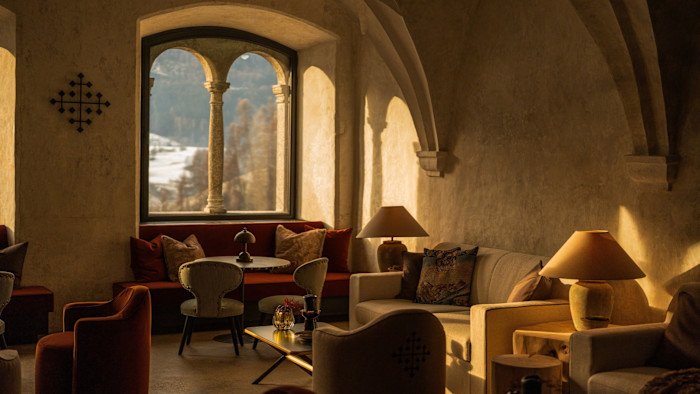
The castle, founded in the 11th century, became a Benedictine convent for some 700 years before finally reaching its purest form, a hotel, in 1971. After a thorough three-year renovation and upgrade, it was relaunched just before Christmas as a five-star retreat. It is owned by two local families and Kronplatz Holding (which runs the nearby ski area as well as several other hotels and restaurants) but it is now managed by the company behind Borgo Egnazia, the Puglian resort that has hosted everything from Madonna’s birthday party to a G7 summit.
The opposite of ski-in, ski-out, you could entirely forget that you’re here for winter sports as you stare wistfully out of your casement window through the mist into the Middle Ages. You can understand how the 15th-century Abbess Verena von Stuben might have fallen out terminally with the meddling bishop and attempted to secede her fortress of peace and learning from his oversight. Did she triumph over the church in a unique piece of history? She did not. They all died, our guide tells me.
Today, the corridors and chambers are perfect for pacing meditatively while cataloguing the fragments of antiquity. There are so many bits of cloister that they both decorate the inside and pile up in courtyards outside like a medieval jigsaw.


The number of bedrooms has been cut from 38 to 29, each one different but all with stone walls softened by warm wooden floors, woollen blankets and velvet couches. Should you happen to end up in the spa, you could nap meditatively on your recliner in the glass solarium and only the mountains would know. I had a facial in the abbess’s former quarters in the crypt. I feel certain that she and the bishop could’ve found an accord, had bespoke wellness been more fashionable.
Tempting as it is to spend a long weekend sheltered from the world in a fortified castle with a celebrated kitchen, we are here to sample the mountains, and the Castel partners with the excellent Dolomites Mountain team who plan every detail so that your time can seem effortlessly spent. Kronplatz, on the south side of Val Pusteria, is the nearest ski area, and our guide Matteo Faletti picks us up for the 10-minute drive.


My passion for the convenience of skiing from front door to lift melts as we find ourselves boarding a gondola before 9.30am. There are, you see, no people. Admittedly, Lindsey Vonn is at this moment breaking her leg on the Olympic downhill just round the corner, so it is conceivable that everyone is in Cortina — but on a Sunday in February, the slopes feel gloriously spacious and we barely see a soul for two days.
I feel like an adventurer pioneer on day 2, when we are told very firmly to be ready for our driver at 8am. I’m unclear how many adventurer pioneers are collected by SUV to be driven 50 minutes with the heating on comfort, but I’m pretty sure it’s standard.
The Sellaronda circuit links the four Dolomite valleys of Gardena, Alta Badia, Fodom and Fassa, and is far too renowned and accessible to be a mountain feat. Still, it demands to be completed and attracts obsessive documentation. Which way round? How fast? What time did you start? How many stops? We skied 38km by departing our castle at a strict 8.01am, setting off on skis from Corvara and returning before 4pm with a couple of extra runs thrown in.


For authenticity, we stopped for a serious lunch in a glorious restaurant with floor-to-ceiling glass — as all mountaineers must — and flushed and triumphant at the end, we remounted our faithful car to proudly post our resulting “five-year-old draws an eight-pointed star” on the tracker app. On a longer stay, you could be guided on non-circular tours with overnights in mountain huts and your gear miraculously transported in your wake.
To a skier used to a single resort, the Dolomites can seem confusing. They make more sense at altitude. From a chairlift, gazing at these scattered villages, seemingly thrown across the valleys and peaks at random, it is perfectly explicable that none of these nearly-linked hamlets speaks quite the same language as the other — the three official languages rendered irrelevant by a distinct dialect every 5km. The local speciality bread, Schüttelbrot, a spectacular crispbread with fennel, looks Italian, tastes vaguely Scandi and is spelled with a Germanic brusqueness.


Matteo recites the names of each peak as if they are a family — looming ahead of us Marmolada, the “queen of the Dolomites” — and explains the geology behind their distinct personalities. It would take weeks to explore properly: the Dolomiti Superski pass covers 1,200km of pistes and 450 lifts. But a weekend taster (thanks to the short hop from London to Innsbruck and 100km transfer) is surprisingly achievable.
Back in our castle dining room, with its miraculously preserved and restored panelled ceiling, toasting our triumph with fine, flinty local wine, I realise we are both pampered and captive. The urge to eat one’s way through the menu is both alluring and necessary; there is no pizza dispenser on the corner of the street. Like the abbess, your isolation is complete, but you command all you see. Mind, you’ll struggle to find a pharmacy on Sunday.
Janine Gibson is the editor of FT Weekend
Details
Janine Gibson was a guest of Castel Badia (castelbadia.com) and Dolomite Mountains (dolomitemountains.com). Double rooms cost from €406 per night including breakfast, or €506 half-board. A day’s guiding with Dolomite Mountains costs from €700 for up to four people
Find out about our latest stories first — follow FT Weekend on Instagram, Bluesky and X, and sign up to receive the FT Weekend newsletter every Saturday morning