BERLIN- Emirates Airlines (EK) may gain an opportunity to launch flights to Berlin Brandenburg Airport (BER) and Stuttgart Airport (STR) if Germany decides to expand bilateral aviation rights with the United Arab Emirates (UAE).
The airline currently operates German services from Dubai International Airport (DXB) to Frankfurt Airport (FRA), Munich Airport (MUC), Düsseldorf Airport (DUS), and Hamburg Airport (HAM).
Recent political discussions in Germany suggest the possibility of additional landing rights for Emirates (EK), though the proposal faces resistance from Lufthansa and Germany’s transport authorities. Reports from aeroTELEGRAPH, Tagesspiegel, and Berliner Zeitung indicate that the German Chancellor’s Office may support expanding the agreement.
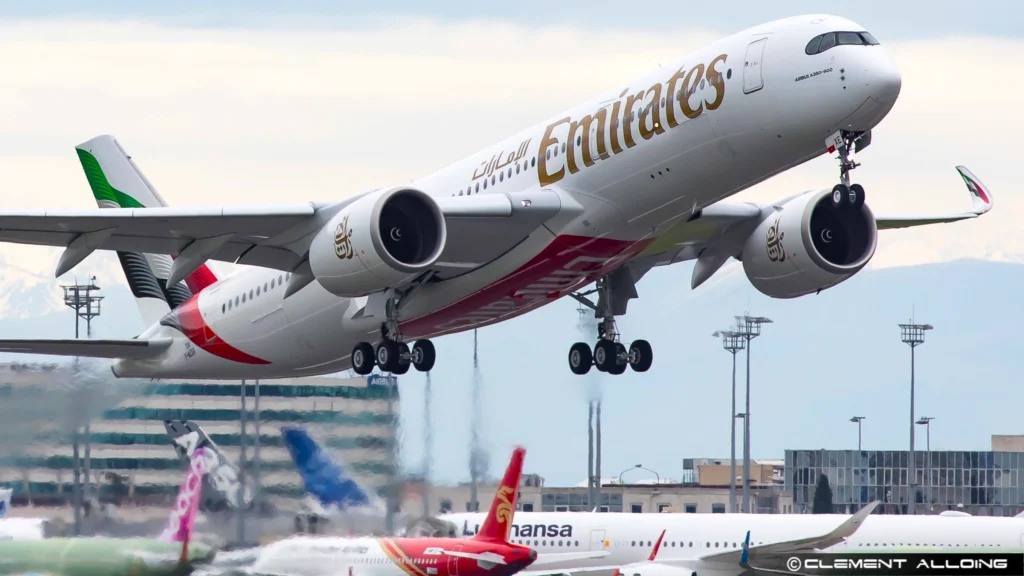
Emirates Eyes Berlin and Stuttgart Flights
Emirates has long aimed to expand its German network beyond the four airports currently permitted under the bilateral air transport agreement between Germany and the United Arab Emirates. The airline has repeatedly expressed interest in launching flights to Berlin and, more recently, to Stuttgart.
Under the existing arrangement, Emirates serves Frankfurt (FRA), Munich (MUC), Düsseldorf (DUS), and Hamburg (HAM) from its hub at Dubai International Airport (DXB). The agreement limits UAE carriers to four German destinations, preventing Emirates from adding new routes unless Germany revises the framework.
Earlier in January, media reports suggested Emirates might begin Berlin flights by December. However, sources told aeroTELEGRAPH that Germany’s Ministry of Transport had not changed its position, maintaining a stance that aligns with Lufthansa’s opposition to expanding Gulf carrier access.
Emirates later clarified that it had only submitted a slot application at Berlin Brandenburg Airport (BER) as part of routine planning processes.

Political Momentum from the Chancellor’s Office
The debate shifted in late February when Tagesspiegel reported that Germany’s Chancellor’s Office was exploring ways to grant Emirates additional landing rights in Berlin and Stuttgart. According to the report, the effort was taking place despite resistance from Lufthansa and the Ministry of Transport.
Berliner Zeitung further reported that during a February visit to the United Arab Emirates, a German delegation linked to Chancellor Friedrich Merz discussed the possibility of establishing daily flights from Dubai (DXB) to Berlin (BER) and Stuttgart (STR).
If such plans move forward, the Chancellor’s Office would issue the directive while the Ministry of Transport would oversee implementation.
ALSO READ: Top 10 Longest Nonstop Routes of Emirates Airlines in 2026
European Aviation Implications
Granting Emirates additional rights is not simply a domestic decision. Germany must consider the wider European aviation framework and potential reactions from neighboring countries.
Allowing Emirates to add Berlin could affect aviation interests in Poland, while new flights to Stuttgart might have implications for France due to competitive traffic flows and airline networks within Europe.
These geopolitical and economic considerations complicate the approval process.
Bilateral Negotiations and Reciprocity
Expanding Emirates’ access would typically involve reciprocal concessions from the United Arab Emirates. Germany would normally seek additional operational rights for its airlines in return.
However, it remains unclear what specific concessions the UAE could offer that would satisfy German regulators and industry stakeholders.
How Germany Could Change the Rules
Despite the political debate, granting Emirates new rights could be legally straightforward. The core bilateral air transport agreement between Germany and the UAE dates back to 1994 and entered into force in 1997.
The agreement itself addresses general aviation cooperation but does not list specific airports or airlines. Instead, route details are defined in an air route plan negotiated between aviation authorities and confirmed through diplomatic exchanges.
These operational details are contained in annexes known as the Agreed Minutes and Revised Route Schedule from 2000. The documents are not publicly available.
Because the airport limitation appears in these annexes rather than the main treaty, Germany could revise the four-airport restriction through negotiations with the UAE without requiring new approval from the Bundestag or Bundesrat.
This structure allows aviation agreements to remain stable over decades while still adapting to changing airline markets.
Long-Term Framework for Aviation Agreements
Germany’s aviation treaties often follow this flexible model. The agreement with the United Arab Emirates has been active since the late 1990s, while some other German aviation agreements are even older.
For example, Germany’s air transport agreement with Peru has been in force since 1964.
Such frameworks allow governments to update operational details without renegotiating the entire treaty.
Stay tuned with us. Further, follow us on social media for the latest updates.
Join us on Telegram Group for the Latest Aviation Updates. Subsequently, follow us on Google News


