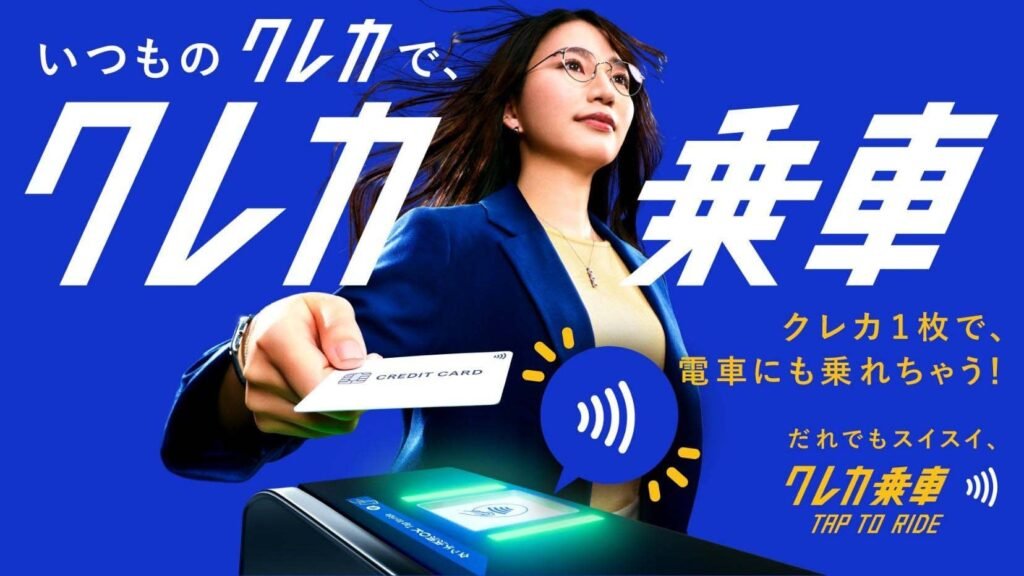
For decades, IC transit cards have been the preferred way for many passengers to pay for fares on trains and buses in Japan. That’s changing as more transit companies experiment with supporting a simple credit card tap for fare payments.
This month, millions of customers in Tokyo will be able to tap to pay at over 700 stations across the metropolis – the largest rollout of tap-to-pay services to date. Here’s how it’ll work and who – and who isn’t – supporting this new ticket to ride.
11 train and subway companies join “Tap to Ride”

The new system, called クレカ乗車 (kure-ka jōsha), is the brainchild of Mitsui Sumitomo Card. According to Toyo Keizai, the system will work with the trains and subways of 11 train and subway companies in Tokyo, including Odakyu, Odakyu Hakone, Keio, Keihin, Sagami, Seibu, Tokyu, Tokyo Metro, Toei, Tobu, and Yokohama Minatomirai.
The service is already available in the Yokohama Municipal Subway and Tokyo’s Yurikamome line. As of March 25th, it will encompass 729 stations in the greater Tokyo Metropolitan Area, eventually reaching 820 stations.
The system addresses a weakness of IC transit cards: they operate on a pay-as-you-go model. If you forgot to fill up your balance before passing through the gate, you’ll be denied entry. By contrast, a credit card tap is validated remotely against your credit balance at the time of purchase.
Mitsui Sumitomo also hopes the system will improve the tourist experience in Japan. Enabling credit card tap will reduce and perhaps even eliminate the need for travelers to purchase an IC transit card.
This is the largest tap-to-pay rollout to date for transit in Japan. It follows on the heels of years of experiments with credit card payments by Toei, Tokyo Metro, and other transit companies.
The death of IC transit cards? Not so fast…

Avid Tokyo fans and residents will notice that one rail company is conspicuously missing from this lineup.
JR East, which runs critical lines in Tokyo such as the Yamanote, is paving its own path forward. The company has recently announced multiple changes that would turn its beloved Suica transit card into a full-featured cashless payment app. The changes are meant to position its Suica IC transit card as an alternative to PayPay, currently Japan’s most popular cashless payment option.
As of November 2025, JR East is adamant that it has no plans to introduce tap-to-pay support on its lines. However, it aims to introduce a “gateless” system using Suica by 2028.
Still, the bold move by Mitsui Sumitomo raises the question: Could IC transit cards in Japan eventually go extinct?
See a side of Tokyo that other tourists can’t. Book a tour with Unseen Japan Tours – we’ll tailor your trip to your interests and guide you through experiences usually closed off to non-Japanese speakers.

On the one hand, some areas in Japan are abandoning support for the country’s national IC transit card system. The system enables the use of regional cards, such as JR East’s Suica, in areas where the issuing company doesn’t provide public transit service. Most transit companies in Kumamoto, for example, recently abandoned the network in favor of a credit card tap and QR code system due to cost concerns.
On the other hand, the cards exist for a reason: they’re fast. IC cards, which use Sony’s FeliCa chip, take only 0.1 to 0.2 seconds to process a transaction. This is because balances are maintained and validated via data stored directly on the card. Credit card swipes, by contrast, may take seconds to complete.
This isn’t an academic difference. Japan has the busiest train stations in the world. The busiest, Shinjuku Station, can see up to 3.5 million users per day. Forcing all of them to use credit card swipes during the busiest times of the day would grind the station to a halt.
In other words, you can expect, in the near future, to live in a world where both credit card tap-to-pay and IC transit cards exist side-by-side. Card tap will provide an easy option to travelers and to those who commute solely on lines that support the technology. Meanwhile, IC cards will likely continue to process the majority of Japan’s rides, ensuring the smooth flow of traffic through the world’s busiest public transit points.
For tourists, we still recommend that you just get an IC transit card. It’s easy enough to buy a Welcome Suica at a train station, for example, or to add a mobile Suica to your iPhone. And it’s (almost) guaranteed to work no matter how you travel.
Sources
チャージ不要の「クレカ乗車」が首都圏729駅で3月25日解禁! Suicaユーザーも知って損はない新方式の「できるorできない」. Toyo Keizai


