
An Egyptian archaeological mission has completed the restoration and reassembly of a major gate built by King Ramesses III at the Karnak temple complex, bringing renewed attention to one of Egypt’s most important ancient sites.
The project focused on the northern gateway of Ramesses III’s enclosure wall, located in the northwestern sector of Karnak. Work was carried out between 2022 and 2025 by the Franco-Egyptian Center for the Study of Karnak Temples (CFEETK), in cooperation with Egypt’s Supreme Council of Antiquities and the French National Centre for Scientific Research.
Archaeologists dismantled, conserved, and reassembled the structure using a detailed scientific approach. The lower part of the gate had first been identified in the 19th century, in poor condition and hidden under vegetation. Recent restoration has allowed researchers to recover its original form and better understand its role within the temple complex.
Layers of construction reveal a long history

The work also revealed earlier phases of construction. Researchers identified reused decorated stone blocks dating to the reign of Amenhotep III of the 18th Dynasty, likely taken from an earlier gateway at the same location. Sections of the northern enclosure wall of the Temple of Amun-Ra were also uncovered on both sides of the gate.
These remains point to multiple building phases, including work during the 18th Dynasty and the reign of Ramesses III, as well as later restoration during the Greek and Roman periods. Officials say the findings show how the site developed over time through continuous rebuilding and reuse.
Roman-era stela confirms later activity
During the project, archaeologists discovered a sandstone stela dating to the reign of the Roman Emperor Tiberius. The artifact was found within a layer linked to mudbrick structures from the late Roman and Byzantine periods, just northwest of the gate.
A sandstone stela from the reign of Emperor Tiberius has been uncovered at #Karnak, depicting Amun-Ra, Mut, and Khonsu with an inscription recording restoration work on the temple complex—evidence of continued activity during the #Roman period in ancient #Egypt.#KarnakTemple pic.twitter.com/mhuosrMnxq
— Tom Marvolo Riddle (@tom_riddle2025) March 23, 2026
The stela measures about 60 by 40 by 10 centimeters (23.6 by 15.7 by 3.9 inches). It depicts the emperor standing before the Karnak triad of Amun-Ra, Mut, and Khonsu. Below the scene, a five-line hieroglyphic inscription records restoration work carried out on the enclosure wall of the Temple of Amun-Ra.
Researchers say the inscription matches architectural evidence uncovered at the site, confirming repair activity during the Roman period.
Paved road reconnects temple layout
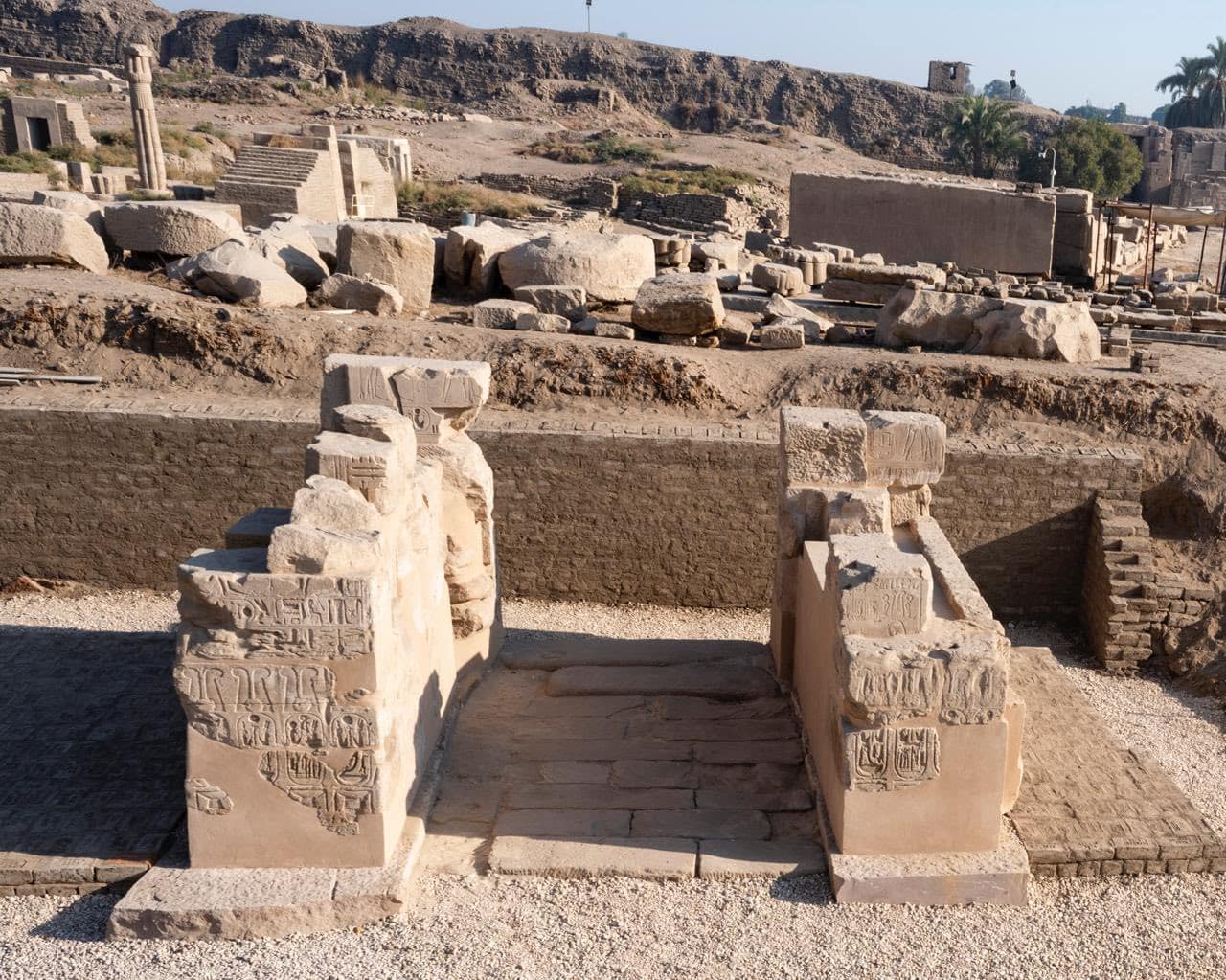
Further work in the summer of 2025 revealed a paved road linking the gateway of Ramesses III to the courtyard of the Third Pylon. The road had been recorded in the early 20th century, but had not been fully exposed until now.
Officials say the discovery helps clarify how different parts of the Karnak complex were connected and used.
Project supports tourism and research goals
Egypt’s Minister of Tourism and Antiquities, Sherif Fathy, said the project reflects strong cooperation between Egyptian and French teams. He described it as part of a broader plan to develop the Karnak Temples, including upgrades to the open-air museum and improvements to visitor services.
Officials said the restoration and discoveries provide new insight into the long history of Karnak. The site shows continuous construction, reuse, and repair across centuries, from the New Kingdom to the Roman period.


