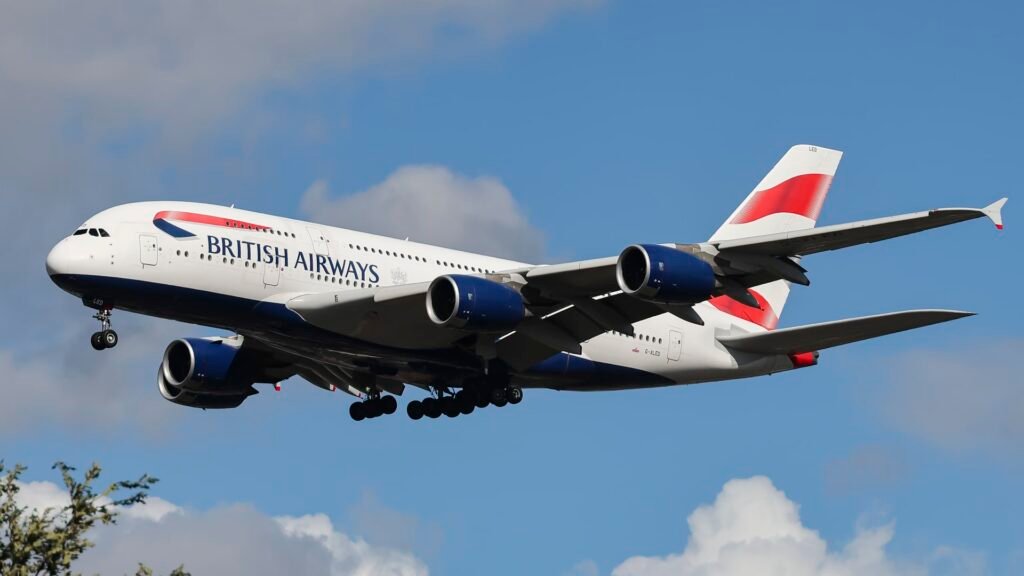
British Airways Airbus A380 Superjumbo passenger aircraft, spotted flying on final approach for landing on London Heathrow Airport runway in the United Kingdom.
Nicola Economou | Nurphoto | Getty Images
British Airways is offering a financial incentive to its pilots who reduce their planes’ fuel consumption, as the U.S.-Iran war continues to plague travel and drive up jet fuel prices.
The airline’s pilots would have to cut their aircraft’s carbon dioxide emissions by 60,000 tons more than their 2025 levels to receive a bonus worth 1% of their base pay, according to documents viewed by Bloomberg News and reported on Tuesday.
British Airways confirmed to CNBC that it’s working with the British Airline Pilots’ Association (BALPA) on this initiative and said it’s “fully committed to making improvements to colleagues’ experience at work,” in a statement.
Members of the BALPA will vote on the proposal at the end of April and it is expected to go into effect next year, a person familiar with the matter told Bloomberg.
“BALPA and British Airways are exploring potential changes to terms and conditions for pilots at British Airways, including ways in which pilots can continue to contribute to the company’s sustainability goals,” BALPA said in a statement to CNBC.
The trade union, which says it represents 85% of pilots in the U.K., added that “any proposed changes to terms and conditions will be put to members to vote upon.”
Jet fuel prices surge
The initiative comes as global airlines continue to struggle with soaring jet fuel prices amid the U.S. war with Iran. Iran’s blockage of the Strait of Hormuz, through which about 20% of global oil supply passes, has caused prices to surge to over $100 per barrel.
International benchmark Brent crude last added nearly 5% to trade at $107 per barrel, while U.S. West Texas Intermediate futures climbed 4.2% to $94 per barrel.
Meanwhile, jet fuel prices have also surged about 106% compared to a month ago, according to data from the week ending March 20, via the International Air Transport Association.
Airlines are looking at a range of measures from charging higher ticket fares to canceling less profitable flights.
China’s Cathay Pacific increased its fuel surcharge in response to the Middle East conflict, saying it’s an important mitigation tactic to offset rising fuel costs, which made up 30% of its total operating costs in 2025.
Meanwhile, United Airlines’ CEO Scott Kirby said that the oil price spike would have a “meaningful” impact on the carrier’s financial results in the first quarter, earlier this month. Kirby said in a staff memo last week that the airline is going to cut unprofitable flights over the next two quarters.
United expects oil prices to surge as high as $175 a barrel and remain above $100 until the end of 2027 — this would result in the company’s annual fuel bill rising to $11 billion.
Additionally, Australia’s Qantas and Scandinavian Airlines are raising ticket fares, while Air New Zealand lowered its financial outlook for as long as the war isn’t resolved.