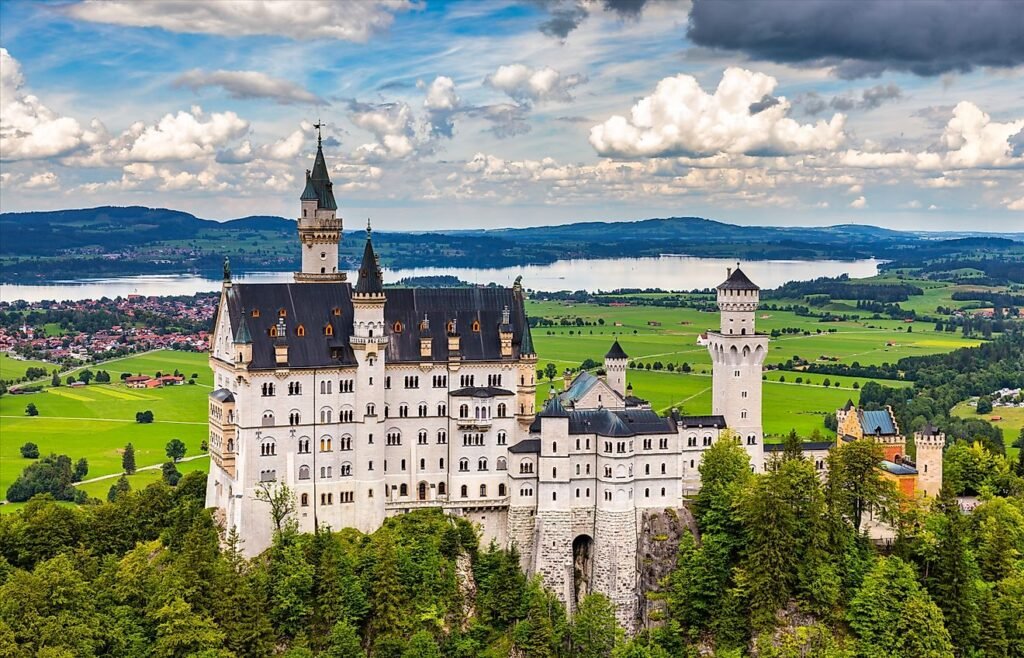
Germany’s small towns cover a surprising range of settings and stories. Moritzburg is home to a grand Baroque hunting palace set in the Saxon forest, while Fehmarn offers a very different scene with Baltic coastlines, birdwatching spots, and long hours of sunshine. That range continues in places like Quedlinburg, known for its Romanesque-era landmarks, and Cochem, where a hilltop castle stands not far from a secret Cold War-era nuclear bunker. Further south, Schwangau rises into the Bavarian Alps, home to the world-famous castle that later helped inspire a certain Magic Kingdom. From the Alpine peaks to the Baltic coast, here are 10 of the most breathtaking towns in Germany.
Schwangau, Bavaria

The village of Schwangau might seem like a small Bavarian village near the Austrian border, yet this town is home to what may be the world’s most famous landmarks. If anyone has wondered what inspired the iconic Sleeping Beauty Castle at the original Disneyland in the United States, one need not look any further than Neuschwanstein Castle, the UNESCO-recognised hillside castle that King Ludwig II of Bavaria ordered built between 1868 and 1892, but never fully completed. Then, for another dose of regal splendour, the nearby Hohenschwangau Castle lets visitors tour this royal compound, first mentioned in records in the 12th century and extensively rebuilt by Ludwig’s father, King Maximilian II, after he acquired it in 1832.

While Schwangau certainly impresses with its grand historic castles, it’s also a town that makes it easy to calm down and relax, especially at the Königliche Kristall-Therme spa complex with an expansive array of saunas, natural hot spring-fed thermal pools, and healing spa treatments. And near the castles, the AMERON Neuschwanstein Alpsee Resort & Spa offers a deluxe spa for guests, along with 136 individually designed rooms and junior suites, and an appetizing assortment of bars and restaurants.
Fehmarn, Schleswig-Holstein

Located between the mainland coast of Schleswig-Holstein and the Danish island of Lolland, around 146 kilometres (or 91 miles) north-east of Hamburg, is Germany’s “sunshine isle” of Fehmarn. Since this island has some 78 kilometres of coastline and 2,200 hours of annual sunshine, it is an ideal place to spend time by the water. In particular, Südstrand features a calm and family-friendly stretch of Baltic Sea coast on the south side of the island, while Grüner Brink is a gorgeous nature preserve on the north side of the island that’s great for birdwatching (especially when it comes to the native red-necked grebe). And on the west end of Fehmarn, the Wallnau Waterbird Reserve may be even more of a birdwatching hotspot, as cormorants, lapwings, swans, and multiple species of ducks and geese are often spotted at this beach and wetlands preserve.
After a long day wandering the Fehmarn coast, Burg-Klause offers comfortable accommodation with cozy guest rooms and an on-site restaurant.
Binz, Mecklenburg-Vorpommern

Situated on the island of Rügen in the German state of Mecklenburg-Vorpommern (also known by its anglicised name of Mecklenburg-Western Pomerania) is the classic coastal resort town of Binz. Here, there’s no shortage of spectacular Baltic Sea beaches, including the more low-key and nudist beach sections, and the more family-friendly Binzer Bucht with perfectly calm water for bathing and swimming. And just to the east of town, the UNESCO-recognised Biosphärenreservat Südost-Rügen protects a wide variety of unique coastal ecosystems, from leafy beech forests to open meadows and dry grasslands, and contains the remains of ancient historic sites, such as Neolithic tombs and Bronze Age burial mounds.
Whatever visitors decide to do in and around Binz, Strandhotel Binz offers a beachfront stay with spacious, contemporary guest rooms, an on-site restaurant, and a full-service spa with a Finnish-style sauna.
Moritzburg, Saxony

Just north of Dresden, and about 171 kilometres (or 106 miles) north of Prague in the Czech Republic, the village of Moritzburg has a uniquely regal feel. After all, it’s the home of Schloss Moritzburg, which was first built as a hunting lodge in 1542, then expanded by Augustus II the Strong in 1723 into a grand Baroque palace with one of Europe’s largest collections of hunting trophies. Just beyond the palace compound, there’s even more to experience in the area, including the Wildgehege Moritzburg park that provides critical habitat for native animals like deer, wolves, and lynxes. And at Naturschutzgebiet Oberer Altenteich, visitors will find another leafy forest area perfect for hiking and biking.
Once one’s ready to wrap up for the day, Eisenberger Hof provides a convenient location near the castle, as well as a great Saxon-style restaurant and a boutique hotel with beautifully designed rooms and suites.
Quedlinburg, Saxony-Anhalt

Perched on the north edge of the Harz Mountains, about 220 kilometres (or 137 miles) south-west of Berlin, is the quaint millennium-old town of Quedlinburg. The town is listed as an official UNESCO World Heritage Site for its extensive collection of Romanesque-era sites, with key highlights including the Church of St. Wiperti, with its 1,000-year-old crypt, and the Collegiate Church of St. Servatius, which King Henry I established as a palatine chapel in the 10th century. In addition, folks can check out the Münzenbergmuseum and tour the site of this former Benedictine monastery that still contains remnants of an Ottonian-era basilica.
For those looking to round out a stay in Quedlinburg, the Romantik Hotel am Brühl is a fitting option. This elegant hotel proudly provides warm, personalised service, alongside stately guest rooms and suites and two delectable restaurants.
Cochem, Rhineland-Palatinate

Just 169 kilometres (or 105 miles) west of the bustling 21st-century metropolis of Frankfurt, travellers will find the splendid, fairy tale-like historic village of Cochem. While here, it’s hard to miss the imposing Reichsburg Cochem, originally built in the 12th century and renovated and expanded in the 19th century into a truly majestic, romantic-style castle with its signature turrets. Yet while in town, it’s also worth visiting the ruins of the Burgruine Winneburg and wandering around the stone walls that once provided critical protection in the 13th century. And speaking of protection, another fascinating find is the Bundesbank Bunker Cochem, a Cold War-era vault that once housed around 15 million German Marks in emergency currency, along with a secret bunker specifically designed to survive a nuclear war.
Though visitors may not be able to stay in one of the local historic castles, the Flair Hotel Am Rosenhügel is a comfortable alternative. Located right by a verdant stretch of winery vineyards, this family-run hotel offers comfortable, spacious guest rooms, a Finnish-style sauna, a grassy lawn, a fully equipped fitness centre, and a generous breakfast buffet every morning.
Bad Münstereifel, North Rhine-Westphalia

Near the south-western corner of North Rhine-Westphalia is Bad Münstereifel, a soothing and healing resort town set in the lush expanse of the Münstereifel Forest. Just to the west, visitors can head out to Eifel National Park, a gorgeous nature preserve near the Belgian border full of cobalt-blue lakes, delightfully babbling brooks, thick forests rising up the mountains, and stunning wildflower fields that bloom vibrantly in spring and summer. Heading into town, the City Outlet is an interesting collection of stores that have emerged from the historic town centre, full of half-timbered structures dating back to medieval times. And in the heart of town, the Schwanen-Apotheken-Museum lets folks walk back into the realm of medicine and health care as it existed in the 19th and 20th centuries.
Mere blocks away from Bad Münstereifel’s historic town centre, Boutique Hotel Landhauszeit makes for a truly sweet escape with specially designed guest rooms, a full morning breakfast featuring locally sourced foods, and the highest calibre of personal service.
Ottenhöfen im Schwarzwald, Baden-Württemberg

Set in the famed Black Forest of south-western Germany, around 45 kilometres (or 28 miles) east of Strasbourg (France), is the verdant village of Ottenhöfen. Perhaps the top highlight here is Nationalpark Schwarzwald, or Black Forest National Park, a 10,062-hectare nature preserve with a wide network of hiking trails, long stretches of spruce-fir-beech forest, and key habitat space for wildlife like red deer, tree-cavity bats, woodpeckers, and boreal owls. Also nearby is Karlsruher Grat, the only via ferrata, a protected climbing route, in the northern Black Forest. And right by the Lauenbach stream, visitors will discover the historic Bühler Mühle, built in 1897 and still a fully functioning mill, with water pressure keeping the mill wheel turning.
For those wanting more quality time to explore the local Black Forest wilderness, the Hotel-Pension Breig in town makes a great place to stay, thanks to its ideal location near the local hills and meadows and the cosy atmosphere of this family-run establishment.
Radolfzell am Bodensee, Baden-Württemberg

On the western shores of Lake Constance, around 92 kilometres (or 57 miles) north-east of Zürich, Radolfzell am Bodensee stands out for its calm lakeside setting. On the Mettnau Peninsula, the Mettnau Nature Reserve is ideal for birdwatching and easy strolls along the lakeshore. Then, a short distance east, the Naturschutzgebiet Mindelsee protects a body of water that first formed during the Ice Age, along with wetlands that serve as key habitat for animals like bats, tree frogs, dragonflies, and beavers. And to the west, the Aach River Confluence is a gorgeous estuary environment full of fruit tree meadows, pretty ponds, and habitat for rare animal species like lampreys and green sandpipers.
In case all these beautiful parks and open spaces don’t provide enough refreshment, visitors can rest assured that Bora HotSpaResort occupies their “own little world full of warmth, water, and life.” Folks can come to enjoy the sauna and spa treatments, stay in their sleek and stylish spa-style rooms and suites, and feast on the culinary delights of their on-site Restaurant Rubin that’s only available to hotel guests.
Oberstdorf, Bavaria

All the way at the southern tip of Germany, around 171 kilometres (or 106 miles) south-west of Munich (or München in German), Oberstdorf might be the nation’s most adventurous mountain town. Thanks to its location in the Allgäu Alps, the Oberstdorf-Kleinwalsertal ski region offers over 130 kilometres of pistes on both sides of the Germany-Austria border that are regularly open for skiing from December to May, and the complex opens in summer for hiking, via ferrata climbing, and paragliding. Meanwhile, in town, folks can check out the Fugger Aktiv Park Oberstdorf and try a diverse range of activities, including a Kneipp area with a wading pool, an intricate set of parcours to help strengthen motor skills, and a special scent and rock garden. And just beyond town, the Allgäu High Alps Nature Reserve spans 20,724 hectares of unspoiled mountain wilderness, often considered one of the most valuable parks in the Alps for its rich biodiversity.
Whatever travellers decide to do in and around Oberstdorf, Hotel Franks not only provides a welcoming retreat, but also a luxurious oasis complete with a full-service spa, comfy chalet-style rooms and suites, and even a full calendar of activities tailored to the seasons and available to guests during their stay.
Catch Your Breath, and Be Taken Away by the Grand Beauty of Germany
Across Germany, travellers will find all kinds of precious treasures and wondrous attractions that are hard to replicate anywhere else. Even though Disney looked to Neuschwanstein Castle for inspiration as they were designing Disneyland’s Sleeping Beauty Castle, there’s nothing quite like the original in Schwangau. Then, at the opposite end of the country, Binz is a delightful Baltic Sea beach town perfected by nature. There’s also Quedlinburg, with its wealth of Romanesque-era landmarks, Cochem, with its fairy-tale-like castle and the shocking secret of a Cold War nuclear bunker, and Ottenhöfen, with its beautiful wilderness trails in the Black Forest National Park. Germany offers no shortage of memorable scenery, from lakeshores and castles to forest trails and Alpine peaks.


