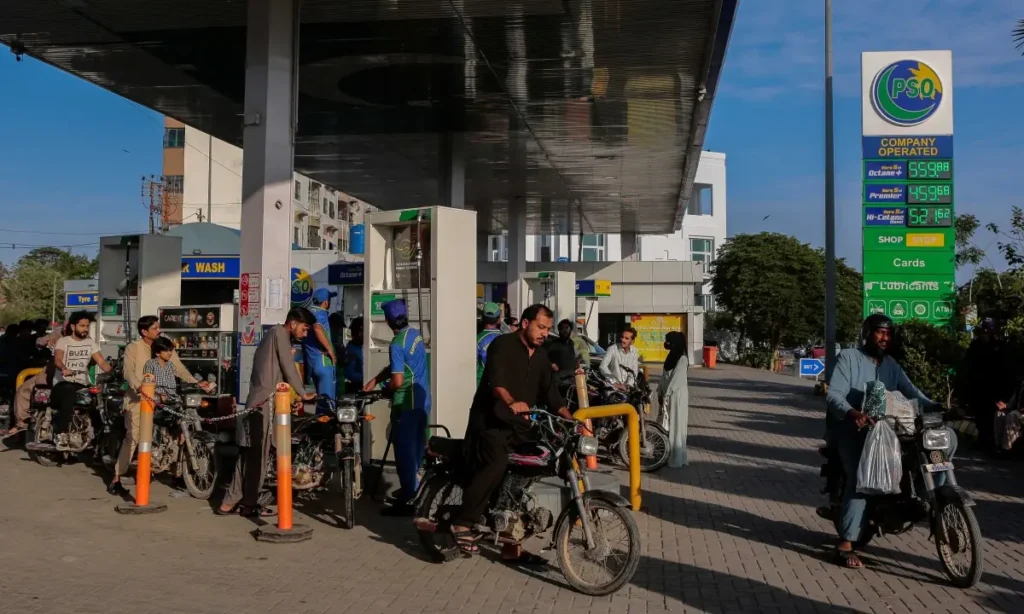
ISLAMABAD: Coordinated by the Centre, the provincial governments will now be taking the lead in administering subsidised fuel quotas to motorcyclists, farmers and transporters, involving a fiscal impact of around Rs65-70 billion per month.
On Thursday night, while announcing an unprecedented hike in the prices of petroleum products, the federal government had also announced targeted relief measures for motorcyclists, small farmers and transporters.
To ensure national uniformity, the provincial chief ministers and their teams were in elaborate discussions on the nitty-gritty with the Centre over the past week. Based on that, Finance Minister Muhammad Aurangzeb announced Rs70,000, Rs80,000 and Rs100,000 per month to food transport vehicles, large trucks and public service buses, respectively. In addition, support of Rs1,500 per acre was also announced for small farmers, given the central priority to minimise food inflation.
The announcements were based on elaborate datasets from the provincial governments and their district administrations, who will arrange their distribution and administration from their own resources, as the Centre’s fiscal space has been exhausted to the International Monetary Fund’s (IMF) limit of tolerance — about Rs154 billion so far.
Altogether, the provinces are pooling around Rs200bn for three months on the pattern of their National Finance Commission (NFC) shares – Rs100bn or so from Punjab, Rs51-52bn from Sindh, Rs15bn from Khyber Pakhtunkhwa and about Rs8-9bn from Balochistan.
The two larger provinces – Punjab and Sindh – have, in fact, insisted on passing on international prices to general retail prices so that they can provide targeted relief to priority areas and the vulnerable.
Punjab
Background discussions with government officials indicate that Punjab will be spending about Rs35bn a month to provide a subsidy of Rs100 per litre to 22 million bikers, including 11 million 70cc bikers, and more than 765,000 goods transporting vehicles, besides intercity public service transport.
Most of them are registered with excise departments and are, as a result, accessible to district authorities. Of this, around Rs10bn is estimated for bikers, Rs7bn for inter-city goods and public transport and Rs18bn for farmers.
Punjab has reported that more than one million farmers have Kissan Cards, and total wheat sowing has been reported over 16 million acres. It has been reported that it has digital access to goods transporters and farmers through Kissan cards, digital accounts or cash vouchers.
Sindh
Pakistan’s second-largest province in terms of population has reported that 6-7 million bikers will be provided with support, through mobile apps and other digital means, involving about Rs12bn a month at the rate of about Rs2,000, i.e. Rs100 per 20 litres per person.
The province reportedly has more than 400,000 farmers, who can be reached through Hari Cards; support of Rs1,500 per head will be provided to small farmers with land holdings of under 25 acres.
Sindh, which will be coughing up about Rs15-18bn per month burden, had proposed using Benazir Income Support Programme (BISP) cards as well for doling out subsidies to farmers and transporters in addition to Hari Cards. However, Punjab did not agree, saying it had made its own detailed arrangements through elaborate datasets in all fields and was ready to roll them out.
Khyber Pakhtunkhwa
The PTI-governed province is already in its implementation phase. It had announced a Rs2,000 per month subsidy to bikers ahead of the programme. It has more than 1.6 million bikers with a Rs5bn monthly fiscal impact on top of another Rs6-7bn it needs for other sectors.
Balochistan
Balochistan’s preparedness is not only lacking in its current state but is also challenging in the days ahead. It reported that its data availability for registered vehicles is limited only to 6-7 districts.
It is evident that unregistered bikers and transporters, whether in Balochistan or elsewhere, will not be able to benefit from the subsidy schemes, although Balochistan has promised that it could utilise BISP data and could only subsidise agriculture.
Mobile app
On the other hand, the Centre is expecting the rollout of a mobile app for providing the subsidised fuel quota to bikers by next week, funded by the provinces. Instead of earlier suggestions for the inclusion of three-wheelers and small cars, the subsidy scheme has been restricted to two-wheelers.
The technical and hardware details of the quota-based system have been tested and finalised by the Oil and Gas Regulatory Authority (Ogra) and the ministries of finance, petroleum and information technology.
The Ministry of Information Technology, in coordination with relevant agencies, had already ordered the procurement of 24,000 mobile sets to be provided two each at all the 12,000 registered petrol stations across the country.
Neither the federal nor provincial government is sharing the cost of mobile sets; oil marketing companies (OMCs) will be providing these cellular sets to their retailers with a reporting mechanism tied to Ogra.
The specialised phones are estimated to cost about Rs36,00 per unit – meaning Rs72,000 per station. Petrol stations and OMCs are required to deposit funds into a designated government account to ensure immediate delivery of devices.
Biker/customer-based quotas of 20 litres will be linked to the user’s app via a registration number and their computerised national identity card (CNIC). The users will generate a digital voucher through the app, while the retailers will scan or enter the voucher in their app, leading the system to auto-validate the available quota. Retailers and petrol stations will be required to dedicate specific dispensers or nozzles for 2-wheelers to facilitate subsidised fuel distribution.
All OMCs will be required to appoint focal persons for each retail site for seamless operations of the scheme and provide their contact details to the Ogra for round-the-clock monitoring of the scheme at the outlet stage across the country for avoidance and redressal of consumer complaints. The details of focal persons, including name, mobile phone numbers and CNIC, will also be available to Ogra.
For implementation and oversight, the details of retailers’ focal persons and contact numbers would also be provided to OMCs and the petroleum division as well. The IT ministry will provide demos and video tutorials on operating the system. In case of emergencies, a dispensation system would be made available for approvals through a designated process.


