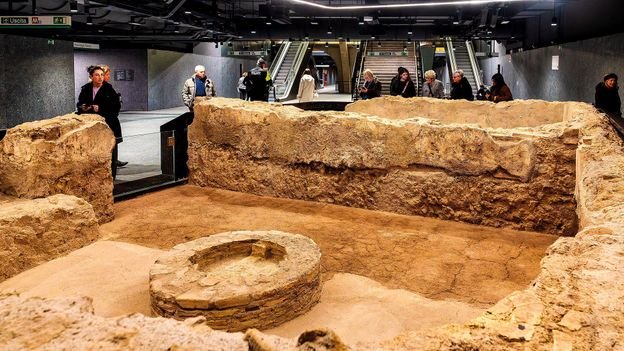
Construction on Rome’s Metro C has uncovered spectacular Roman ruins, and its new “archaeo-stations” are giving visitors a whole new way to experience the city’s ancient past.
On a recent Friday afternoon, I made my way through the usual tourist queues swarming the Colosseum, and entered the recently inaugurated Colosseo-Fori Imperiali Metro C station. As I took the escalator underground, the crowds vanished. Metal gridwork and four cascades of criss-crossing escalators created an Escher-like atmosphere. Even so, I was still coming face to face with the city’s storied past.
In one corner, a collection of ancient pottery first excavated a few metres away was displayed behind glass. Further ahead stood the crumbling remains of a Roman bath. But this wasn’t a gallery or museum tour I’d had to book in advance; Rome’s newest metro stop is also Ancient Rome’s newest attraction, and my entry cost just €1.50 (£1.30; $1.75).
A unique problem
When most cities build metro systems, they simply blast through rock. But in Rome, a city famously built on the remains of its past, engineers must tunnel through nearly 3,000 years of history. Each time workers break ground, they risk encountering ancient ruins, requiring painstaking excavations. Civic progress is slow, often rerouted or indefinitely suspended.
This unique problem meant that until 2014, just two main metro lines (Metro A and Metro B) served a metropolis spanning 1285 sq km (496 sq miles). But construction on Metro C has been ongoing for nearly 20 years, and the closer it’s inched from the suburb of Monte Compatri-Pantano to Rome’s historical centre, the more of Ancient Rome it’s unearthed.


