The voluntary unpaid leave program, T’way’s first since August 2024, was offered to cabin crew this week. The carrier described the measure as a way to “offer greater flexibility in working conditions” and ease crew fatigue following recent flight schedule cuts, a T’way official told The Korea Times.
T’way is under acute liquidity pressure. The carrier posted an operating loss of 12.3 billion won (US$8.3 million) in 2024 that widened sharply to 265.4 billion won ($178.6 million) in 2025, according to disclosures the company made on Feb. 26. Revenue rose 17% to 1.79 trillion won over the same period, but the cost base grew faster.
The loss surge predates the current Iran war and traces instead to T’way’s aggressive push into long-haul routes, an expansion that flowed directly from the Korean Air-Asiana Airlines merger. The European Commission required Korean Air to surrender slots and traffic rights as a condition for approving its Asiana takeover, and T’way picked up the routes, launching services to Rome, Paris, Barcelona and Frankfurt in 2024 and Vancouver in July 2025, according to Aviation Week.
 |
|
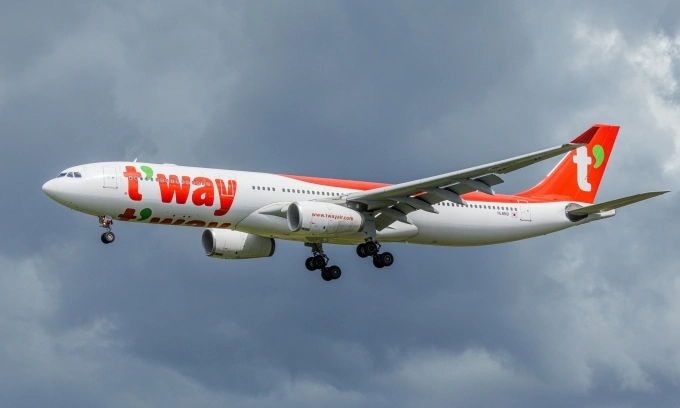
A T’way Air aircraft. Photo by Unsplash |
Korean Air leased the carrier five Airbus A330 wide-bodies and later supplied wet-leased Boeing 777s with Korean Air pilots and engineers to keep the new long-haul operation flying.
The European routes have been troubled. T’way’s A330 fleet has experienced repeated defects, delays and cancellations on its new long-haul services, raising questions about the low-cost carrier’s operational readiness for intercontinental flying, Topdaily Korea reported. The airline doubled its annual safety investment to roughly 570 billion won in 2024 and planned to lift that to 600 billion won in 2025, an unusually steep ramp for a carrier T’way’s size.
The Iran war then arrived at the worst possible moment. Jet fuel prices in Asia and Oceania climbed to $204.95 per barrel by late March, more than double the $95.95 recorded just before the U.S. and Israel launched joint strikes on Iran on Feb. 28, according to International Air Transport Association data cited by Seoul Economic Daily. Fuel typically accounts for around 30% of an airline’s operating costs.
T’way became the first Korean carrier to enter emergency management mode on March 16. Asiana Airlines followed on March 25, and Korean Air, the country’s largest airline, announced its own transition on March 31, with implementation starting in April. Beyond the cabin crew leave, T’way has scaled back service across its network, cutting daily Bangkok-Incheon flights to twice weekly from May 10 to July 14, suspending Bangkok-Daegu service through July 15, and raising the passenger fuel surcharge on Thai routes from 1,900 baht to 2,850 baht, according to the Bangkok Post.
The carrier is also reducing Busan-Kaohsiung and Busan-Tokyo Narita services in May, AeroRoutes reported.
The pressure is rippling across South Korea’s low-cost sector. Eastar Jet will suspend roughly 50 flights on its Incheon-Phu Quoc route from May 5 to 31, citing both fuel costs and limited jet fuel supplies at Vietnamese airports. Air Busan is dropping 20 flights this month on routes from Busan to Da Nang, Cebu and Guam, while Jin Air is suspending 45 round-trip flights across eight routes including Incheon-Nha Trang from April 4 to 30, Seoul Economic Daily reported.
Air Premia is cutting roughly 42 U.S.-bound flights between Incheon and Los Angeles, Honolulu, San Francisco and New York in April and May. Aero K is partially halting four routes, including Cheongju-Ibaraki, Cheongju-Narita, Incheon-Osaka and Incheon-Ibaraki, through June.
A two-week ceasefire announced in early April has yet to bring fuel prices down meaningfully. International Air Transport Association director general Willie Walsh told reporters in Singapore last week that even if the Strait of Hormuz reopens, it will take months for refining capacity and supply chains to recover, Reuters reported.
T’way is scheduled to be rebranded as Trinity Airways in the second half of 2026 following its acquisition by the Daemyung Sono Group.


