The trains themselves will be built by Germany’s Siemens Mobility, supplier of high-speed rail to more than a dozen countries and territories on three continents.
The trains, Siemens Mobility’s latest-generation Velaro Novo, will be supplied to Vietnamese conglomerate Vingroup’s railway subsidiary VinSpeed under a framework agreement signed in December 2025.
VinSpeed broke ground on the 120 km Hanoi-Quang Ninh line on April 12. The US$5.58 billion project is targeted for completion in 2028, cutting travel time between Hanoi and Ha Long Bay from 2-2.5 hours to less than half an hour.
 |
|
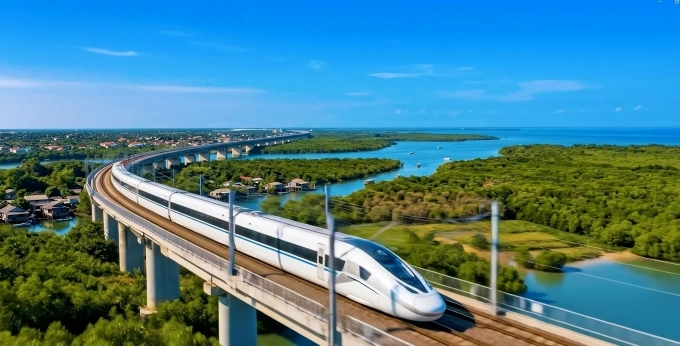
An artist’s impression of the high-speed train to run between Hanoi and Quang Ninh Province. Photo courtesy of VinSpeed |
Two engineering approaches dominate high-speed rail worldwide. The older concentrated-power design, used by France’s TGV, South Korea’s KTX and the original German ICE, places traction equipment in power cars at each end of the train, essentially a modern take on the locomotive-and-carriages arrangement.
The newer distributed-power design, pioneered by Japan’s Shinkansen when it launched in 1964, spreads motors and electrical equipment across multiple cars throughout the train. Nearly every car is a powered car.
The engineering tradeoffs are significant. Distributed-power trains are lighter because they don’t carry the weight of dedicated locomotives. They accelerate faster because more axles are driving the train forward. They handle gradients better, which matters for Vietnam’s terrain: the Hanoi-Quang Ninh corridor runs from the flat Red River Delta through hilly country toward the limestone karsts around Ha Long Bay. They can also fit through narrower tunnel profiles, reducing civil engineering costs. And because the powered axles are spread out, each one transfers less force to the track, reducing wear.
The downside is complexity. Distributing traction motors across the train means more components to maintain, more electrical systems to coordinate, and tighter engineering tolerances across the whole trainset. For decades, this was the reason most European and American high-speed rail programs stuck with concentrated power: it was simpler and cheaper to build.
Over the past 15 years, the industry has shifted decisively toward the Japanese approach. Siemens developed its Velaro family on distributed-power principles, and the platform has now produced more than 500 trainsets for 10 countries and territories including Spain, China, Russia, Turkey, Germany, the U.K., Belgium and Egypt.
 |
|
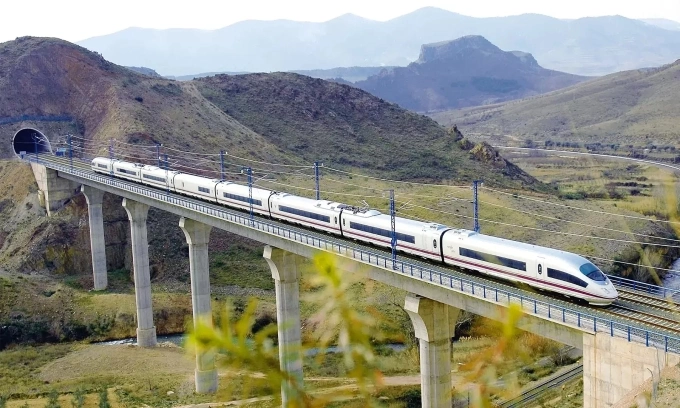
A Siemens Velaro high-speed train on the Madrid–Barcelona line in Spain. Photo courtesy of Siemens |
China’s CRH family, much of which is built under license from Siemens and Kawasaki, is also distributed-power.
Italy’s AGV, the successor to the TGV, abandoned the concentrated-power design that made its predecessor famous. Even Germany’s newest ICE 3 generations use distributed power, making the old concentrated-power ICE a legacy design in its home country.
The Velaro Novo, the specific variant headed to Vietnam, is Siemens Mobility’s latest iteration of the platform. It is designed for a top speed of 350 kph and uses a wider carbody with an optimized empty-tube interior layout that Siemens says delivers at least 10% more passenger capacity than previous generations. Energy consumption is about 30% lower than earlier Velaro models, a gain Siemens attributes to aerodynamic refinements, lighter materials and more efficient traction systems.
The same train will also enter service in the U.S. in 2028 on Brightline West, the private high-speed line being built between Las Vegas and Southern California. Siemens is producing a U.S. variant called the American Pioneer 220 for that project.
Vietnam and the U.S. will effectively receive the same generation of train at roughly the same time, one of the first times a major Siemens high-speed platform has launched in Asia and North America in parallel.
Signalling on the Vietnamese line will use ETCS Level 2, the European standard, combined with automatic train operation (ATO). The combination allows closer train spacing, tighter energy management and higher service frequency than older signalling systems.
Siemens Mobility’s global CEO Michael Peter, speaking at the groundbreaking ceremony, said the Velaro fleet worldwide now runs a combined one million km per day, three times the distance to the moon, with what he described as an unbeaten safety record.
Beyond the trains and signalling, Siemens Mobility is supplying the Hanoi-Quang Ninh project as a turnkey package that also covers telecommunications and electrification systems. The company has committed to exploring joint maintenance arrangements and technology transfer to VinSpeed, with the stated aim of maximum localization as Vietnam builds out its broader high-speed rail ambitions.
A second VinSpeed-Siemens project, the 54 km Ben Thanh-Can Gio metro line in Ho Chi Minh City, broke ground in December 2025 and is also targeting a 2028 finish.


