A large void sealed inside the Great Pyramid of Giza for roughly 4,500 years has been confirmed by three independent teams of physicists using three separate detection technologies, according to a study published in Nature. The space sits directly above the pyramid’s Grand Gallery and measures at least 30 metres in length, comparable to the Grand Gallery itself; one of the monument’s most architecturally complex features.
The finding marked the first major inner structure identified inside the Great Pyramid since the 19th century. Follow-up scans revised that minimum length upward to 40 metres, reinforcing that the void is a single continuous section rather than a cluster of smaller gaps.
How Physicists Scanned a Monument Built 4,500 Years Ago
The ScanPyramids mission, led by Cairo University and the French Heritage Innovation Preservation (HIP) Institute, used a technique called muon radiography to image the pyramid’s interior without drilling or cutting into the stone. Muons are subatomic particles produced when cosmic rays collide with atoms in Earth’s upper atmosphere. Because they pass through dense material at a predictable rate, detectors placed inside and outside the pyramid can identify voids by measuring where more particles pass through than solid stone would allow.
Researchers from Nagoya University installed nuclear emulsion film detectors inside the Queen’s Chamber. A team from Japan’s High Energy Accelerator Research Organization (KEK) positioned scintillator hodoscopes in the same location. Physicists from France’s Commissariat à l’Énergie Atomique et aux Énergies Alternatives (CEA) set up gas detector telescopes on the pyramid’s exterior north face.
All three teams, working independently with different instruments, detected the same void in the same location. “Such a big void can’t be an accident,” said Mehdi Tayoubi, president of the HIP Institute and co-leader of the research.
A Space the Size of a Cathedral Corridor, With No Known Purpose
The Big Void is estimated at roughly eight metres high, two metres wide, and at least 40 metres long, positioned about 20 metres above the pyramid’s ground level. Its cross-section closely mirrors that of the Grand Gallery below it, which stretches 47 metres and stands 8.6 metres tall.
Kate Spence, an archaeologist at the University of Cambridge, told National Geographic that the void’s alignment with the pyramid’s upper pressure-relief chambers makes an internal construction ramp the most plausible explanation. The roof of the King’s Chamber is reinforced by massive granite beams, and a ramp in this position would have been structurally useful for lifting those blocks into place.

After construction, such a ramp could have been left open or loosely filled with rubble. Salima Ikram, an Egyptologist at the American University in Cairo, suggested the void’s location directly above the Grand Gallery may also connect it to how that lower corridor was originally built.
Some researchers have raised the possibility that the space could be a concealed burial chamber for the pharaoh Khufu, whose mummy has never been found. His sarcophagus in the King’s Chamber was discovered empty, and the question of where he was interred has never been resolved. Neither theory has been confirmed, and no physical access to the Big Void has been made.
A Second Structure and a Sealed Door
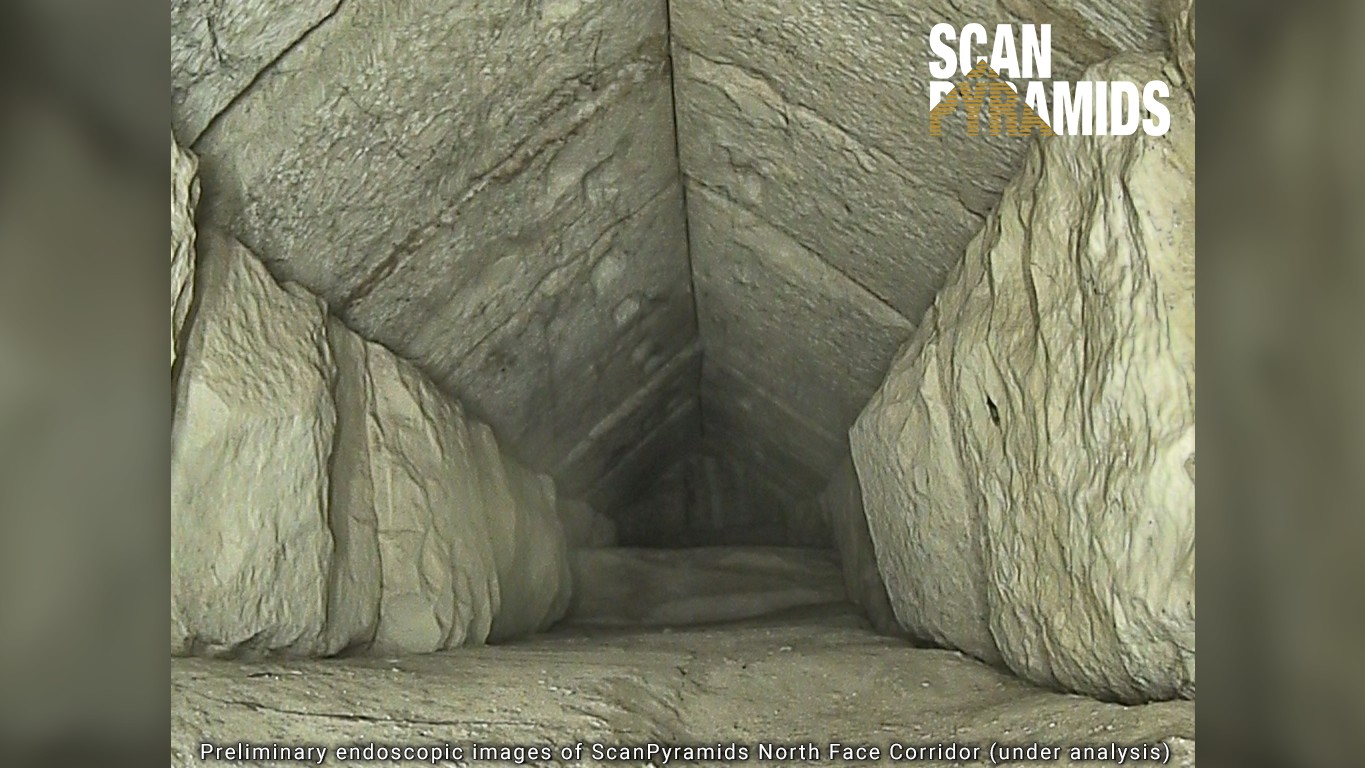
The Big Void was not the only structure the ScanPyramids project identified. A separate, smaller corridor was detected behind the chevron stonework on the pyramid’s north face, between 17 and 23 metres above ground level. In February 2023, researchers inserted an endoscope into this passage and captured the first direct images from inside. Initial photographs showed no artifacts, though the team noted the full interior could not yet be resolved.
![Using dedicated laser surveys and photogrammetry data, researchers were able to create a 3D modelization of the Great Pyramid. This is an East-West cut view of the Great Pyramid and also the front view of the North face Chevron Area. Labels are as follows: a) Subterranean chamber, b) queen’s chamber, c) grand gallery, d) king’s chamber, e) descending corridor, f) ascending corridor, g) al-Ma’mun corri[1]dor, h) north face Chevron area, i) ScanPyramids Big Void with horizontal hypothesis (red hatching) and inclined hypothesis (green hatching).](https://cdn.mos.cms.futurecdn.net/RQ8dmZ8yQvhqedfK39uBv7.jpg)
More recently, Egyptologist Zahi Hawass announced that a corridor roughly 30 metres long has been located deeper within the structure, reached by remote-operated robots equipped with cameras. The robots arrived at a sealed stone door at the end of the passage. Hawass has indicated that what lies behind it is expected to be disclosed in 2026.
More Powerful Technology Is Now Targeting the Pyramid
A research team announced in 2022 plans to deploy muon detection equipment with roughly 100 times the sensitivity of instruments previously used at the site, aiming to produce the first complete tomographic image of the structure scanned from multiple angles simultaneously. A separate study that year, applying Synthetic Aperture Radar Doppler Tomography, suggested the pyramid’s internal network of passages may be more complex than current maps reflect.
The Great Pyramid, built on the orders of Pharaoh Khufu between approximately 2509 and 2483 BC and composed of an estimated 2.3 million limestone blocks, is the only surviving wonder of the ancient world. Despite centuries of study, its internal layout continues to be revised by modern imaging technology and particle physics.
A sealed stone door at the end of a newly discovered interior corridor, reached by robotic probe, is expected to be opened and reported publicly in 2026.


