VidantaWorld’s Elegant looks like a luxury disruptor at first glance, but the pricing and inclusions tell a very different story.

A Mexican Resort Brand Quietly Goes To Sea
VidantaWorld has officially entered the cruise market with Elegant, a 216-guest ship positioned as a luxury mega yacht, adults-only experience sailing the Mediterranean. On paper, it checks many of the right boxes, including a small guest count, a high crew ratio, and itineraries that hit marquee ports like Barcelona, Nice, Naples, and the Greek Islands.
That is the pitch, and it is… interesting… at a glance. A boutique cruise ship with controlled capacity and a hospitality-first mindset should, in theory, be exactly what the luxury cruise segment has been trying to achieve for years. The idea of a resort company bringing its service philosophy to sea is not just interesting, it is logical and the market examples as of late are aplenty.
But once you look beyond the headline positioning and into what is actually included, the product begins to feel misaligned with the market it is trying to enter.
The Inclusions Don’t Match The Price
Luxury cruise lines have standardized what “included” means, and that is where VidantaWorld immediately runs into trouble. On most true luxury lines, guests are paying upfront so they do not have to think about incremental costs onboard, which removes friction and reinforces the sense of value at a high price point. In fact, the Four Seasons Yacht is a rare case of a luxury line not including everything and charging on a per room basis rather than per person.
That is not what is happening here. The base fare on Elegant includes buffet breakfast, buffet lunch, and basic Wi-Fi, but very little beyond that. Dinner is not included, à la carte dining is not included, and alcoholic beverages are not included, which immediately puts the experience at odds with guest expectations in this segment. The brand is quick to point out its 13 restaurants including Pure Sky Deck, a pool bar, Hivata buffet, and restaurants showcasing the best in Mexican cuisine and Asian fusion.
However, the list of exclusions continues to grow from there. Premium Wi-Fi, shore excursions, in-suite dining, laundry, spa services, transfers, and even some basic conveniences all come at an additional cost, along with mandatory gratuities of $20 per person per day. By the time a guest adds back what competing brands already include, the total price begins to drift well beyond the advertised fare.
Then there is the $1,000 per person “Plus Signature Dining” package, which unlocks à la carte dinners and standard non-alcoholic beverages for the duration of the voyage. That is a striking upsell in a category where dining is typically bundled, and it reinforces the sense that VidantaWorld is relying on onboard spending rather than simplifying the guest experience.
Adults-Only Is Not A Real Differentiator
The adults-only, 18+ positioning sounds like a meaningful differentiator, but in practice it is solving a problem that barely exists. At this price tier, the number of children onboard is already extremely limited, which makes the policy more of a branding decision than an operational one.
A useful comparison is Oceania Cruises, which recently leaned into an adults-focused positioning of its own. The reality there was that children represented such a small percentage of passengers that removing them had little impact on the onboard experience, but it did generate attention and reinforce a sense of exclusivity.
That is likely the same dynamic at play here. The policy helps shape perception, but it does not materially change the product, especially for travelers who were unlikely to encounter families in the first place. It also walks away from multi-generational travel, a huge shift in the cruise market. Multi-gen is typically a grandparent (or both) taking their adult children and grandchildren on journeys together. This is a high revenue segment with multiple cabins, usually premium ones for well-off seniors sponsoring the trip. VidantaWorld wants none of that.
The Cabin Product Falls Short Of Expectations
If a brand wants to compete with names like The Ritz-Carlton Yacht Collection or Four Seasons Yachts, the baseline expectation is clear. Entry-level accommodations should feel like suites, and outdoor space should not be optional at this level of pricing.
That is where Elegant runs into a more tangible issue. Not all entry-level accommodations feature balconies, with some limited to ocean-view configurations, which immediately places the ship behind competitors that have standardized private outdoor space across their fleets.

The bedding in the Studio (entry-level) could be a highlight, but this tiny room with even tinier porthole windows reflect that it’s part of a converted cargo ship and has no place in the luxury market. The size of this cabin appears to be similar to crew quarters on other ships.
Luxury travelers notice that distinction quickly, and it is one of the easiest comparisons to make when evaluating value. When pricing aligns with top-tier competitors but the hardware does not, the burden shifts heavily onto service and experience to justify the difference.
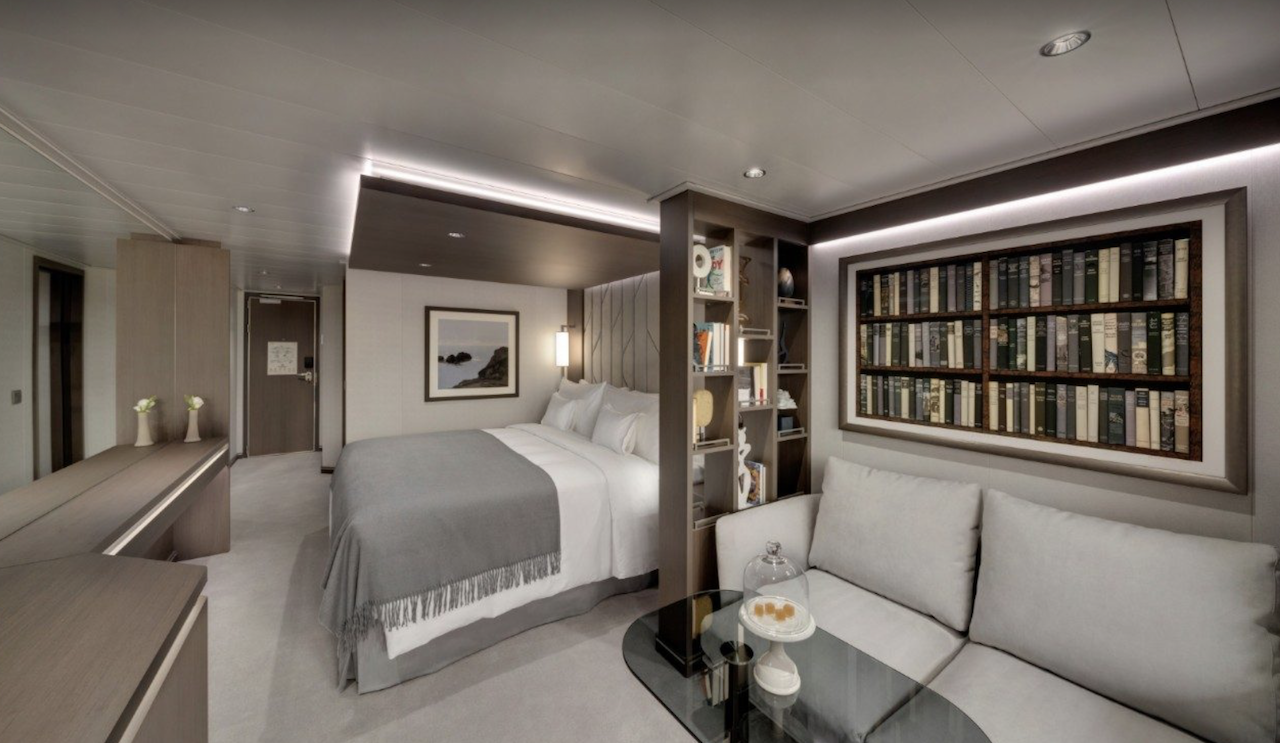
For context, Explora Journeys which includes everything that VidantaWorld’s Elegant does not (full Starlink wifi, in-suite dining, alcoholic beverages, every meal in every restaurant, spa access, and all ocean front terraces) starts at around $3,500 for a week in the Caribbean. That’s 40-70% less expensive than Elegant with all of the inclusions that Elegant charges additionally. In a total 1:1 comparison, Elegant may be as much as twice Explora. Here’s a shot of its entry-level Ocean Terrace, for example:
The Cancellation Policy Undermines Trust
Perhaps the most concerning element is the cancellation policy, which feels unusually restrictive for a product targeting high-end travelers. Guests canceling more than 90 days prior to departure are only eligible for a 50% reimbursement of the total voyage cost, assuming full payment has already been made. Most luxury cruise operators will refund up to 100% as close in as 91 days prior to sailing.
Within 90 days, the booking becomes non-refundable, with only vague references to possible credits on a case-by-case basis. That level of rigidity stands in contrast to the flexibility that many luxury travelers have come to expect, particularly when booking expensive, experience-driven trips.
For a brand that is still establishing itself with a largely unfamiliar audience in the US, policies like this create hesitation rather than confidence. Trust is a critical component of luxury purchasing decisions, and this structure does little to build it.
Why Does VidantaWorld Think This Will Work?
There is still a coherent strategy underneath all of this, even if the execution feels uneven. VidantaWorld is not trying to out-brand established luxury players, but instead attempting to out-operate them by leveraging its experience running high-touch resort environments. It picked the right destinations, sailing the French Riviera, Canary Islands, and throughout the Mediterranean this summer.
The company understands staffing, service delivery, and how to create an environment where guests feel attended to without friction. In a land-based resort setting, that model allows for controlled upselling and strong ancillary revenue, which can offset operational costs while maintaining a premium feel.
The challenge is that the luxury cruise market has evolved in a different direction. Guests in this segment have been conditioned to expect fewer decisions, fewer add-ons, and a more seamless experience, which makes a layered pricing structure harder to justify at comparable rates.
Conclusion
VidantaWorld’s Elegant enters the luxury cruise market with a concept flawed from the start. The idea of bringing villa-style experience (they really referred to this as villa-style) and operational discipline to sea has real potential, but the current execution introduces friction at nearly every stage of the guest experience.
High pricing paired with limited inclusions, expensive add-ons for core experiences, and a restrictive cancellation policy creates a value proposition that is difficult to reconcile with the expectations of this segment. While the onboard service may ultimately prove to be exceptional, the overall structure places a significant burden on the product to justify itself. For a brand that remains largely unknown to many US travelers, that is a risky position to take. The opportunity is there, but so is the skepticism, and VidantaWorld will need to overcome that gap quickly if Elegant is going to compete at the level it is aiming for.
What do you think?



