LAHORE: Unesco has issued a report on its website about the completion of the Lahore Fort’s Picture Wall, welcoming this addition to the conservation efforts.
In April 2026, the restoration of the northern section of the wall was formally completed after more than 10 years of rigorous scientific study and interdisciplinary collaboration.
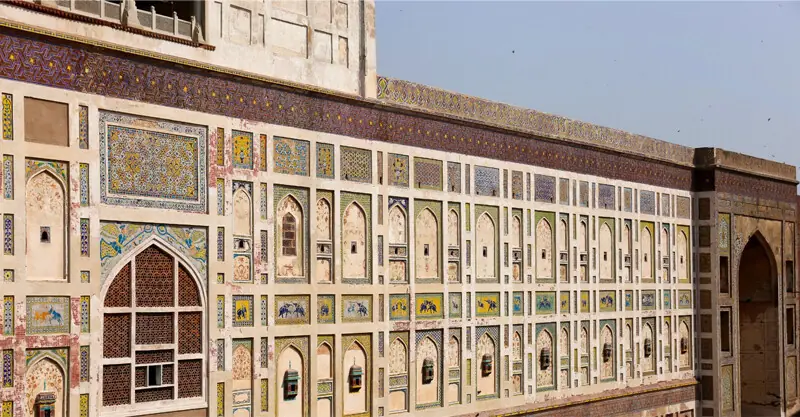
The Picture Wall tells a 400-year story across one of the largest and most intricate mural walls in the world – a rare cultural treasure now revived for future generations. Extending nearly 475 metres in length and averaging 17 metres in height, the wall lines the northern and western edges of Lahore Fort.
Built during the reigns of the Mughal emperors Jahangir and Shah Jahan in the seventeenth century, the wall features approximately 2,000 richly ornamented recessed panels arranged across three tiers. These panels portray hunting scenes, royal processions, angels and mythical figures, animals and birds, as well as geometric and floral designs crafted through glazed tile mosaic (Kashikari), fresco work, marble and red sandstone jali, and terracotta relief. This artistic achievement was a key reason for the fort’s inclusion on the Unesco World Heritage List in 1981.
As a Unesco World Heritage site, Lahore Fort holds significance across the globe. Its restoration has been led by young Pakistani professionals working in partnership with local and international institutions under the guidance of Aga Khan Trust for Culture and with the technical support of international conservation experts.
A significant number of the Aga Khan Cultural Service – Pakistan conservation team were women, serving as conservation scientists, surface conservators, conservation architects, archaeologists, ceramists and skilled artisans.
The Picture Wall has diverse artistic influences, including European traditions, Iranian mythology and Christianity.
The project began in 2015 through a partnership between Aga Khan Cultural Service – Pakistan (AKCS-P) and the Walled City of Lahore Authority (WCLA). The initial phase focused on the comprehensive documentation of the entire Picture Wall using advanced technologies such as 3D laser scanning, Electronic Distance Measurement (EDM) instruments and high-resolution ortho-rectified photography — marking the first time these techniques had been employed on such a scale in Pakistan.
Building on this extensive scientific research, a prototype conservation area measuring 11 metres wide and 16 metres high on the western façade was identified to test and refine restoration approaches. In January 2018, an international workshop brought together prominent conservators, chemists and heritage experts to assess the prototype intervention and define the guiding principles and standards for the larger conservation effort. The findings informed the phased restoration of the entire western section of the wall — a 73-metre-long and 16-metre-high stretch. Conservation work officially began in March 2018.
The conservation effort was made possible through the combined support of public institutions, international partners and philanthropic contributors, including the Punjab government, WCLA, Royal Norwegian Embassy, the German Federal Foreign Office, and the Ambassadors Fund for Cultural Preservation.
A total of $1.5 million was invested in the project.
Tausif Khwaja, CEO Aga Khan Cultural Service – Pakistan, said “The Picture Wall is a key reason for the Lahore Fort’s UNESCO World Heritage status, and this project has proven that world-class heritage conservation is achievable in Pakistan”.
Fuad Pashayev, country representative to Pakistan, Unesco, says the completion of the Picture Wall restoration is a testament to what can be achieved when scientific rigour, international solidarity and local expertise work in concert.
Published in Dawn, May 19th, 2026