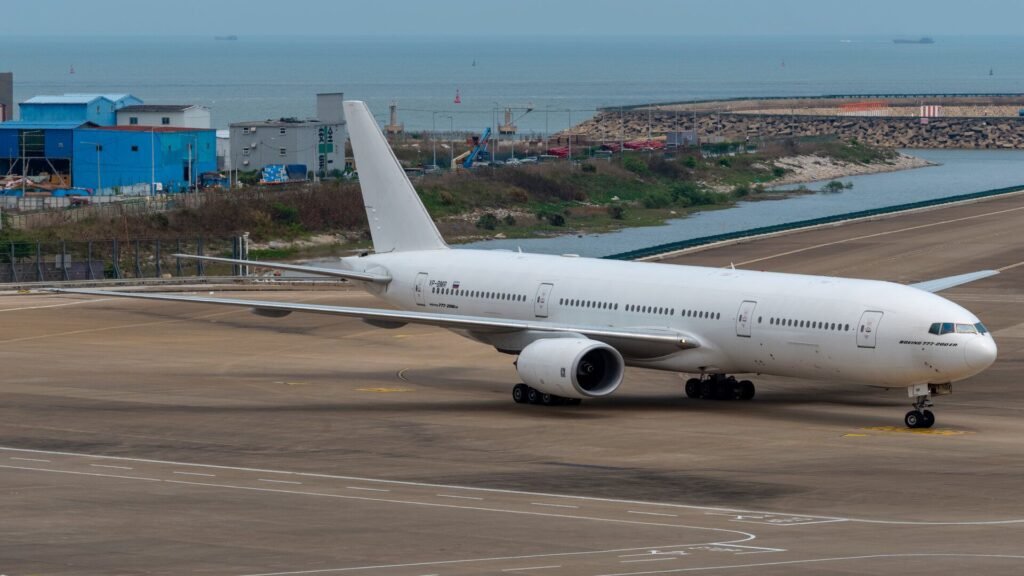
Iran has once again bypassed international sanctions to acquire Western-built aircraft. As reported by Air Data News, five Boeing 777-200ERs have recently been transferred to the country under opaque circumstances. The current restrictions prohibit Iran from purchasing aircraft with US-made components.
This effectively blocks deliveries of both Boeing jets and most Airbus models. Despite this, Iran has previously obtained commercial aircraft through indirect registrations and untracked delivery routes. The latest arrivals are believed to be intended for Mahan Air, a sanctioned Iranian carrier linked to state operations.
Ex-Singapore Airlines 777s Leave Cambodia, Arrive Silently In Iran

According to Planespotters.net data, Mahan Air, which remains under US sanctions, is expecting the delivery of five Boeing 777-200ERs that were originally delivered to  Singapore Airlines between 2001 and 2003. The aircraft remained in service with the airline until 2018 and 2019, after which they were transferred to NokScoot, a now-defunct Thai subsidiary.
Following NokScoot’s shutdown, the jets were stored for a few years and remained inactive until May, when they were reactivated for what appears to be an illicit transfer to Iran. All five aircraft were stored at Siem Reap Angkor International Airport (SIA) in Cambodia between July 4 and July 15. According to Flightradar24, one of the jets, registered as 5R-HER, departed the airport on July 15 and is now stored at Mashhad International Airport (MHD) in Iran.
During the flight, its ADS-B transponder was deliberately switched off while passing over Afghanistan, rendering the rest of its route untraceable. This tactic has been observed in several previous aircraft transfers to Iran, where the aircraft go off radar before reappearing in Iranian airspace.
Not The First Time: Iran Has Repeatedly Secured Aircraft Through Covert Transfers

In recent years, Iran has reactivated several dormant widebodies, often using circuitous registration changes and untraceable flight paths to avoid detection. In April, two Airbus A330-200s, which were originally operated by Hong Kong Airlines, were flown from Oman to Tehran, again without intervention from international authorities.
This follows the May 2023 arrival of two ex-French Air and Space Force Airbus A340-200s, which had long been stored in Indonesia. They were initially re-registered in Mali and disappeared from radar near the Indian coastline. Both eventually landed at Chabahar’s 10th Tactical Fighter Base and are now believed to be operated by Meraj Air on behalf of the government.
Furthermore, most recently, Iran allegedly smuggled two A340s from Lithuania. According to the reports, the two jets, which belonged to the Gambian lessor Macka Invest, departed from Siauliai Airport in Lithuania earlier in 2024. They diverted off course and disconnected from all means of detection by air traffic control and ultimately landed in Iran. The aircraft were supposed to head to the Philippines but ended up at Mehrabad International Airport in Tehran and Chabahar Konarak Airport, respectively.

Related
Iran Air’s Fleet & Flights Under Sanctions: Examined
Iran Air has an operational fleet of mostly outdated aircraft and is only able to operate a limited number of flights.
Aircraft With US Parts Off Limits, But Still Flying In Iran

The United States has imposed long-standing sanctions on Iran that specifically target its ability to acquire commercial aircraft. These measures prohibit the purchase of any aircraft containing more than 10% US-manufactured components, which effectively blocks deliveries of both Boeing jets and most Airbus models.
The impact has been profound. Iran’s fleet remains among the oldest in the world, with many aircraft grounded due to the lack of spare parts and certified maintenance support. Last year, authorities estimated that fewer than 200 of the roughly 330 registered aircraft were operational.
- Length
-
209 ft 1 in (63.7 m)
- Wingspan
-
199 ft 11 in (60.9 m)
- Height
-
60 ft 9 in (18.5 m)
A brief window for fleet renewal opened in 2016 following the signing of the Joint Comprehensive Plan of Action (JCPOA), during which Iran placed multi-billion-dollar orders with Boeing, Airbus, and ATR. But only a handful of aircraft were delivered before sanctions were reimposed in 2018.
Since then, Iran has relied on indirect channels to maintain and grow its fleet, circumventing restrictions through re-registrations, opaque ownership structures, and off-radar ferry flights. These efforts, of course, continue to evade international enforcement.


