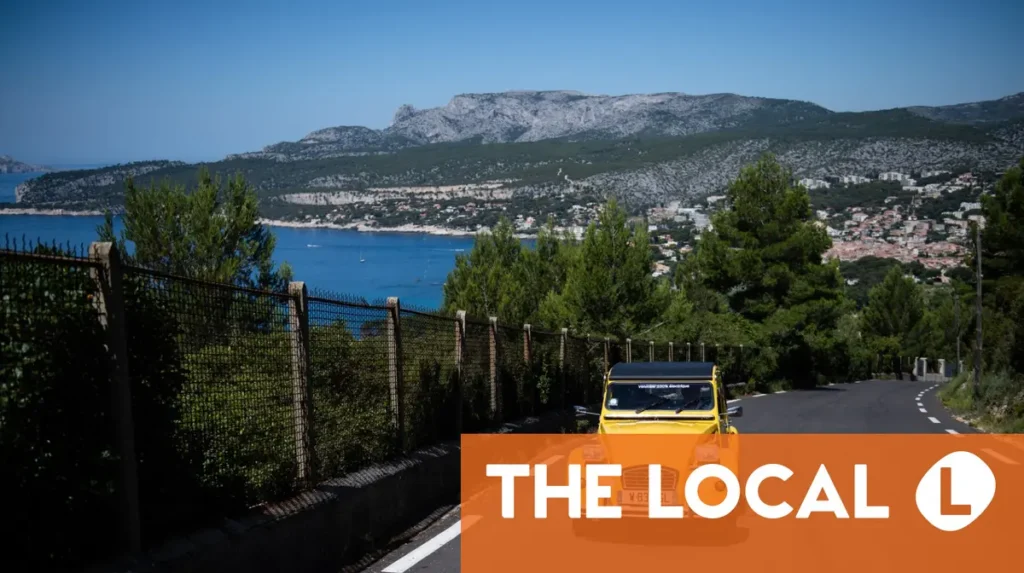
A road trip can be the perfect way to explore France and access some of the more off-the-beaten track attractions – here are some tips for planning a summer trip.
Part of the appeal of a road trip is that you don’t have to book ahead for train or plane tickets so can be a little more spontaneous – but it’s still worth planning a few things in advance.
As with any road trip, it’s obviously a good idea to make sure that your vehicle is roadworthy and in good condition for the journey, and to have some idea of where you’re going and how long it is likely to take.
READ ALSO Who to call and what to say in a driving emergency in France
But then there are some specifically French issues;
Motorway or not motorway?
The generally pay-as-you-go autoroutes of France are excellent. The road surface is usually smooth, traffic flows reasonably, the views generally stunning – and there’s occasional road-side art to spot and debate for a few miles.
France is not a small country and its motorways stretch for more than 12,000km, of which more than 9,000km are toll roads operated by private companies under contracts with the State.
Advertisement
But, you don’t have to use them – it is entirely possible to get from wherever you are to wherever you want to go without using a motorway in France. Just accept that the journey will take longer, may be harder on your car, involve hills, and narrow roads, towns and villages.
If you’re in no rush, great, enjoy la france profonde. If you need to get somewhere a little faster, though, pay the toll.
READ ALSO Is it worth taking a detour to avoid France’s steep autoroute tolls?
Avoid the red and black days
There are some days – particularly during the long summer holidays – when it’s best simply to leave the motorway travel to everyone else. There are days when it seems like the entire population of France is on the road, with a good chunk of northern Europeans also using France as a ratrun to southern Europe, and the sun.
Fortunately, the busy days are mostly predictable – keep an eye on The Local and France’s roads watchdog Bison Futé, which forecasts traffic levels on the country’s main arterial routes, and signals trouble using a colour-coded map of France. Green is good. Red is not. Black is, basically, nationwide gridlock.
And avoid, at all costs, the chasée-croisé.
Take breaks
At some point you’re going to need a pitstop to freshen up, loosen up and, maybe, take on some food and water. And fuel. Let’s not forget fuel.
But, where can you stop on a French motorway? Enter the aires de service.
You’ll see regular blue signs at the side of the autoroute telling you how far you have to travel to the next aire de service and, via the medium of pictograms, what services are on offer – so you’ll know if there’s a filling station, a restaurant, café, a shop, toilet and shower facilities, facilities for caravan or camping car users and so on.
The thing is, these places are not cheap. Fuel is more expensive than in town service stations, and food prices are higher. You’re pretty much a captive consumer so you pay a premium for the privilege.
Most will have charging points for electric vehicles and there’s routinely free wifi access. There will be an outdoor area with chairs and tables, if you’re organised enough to pack a picnic, while for kids there will be an outdoor play area and an indoor area for arcade games.
Advertisement
At peak periods, notably in the summer, numerous service stations offer free activities for children and families. This is actually a very smart idea – it breaks up a journey, gives bored backseat children something to do which delays the inevitable cries of “are we nearly there yet”, and prompts families to take a proper break before getting back in their vehicles for the next leg of their trip.
READ ALSO Aires: Everything you need to know about motorway services in France
Between the aires de service, you may also spot aires de repos. These are, basically, parking areas at the side of the motorway, where you can take a break from driving and relieve yourself if necessary. The good news is that they’re usually landscaped, and have some benches and tables, if you have a picnic, plus toilets.
Take the route less travelled
There are alternatives to motorways and service stations – they’re France’s official villages étapes – or stopover villages.
READ ALSO Driving in France: What are the French ‘villages étapes’?
A signpost on France’s major routes will tell you that, within 5km, there’s a village of no more than 5,000 people that will offer a warm welcome – and food and fuel – to weary travellers. At a fraction of the cost of motorway services.
Advertisement
Heading into La France profonde has advantages beyond protecting your bank balance a while longer. You’ll see stunning views from the motorways – but you’ll experience stunning views off them. Scenic routes are everywhere, and they’re worth the effort if you have the time, and the fuel.
READ ALSO 10 most beautiful parts of France to drive through
Avoid tourist hotspots
France is understandably proud of its reputation as the world’s most visited tourist destination, but that tag does bring with it one or two problems.
According to the French government, some 80 percent of the country’s tourist activity – and there’s a lot of it – is concentrated in just 20 percent of the country, meaning that better-known tourist sites can get overwhelmed by visitors.
Advertisement
France is fairly bursting with places to visit so think a little outside the tourist box – maybe head to the Vanoise and Beaufortain massifs rather than Mont Blanc; the Côte Bleue to the west of Marseille is every bit as beautiful – and much less busy – than the Calanques; while opposite Cannes, the Lérins Islands, are an ideal alternative to the îles du parc national du Port-Cros.
READ ALSO 19 alternative places to visit in France to avoid the crowds
France also has a lot of beautiful villages that are well worth visiting just to experience some traditional rural lifestyle.
READ ALSO: 14 of the best villages in France – according to the French✎
Drive sensibly
This really should go without saying, but keeping to speed limits and maintaining safe distances is the best way to travel. Your blood pressure remains even, you’re less likely to crash. This remains true whatever the locals are up to on the roads.
READ ALSO Swearing, honking and tailgating: French drivers ranked among worst in Europe
Don’t get arrested
Avoiding unnecessary trouble with the law is a common sense approach to life and it should be fairly easy to do.
But, as in all countries, there are a whole range of driving laws to fall foul of – from standard driving infractions to ages-old French rules on running the air-con in your winnebago, for example.
Advertisement
Very minor law-breaking may – may – be solved with a grovelling apology to the world-weary police officer in front of you and tactical use of the ‘dumb foreigner’ defence.
READ ALSO Driving in France: What are the offences that cost you penalty points on your licence?
But more serious offences may see you in the back of a police car en route to a police station, where you can be held for up to 24 hours before someone has to decide whether you can be detained for longer. Suffice to say, this alone will put a kink in your holiday.
READ ALSO What to do if you are arrested in France
But not as much as the kink as any future court appearance and French criminal record may do.
Foreign motorists in France are more likely to experience national traffic laws via the medium of an unwanted speeding fine in the post.
Speeding is taken very seriously in France. You can be pulled over by a police officer for speeding, but you could also be caught by a speed camera and not even realise it until you get a fine in the mail.
READ ALSO Radars, fines and points: How to understand France’s speeding laws
For non-EU tourists driving their own cars in France, whether you receive a point on your foreign licence depends on whether your country (or state) has a reciprocal agreement with France.
If you have been snapped by a speed camera while in a hire car, rental companies will relay your information to French authorities, and they may also apply a surcharge for fines.
And don’t think you’ll get away with it if you’re flashed while driving a UK-plated car.
If you’re planning on taking in some of France’s famous vineyards while on your trip, remember to designate a driver – French drink-drive laws are strict and the alcohol limits may be lower than you are used to, especially if you are from the UK.


