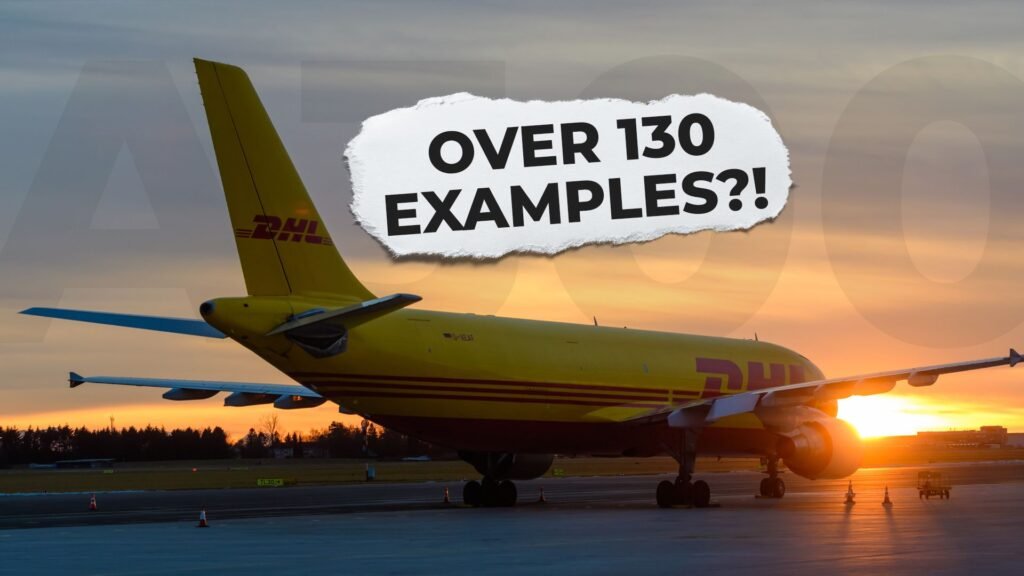
The Airbus A300 stands out for being the aircraft that got Airbus going and set it on the path to becoming the world’s largest airplane maker. However, this aircraft has been out of production for around 18 years, so how many of these old aircraft are still flying today? According to data from ch-aviation, there were a total of 132 examples still operational in early 2025, mostly as freighters. The world’s remaining passenger A300s are all flying in Iran, a nation blighted by sanctions.
However, while ch-aviation listed 132 in service at the beginning of 2025, at least nine more have been retired since then. Just three cargo airlines operate most of the world’s remaining fleet of Airbus A300s, although the number is falling every year as they are retired and replaced with new aircraft. All remaining A300s are equipped with either General Electric CF6 or Pratt & Whitty PW4000 turbofans.
Airbus’ First Commercial Widebody Aircraft

The Airbus A300 was Airbus’s first production airliner, and the jet was produced from 1971 to 2007. The aircraft is a twin-engine, twin-aisle design with a typical capacity of 247 passengers in a two-class seating configuration. Its development started in 1967 as France, West Germany, and the United Kingdom teamed up to develop a larger airliner. The British later left the project, but it was developed by Airbus Industrie GIE, first flying in 1972.
The aircraft came with a range of 2,900 to 4,050 nautical miles. It first entered service in 1974 with Air France and in the mid-1980s found itself competing with variants of the Boeing 767. The passenger Boeing 767 has been replaced by the 787, although production of freighter variants is continuing until 2027, meaning it will outlast commercial A300 production by 20 years. By the time Airbus A300 production came to an end in 2007, a total of 561 examples had been delivered.
The Airbus A300 served as the basis for the smaller A310, which first flew in 1982. Elements of its design were later used for the development of the larger A340 quadjet, which had its first flight in 1991. Significantly, its cross-section was retained in the Airbus A330, Airbus’ top-selling widebody aircraft. The distinctive Airbus Beluga is also based on the A300-600 variant of the family.
Iran Is A Bastion For Passenger A300 Flights

Iran has been heavily sanctioned for decades and is cut off from purchasing new commercial aircraft. This has forced it to keep its aging aircraft in service far beyond what would have been their economic lives. Iran is able to purchase a limited number of retired aircraft (including A340s) on the black market and then fly them to Iran. As these are old aircraft, Iran can find spare parts on the black market as other aircraft are retired and cannibalized for parts.
All in all, it seems that Iran-based airlines have seven A300 passenger examples in active service. According to ch-aviation, Iran Airtour has one A300-600 and one A300-600R in service. These are aged 32 and 39 years old and were originally delivered to Lufthansa and Emirates. IranAir also possesses two active A300-600Rs.
|
Airbus A300 operated in Iran |
||
|---|---|---|
|
Airline |
Quantity |
Role |
|
Iran Airtour |
2 |
Passenger transport |
|
IranAir |
2 |
Passenger transport |
|
Meraj Air |
1 |
Passenger transport |
|
Qeshem Airlines |
2 |
Passenger transport |
|
Moalem Aviation |
2 |
Freight |
Meraj Air has another A300-600R, aged 30 years old which originally served Korean Air. This Meraj Air A300 is notable for being the only Iranian A300 with PW4000 engines, as the rest have GE CF6 engines.
Two other Iranian airlines operate A300s. Qeshem Airlines has another two A300-600Rs, and both were originally operated by Australia’s Compass Airlines. Finally, Moalem Aviation has two. One is an A300C4 ex-South African aircraft that is now 43 years old. Notably, the second Moalem A300 is an A300B4(F) originally delivered to Pan Am, and that aircraft is now 42 years old.

Related
Multinational Manufacturer: A Brief History Of Airbus
The European plane manufacturer has grown to be one of the largest in the world.
UPS Is The A300’s Largest Operator

United Parcel Service is another giant cargo airline offering services across the world. It operates a similar number of Airbus A300-600RF aircraft as its rival, FedEx, with a total of around 52 examples in service. Of these, 46 are currently active and six are parked. UPS’s A300 fleet is now 22.6 years old on average, and it was the original customer for all of these aircraft, having taken delivery of them from Airbus between 2000 and 2006.
Whereas FedEx has retired 20 A300s from inventory, UPS has only divested a single example. That aircraft (registered N155UP) was delivered in 2004 and was written off in 2013 after crashing. The aircraft crashed on August 14, 2013, at Birmingham–Shuttlesworth International Airport in Alabama, 0.8 nautical miles short of the runway while coming in to land. Both crew members onboard the flight perished, according to the Aviation Herald.
|
Largest Airbus A300 operators |
|
|---|---|
|
UPS |
52 |
|
FedEx |
51 |
|
DHL Aviation |
Approximately 25 |
Until a few months ago, UPS was the world’s second-largest operator of the A300. However, 2024 and 2025 have seen FedEx make waves of A300 retirements. FedEx was previously the largest A300 operator, but as of the time of writing, it appears UPS has one more in service. FedEx withdrew two units in late 2024 and has so far withdrawn seven more in 2025. These are listed by Planespotters.net as stored, and it is unclear if any will be returned to service.
FedEx Is The A300’s Second-Largest Operator

FedEx is the world’s largest cargo airline by fleet size, and it is the largest operator of the A300 today. It has a total of around 51 examples in inventory, of which 46 are active and five are parked. FedEx’s ‘superhub’ is located at Memphis International Airport, and it serves over 375 destinations in over 220 countries and territories.
According to Planespotters.net, FedEx operates a fleet of 459 aircraft, meaning over 12% of FedEx’s fleet is composed of Airbus A300s. All of these A300s are the A300-600F variant. While FedEx was the original customer for most of these aircraft, it has also purchased many more passenger A300s from commercial airlines over time and converted them to freighters. It has purchased old A300s from Korean Air, La Tur, EgyptAir, Garuda Indonesia, China Eastern, China Northern, and others.
The average age of FedEx’s fleet is now 29.4 years old. In total, the cargo airline has operated 71 Airbus A300s, with 20 of these since having been retired. FedEx is also the largest operator of the Boeing 757-200 and McDonnell Douglas MD-11F, and it is currently taking deliveries of Boeing 737-300F and 777F freighters.

Related
The Evolution Of Airbus Aircraft: From The A300 To The A350XWB
Since the introduction of the A300, Airbus has delivered 16,000 aircraft and has become the world’s largest commercial jet maker.
DHL Is The A300’s Third-Largest Operator

European Air Transport Leipzig is a major German cargo airline based in Leipzig/Halle Airport and is owned by Deutsche Post. The airline operates the group’s DHL-branded parcel post and express mail services and is today the third-largest operator of the aging Airbus A300. According to Planespotters.net, European Air Transport Leipzig has a total of 27 Airbus A300-600s in service, with its fleet now averaging 30.6 years old. These make up the backbone of its 40-strong freighter fleet.
European Air Transport Leipzig is part of the larger DHL Group, which had a total of 36 Airbus A300s in service at the beginning of 2025. Other members in the group include ASL Airlines Ireland with six Airbus A300s, Air Hong Kong with two A300s, and Solinair with two A300s in inventory at the start of the year. The DHL Aviation fleet has a total of around 212 freighters in service.
Like with FedEx, these A300s are gradually being phased out, and Air Hong Kong retired its two Airbus A300-600Fs in June 2025. The DHL Group has Boeing 777F jets on order as well as 12 small Eviation Alice electric-powered aircraft. The latter type is planned to enter service in 2027, but the company is currently experiencing troubles, and it is unclear if the aircraft will be delivered.
Fewer Than A Quarter Of The World’s A300s Remain In Service

All of the remaining passenger A300 operators are in Iran, while all the other A300s still operating around the world are freighters. Three freighter groups, UPS, FedEx, and DHL, operate most of these freighters. The world’s other A300 operators are Easy Charter, Fly Pro, Gewan Airways, and SM Executive Aviation, where each of these has a single freighter example in inventory. Finally, Airbus has a single A300-600ST Beluga in operation.
At the beginning of 2025, of the world’s 561 A300s that were delivered, around 132 (23%) remained in service, with more in storage. FedEx has already stored a significant number of A300s, and more are currently meeting this fate. The A300 remains in service, but is aging, with the total number still in use falling constantly. Just weeks ago, Air Hong Kong became the latest airline to divest of its Airbus A300s.
Meanwhile, in the last few weeks, FedEx has withdrawn more of its A300s, causing it to fall behind UPS in terms of the number of A300s in service. For Airbus, the A300 is the aircraft that started it all and helped catapult it to overtake Boeing to become the world’s largest airplane maker. The aircraft is one of Europe’s first successful widebody aircraft and marked a turning point in merging major aviation companies to create Airbus, one of only two widebody commercial aircraft manufacturers today.

- First Delivery
-
May 23, 1974
- Last Delivery
-
July 12, 2007
- Number Delivered
-
561


