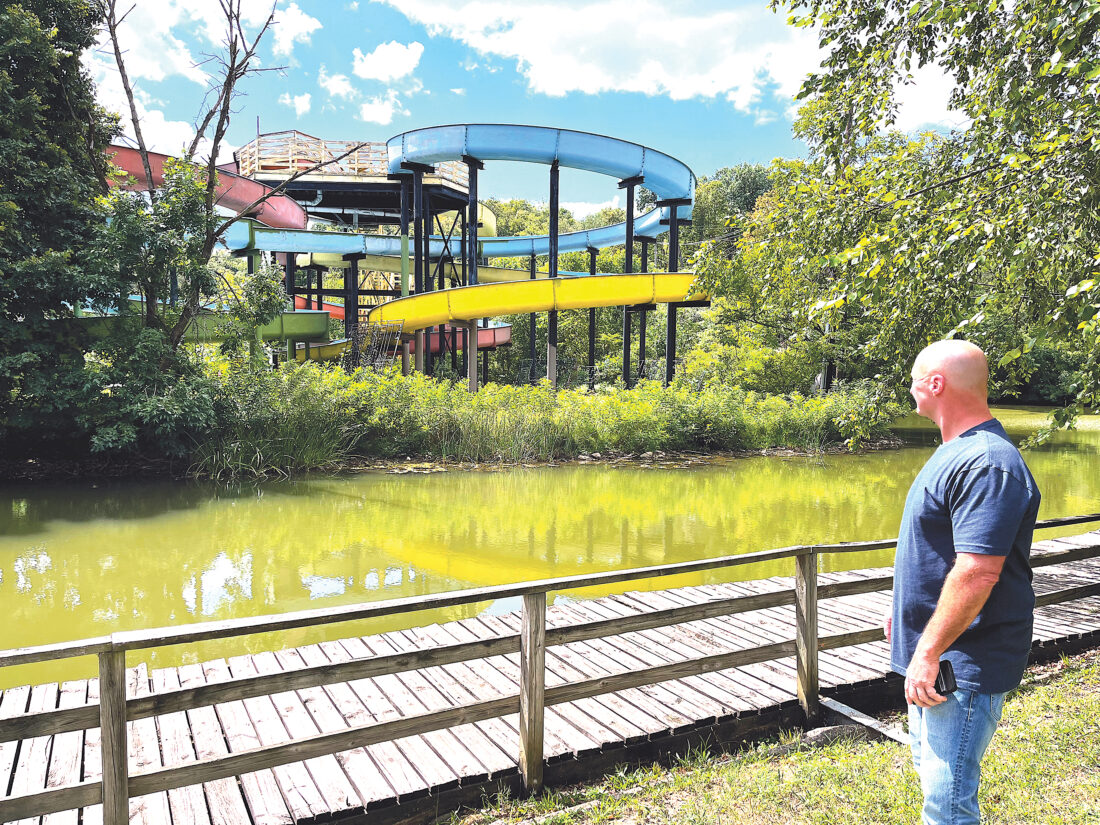
Blair County Commissioners’ Chairman Dave Kessling looks over the water at the now defunct water slides at Lakemont Park during a tour of the park on Wednesday.
Mirror photo by William Kibler
Editor’s note: The following article featuring Blair County Commissioners’ Chairman Dave Kessling on a walk-through of Lakemont Park was completed earlier this week, before the lawsuit was filed against the commissioners by the Lakemont Partnership.
Lakemont Park Timeline Compiled by the Blair County Historical Society 1754-2022 (1)
There used to be bumper cars at Lakemont Park, but they’re not there anymore.
Their absence — and the years-long absence of all the other classic amusement park activities that once dominated the park’s identity — have landowner Blair County and leaseholder Lakemont Partnership colliding like a pair of kids in those old electrified vehicles.
Blair County Commissioners’ Chairman Dave Kessling believes that the partnership that leases the county-owned land — which includes Boyertown-era office buildings on one side, the Curve ballpark on the other side and the former amusement park in between — is letting the old rides and water park facilities there deteriorate in hopes of eventually acquiring the ground for development, perhaps when new commissioners take over.
“That’s absolutely not true,” wrote partnership President Andrea Cohen in an email.
“It’s a volatile situation,” Kessling said this week. “It’s touchy.”
The partnership makes good money on the Boyertown offices and on the Altoona Curve at the ballpark, but claims it can’t make money on the amusement park — although it operates Lights on the Lake within the park fences, according to Kessling.
If finances for the amusement park property are a problem, it would behoove the partnership to turn over the park ground, so the county can find a partner to create an attraction there that would benefit the community in a way that the current basketball, volleyball, mini-golf, batting cages, play equipment and picnic pavilions do not, according to Kessling.
But the partnership’s compensation demands for such a turnback have been “unreasonable,” according to Kessling.
“(T)he only offer that has been made to us is $800,000 to terminate our lease for the entire property, including the Village, Galactic Ice, Curve baseball stadium and more,” Cohen wrote. “This is not feasible since we still have 41 years left on the lease, have invested more than $30 million in the property and currently have almost $6 million in debt.”
“We offered certain things,” Kessling said. “We thought it was more than fair.”
“We have tried to work with the Commissioners to find a viable solution moving forward, and they have been unwilling to do that,” Cohen wrote.
“They want money — millions of dollars,” Kessling said. “We are not paying millions for something we already own.”
It’s possible that, two years from now, new commissioners would be more “sympathetic” to the partnership and wouldn’t object to its getting full control of the property, so it could become the site for high-rise buildings, including apartments, Kessling said.
The current commissioners, who have been in discussions with the partnership for the past year, are united in opposition to such development — to anything other than a park, even though developers in the community are probably eager to exploit that ground, according to Kessling.
The lease agreement, which runs to 2066, is open to interpretation, according to Kessling.
Based on the commissioners’ interpretation, the partnership is responsible to maintain the park as it was when they took over its management, including the water park, he said.
Not so, according to Cohen.
“That interpretation is not supported by the controlling legal documents,” she wrote. “Statements like this create confusion and prevent productive discussions.”
It’s likely going to require a judge to rule on the matter, Kessling said.
At best, the partnership is out of compliance with the “spirit” of the agreement, he said.
The partnership seemed to be operating within the lease requirements in early 2024, given that the park was available to residents to stroll around during the hours when it was open, then-county solicitor Nathan Karn told the Mirror at the time.
The amenities currently at the park are insufficient — “minimal” — according to Kessling.
“(But) today’s economic climate simply doesn’t justify keeping the amusement rides open,” wrote Cohen. “It is not economically feasible or sustainable,” due to declining attendance, a declining local population and increased maintenance and insurance costs, she wrote.
That became clear between 2019 and 2023, when ridership was disappointing, she wrote.
Still, what’s there currently is not insignificant, according to Cohen.
There have been many park attendees this summer, she wrote.
“(They) have used our recreation facilities and expansive green spaces, as well as (the) pavilions for both public and private events,” she wrote.
The two mini-golf courses and the batting cages remain popular, she wrote.
There are four batting cages, four basketball courts, two volleyball courts, a playground and 10 pavilions, as well as the two mini-golf courses, according to the park’s website.
The park has also hosted sports camps, the Central Blair Recreation and Park Commission’s summer basketball league, a volleyball league, “Touch-A-Truck,” Glow Golf Night, movie nights, yard sales, car shows and several runs or walks, Cohen wrote.
And there’s an event this weekend, she wrote.
Pickled Palooza will take place Saturday, “featuring over 50 vendors, music, food, pickle-themed games and eating contests,” she wrote.
The partnership welcomes community support for such events, so they can continue and even increase, she wrote.
On Monday, a Mirror reporter went to the park and inquired of maintenance workers at the front gates whether the park was open, and was told it was not, but that it would be open around 1 p.m. Wednesday.
That was reflective of the current normal weekly schedule, according to the worker.
At 1 p.m. Wednesday, the front gates were again closed — although a vehicle gate on the side was open and unattended, and no one stopped Kessling and the reporter from entering the gate and walking through the park grounds.
Over the following 45 minutes, no other park users appeared.
But according to the park website, the park was slated to be closed at that time.
It’s open from 4 to 8:30 p.m. Wednesday to Friday and from 1 to 8:30 p.m. on Saturday and Sunday, according to the website.
The partnership “has no interest in sinking millions to get (the park) back to what it was,” Kessling said.
The county can’t afford to do it alone, he said.
Therefore, in anticipation of eventually regaining control of the park, the current commissioners are looking for a partner that could upgrade the park to something better than what’s there now, he said.
That doesn’t necessarily mean a full-fledged amusement park, as before, according to Kessling, who acknowledged the economic challenges outlined by Cohen.
At this point, “it’s hard to say” what such a setup would look like, he said.
“(But) we have to get past the first step” — that is get the park back under county control, he said.
Kessling feels nostalgia for the rides that have been idled, like the Leap the Dips, the Skyliner and the racecars, he said.
He came there with his family as a child, he said.
He recently saw antique postcards that depicted the park in its former glory.
“It just is falling into disrepair,” he said Wednesday, looking at the old structures, including peeling white paint on the wooden framework of both roller coasters and weeds growing in the islands of the racecar track. “It’s heartbreaking to see,” he said.
The Leap the Dips is unlikely to operate again, he said. The same is probably true of the Skyliner roller coaster, he said. “I don’t know that any of these rides here will ever run again because I don’t think there’s any interest for them to run,” he said.
“They say they can’t afford to operate the park,” Kessling said. “We’re saying, give it back, let us take it.”
“If (you) can’t make money on it, why are you keeping it?” he asked.
Mirror Staff Writer William Kibler is at 814-949-7038.
Lakemont Park timeline
Michael G. Farrow of the Blair County Historical Society compiled a history timeline of Lakemont Park for the Mirror. This is an abridged version; the full version, from 1754-2022, can be viewed online at altoonamirror.com.
The information is compiled from “A History of Lakemont Park,” William Pine, ed., Lakemont Park Historical Museum, 1990, the Blair County Historical Society Archives and the Altoona Mirror. This list has been edited to include recent events
1836 — Elias Baker, newly arrived from Lancaster County, Pennsylvania, purchases the land that is now Lakemont Park as part of his 3,373 acres for his new Alleghany Iron Furnace enterprise with Roland Diller, and reactivates the furnace.
1864 — Sylvester Baker, son of Elias, takes over operation of the furnace and land upon his father’s death; he builds a narrow gauge railroad to extract ore from the hill at the site and to haul it to the furnace. The railbed later becomes the “Lover’s Lane” of Lakemont Park. Four mines are in the vicinity, two of which are in the future Lakemont Park
1876 — Armand Willis presents the idea of the ground to be ideal for a park and for picnics to a George Akers, printer at the Altoona Tribune. He organized 55 volunteers to clean up the area and names it “Oak and Pine Grove,” the beginning of the future Lakemont Park.
1879 — Swimming is permitted for men and boys only.
1889 — Prior to the opening of Lakemont Park, the Pavilion is built, later to be called the Casino.
1891 — The City & Park Railway company is chartered to build a trolley line from South Altoona into Lakemont where it plans to build an amusement park. Sylvester Baker agrees to have timber cut on the 13 acres of land intended for an artificial lake.
1892 — Lakemont Park opens with two buildings, the Casino and the theatre. The theatre is one of the first summer theaters in the U.S. The City Passenger Railway, a horse-drawn trolley company, obtains a charter in 1882 and operates its first electric trolley in July 1891.
1893 — John Lloyd, President of the Altoona and Logan Valley Electric Railway, obtains a 95-acre tract of land for the future park from Sylvester Baker.
1894 — John Lloyd purchases an additional 13 acres from Sylvester Baker for a total of 113 acres. The deed called for the land (park) to revert to the Baker Estates should it ever be terminated. Concessions are introduced including a gravity railroad, carousel, and a 25-foot electric launch.
1895 — The park gardens are planted with 10,000 hyacinths, tulips, crocus, snowdrops, pansies, violets, carnations, sweet williams, roses, narcissus and honeysuckles.
1901 — A switchback gravity railway is added. It is a precursor to a roller coaster. Cars go up on a track. People switch to another car, and ride back down on a straight track using gravity.
1902 — Leap the Dips roller coaster is built to replace the Gravity Railroad, which burned. By the late 20th century, it becomes the oldest operating wooden roller coaster in the world.
1915 — The first alligator is introduced to the park. Over time up to seven alligators made the park their home. In the winter, they lived in the greenhouses.
1918 — Lake water begins to get muddy due to continued building in the area. The lake is stocked with leatherback, silver carp, and catfish. Black bass were the primary species in the lake when it first opened.
1920 — Bible conferences begin to use Lakemont Park as a venue and continue for 59 years, ending in 1979.
1926 — “Shoot the Chutes” is installed. It is 325 feet Iong and 90 feet high. Boats climb the height and slide down into the lake.
1933 — The theatre at Lakemont presents the last show and closes. Sara Bernhardt, the Barrymores and Lillian Russel were among the vaudeville and early stars that performed at the park.
1936 — A great flood following heavy rain, swept through the park causing much damage. An article in the Altoona Mirror stated “Shall Lakemont Park be Abandoned?” The amount of damage is so great and finances so depleted, that the county commissioners accept ownership of the park from the trolley company for one dollar. The greenhouses and flower beds are all gone. The Lakemont Citizens Advisory Council is formed to undertake restoring the park.
1937 — Lakemont Park formally reopens after the 1936 flood. Elias Burket, who leased the theatre in the early 1930s, converts it into a roller skating rink.
1938 — The park is entirely refurbished. The cost is covered by the Works Progress Administration appropriation which paid for dredging Brush Run, constructing a reinforced concrete bridge, rebuilding six rustic bridges, macadamizing the walkways, building a children’s wading pool, converting the Casino into a community and sports center, constructing the children’s playground, a bobsled and toboggan run and major infrastructure improvements.
1939 — The Blue Island swimming pool opens and brings back crowds to the refurbished park, making it financially successful.
1943 — Rides include the Leap the Dips, whip, shooting gallery, scooter, carousel, swings, miniature railroad, pony ride, childrens carousel, penny arcade and the largest roller skating rink in central Pennsylvania. For water enjoyment, there are the paddle wheel boats, regular and old-fashioned rowboats, a 550,000 gallon swimming pool on the island and the 13-acre lake.
1954 — The last trolley ride from Hollidaysburg and Altoona to Lakemont Park takes place..
1957 — The upper part of the lake is dredged for the showboat, a $6,500 reproduction of an old Mississippi River sternwheeler. The showboat was put into drydock in 1979 and then retired.
1982 — After 30 years of financial difficulties, the Lakemont Park Citizens Advisory Council, which manages the park, sells the carousel for $225,000 to reverse its financial decline.
The Casino is badly deteriorated. A citizens group, the Blair County Heritage Inc., removes the veranda before it can fall into the lake and patches the roof. The arcade buildings from the early days of the park are demolished during this decade.
1985 — The Blair County Commissioners lease the park to Anthony Forgione, president of Altoona’s Boyer Candy Co. The theatre building, scheduled to become a candy factory, is unsuitable, torn down and burned. The grandeur of the famous park gardens since 1895 is gone. The century old trees are felled and the pre-World War atmosphere of the park disappears.
1986 — Anthony Forgione renames the park Boyertown USA on Memorial Day. Construction of the Skyliner roller coaster begins. The entrance price is $12.95.
1988 — Forgione, after two years of operating the park, runs into financial difficulty and cannot fulfill the terms of the lease. The Blair County Commissioners sell the park to contractor Ralph Albarano and Donald Devorris for $1 million. The park is renamed Lakemont Park
2017 — Lakemont Park closes for improvements.
2018 — The management of Lakemont Park begins investigating ideas for restructuring the park by installing basketball courts, ballfields and other outdoor activities.
2019 — Pared down Lakemont Park reopens as a community park after many of the rides were sold and a two-year renovation project saw the park operators create new mini-golf courses, basketball courts, batting cages, volleyball courts and a playground.
2020 — COVID-19 causes delays in the opening. Features included in the season are Motorway go-carts, Keystone Falls Mini-Golf, Rabbit Hole Mini-Golf, batting cages, as well as basketball and volleyball.
2022 — The American Coaster Enthusiasts celebrated World Roller Coaster Appreciation Month at Lakemont Park along with 21 other parks across the country enjoying the Leap-the- Dips and the Skyliner coasters.
2023 — Water park remains idle for fourth year in a row.
2024 — Lakemont Park eliminates rides for the 2024 season.
2025 — Casino at Lakemont Park closes. Lakemont Partnership sues Blair County Commissioners.


