The humble bus was one of the greatest inventions in transportation history. Even today, buses remain important for the many people who either choose not to drive, do not own a car, or need to hop between two cities that are so close together that flying would be impractical. One way the bus has remained relevant in the age of the personal car and cheap flights is through cramming as many people into one space as possible. Perhaps the most famous example of this was the Neoplan Jumbocruiser. This 1970s behemoth, once the world’s largest bus, carried up to 170 people and was the road-going equivalent of widebody aircraft like the Boeing 747 and Airbus A380.
The economy of transit is a subject that most people never really think about, even if it personally impacts their daily lives. One method a transit operator may use to potentially increase profit and lower fares is by fitting as many people as it can into a vehicle for one trip. As I wrote in 2022, this was one of the ideas in the head of Pan American World Airways CEO Juan Trippe when he demanded a replacement for the Boeing 707. Trippe believed that if he had a plane with twice the seating capacity, he could charge less money per seat because more people would shoulder the costs of the flight.


This strategy is one of the reasons why air travel has become more affordable, alongside the Airline Deregulation Act of 1978, changes in airline structures, and changes in what services airlines offer for free. Sure, the last Spirit flight that you were on probably made you feel like you were a sardine in a can, but I bet you also flew quite a long distance for not a lot of money.

This high-volume strategy is also one reason why long-distance bus travel can work. If you have lots of passengers paying to ride the bus, then you can either pocket the profits or drive down ticket prices. This works even better in buses because buses don’t require highly trained pilots or flight attendants, and increasing the passenger load doesn’t necessarily increase the crew needed to operate the bus.
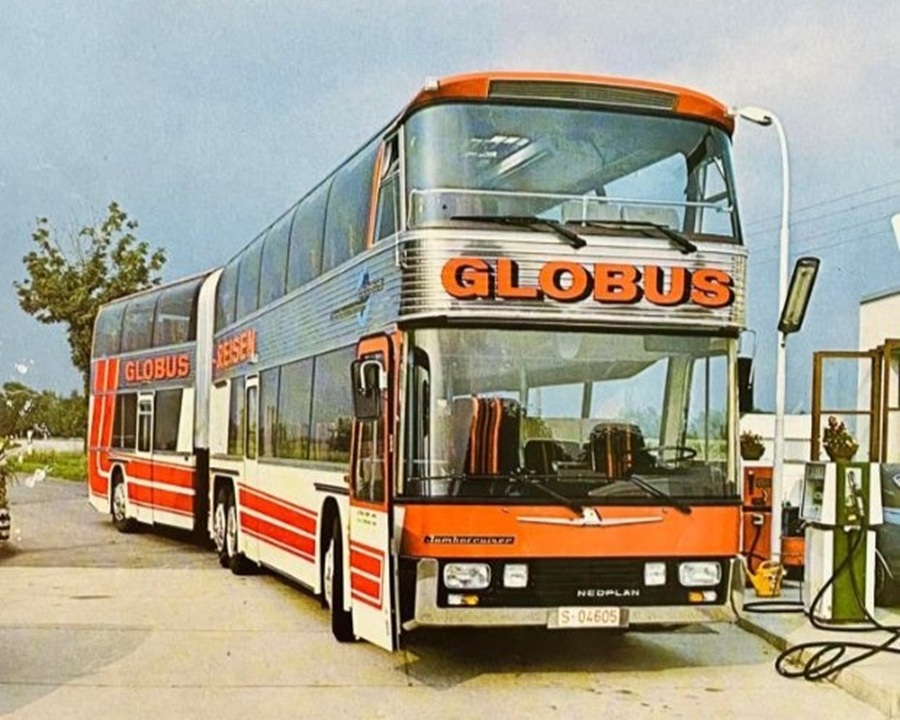
The Neoplan Jumbocruiser applied this idea to the extreme. It was a bus that carried as many people as a plane, and did so to solve a transportation problem faced by Europeans in the 1970s.
One Of The Weirdest Bus Builders
Neoplan is one of history’s weirdest bus manufacturers. If you do an Internet search for “weird bus,” a Neoplan is bound to show up. However, look beyond the goofy designs and you’ll find that Neoplan is also a bus innovator. Here’s what I wrote in a previous story:
As Neoplan’s engine supplier, MAN, notes, Neoplan was launched in Stuttgart in 1935 by Gottlob Auwärter. His small shop produced bodywork for bus and truck chassis. After World War II, the company began building bodies with an all-steel construction. Then in 1953, Neoplan moved away from building bodies for existing chassis to building its own buses. These new buses had partial monocoque designs featuring tubular steel skeletons. MAN says that Neoplan means “New Passenger Transport Vehicle” or “the New Plan.”

Neoplan’s engine supplier continues, pointing out innovations from Neoplan. In 1957, Neoplan was reportedly the first bus manufacturer to announce that its buses would have air suspension and independent front wheel suspension as standard. MAN goes on to note other innovations like a predecessor to today’s low-floor city bus, rear engine buses, and even the first bus to have passenger-adjusted air nozzles, not unlike what you’d find in planes and buses today.
A Jumbo Jet For The Road

According to German bus magazine Omnibus Spiegel, Neoplan’s next project sought to solve the problem with commercial aviation in Europe in the 1960s, namely, the lack of affordable plane tickets. If you were a vacationer and couldn’t afford a plane ticket, you were stuck driving a car, riding a train, or taking one of the existing single-deck buses.
That’s when Neoplan chief designer Bob Lee cooked up an idea. In theory, he thought, bus travel could be made cheaper simply by making the bus carry more people. If you fit two busloads of people into one bus, you can cut down on personnel by half, and even though a double-decker bus won’t be as economical to run, it should still be cheaper to run and maintain than two separate buses.

In April 1967, Neoplan debuted its next great idea, the NH 22 Skyliner, pictured above. Neoplan says that the Skyliner was the first long-distance double-decker coach bus. While double-decker bus-type of vehicle shave been around for well over a century, Neoplan claims that none of them were built for true long-haul travel until the Skyliner. Nowadays, double-decker coach buses are everywhere, even here in America.
Omnibus Spiegel reports that when the NH 22 Skyliner debuted, Bob Lee already had his next big idea in the works. In June 1967, Lee sketched a double-decker articulated version of the Skyliner, and called it the Super Skyliner. Lee would join forces with Neoplan chief engineer Manfred Wenger, and the Neoplan team would end up taking eight years to make the new bus a reality. The new bus made its debut at the 1975 IAA Frankfurt show, and it was something the world hadn’t seen before.

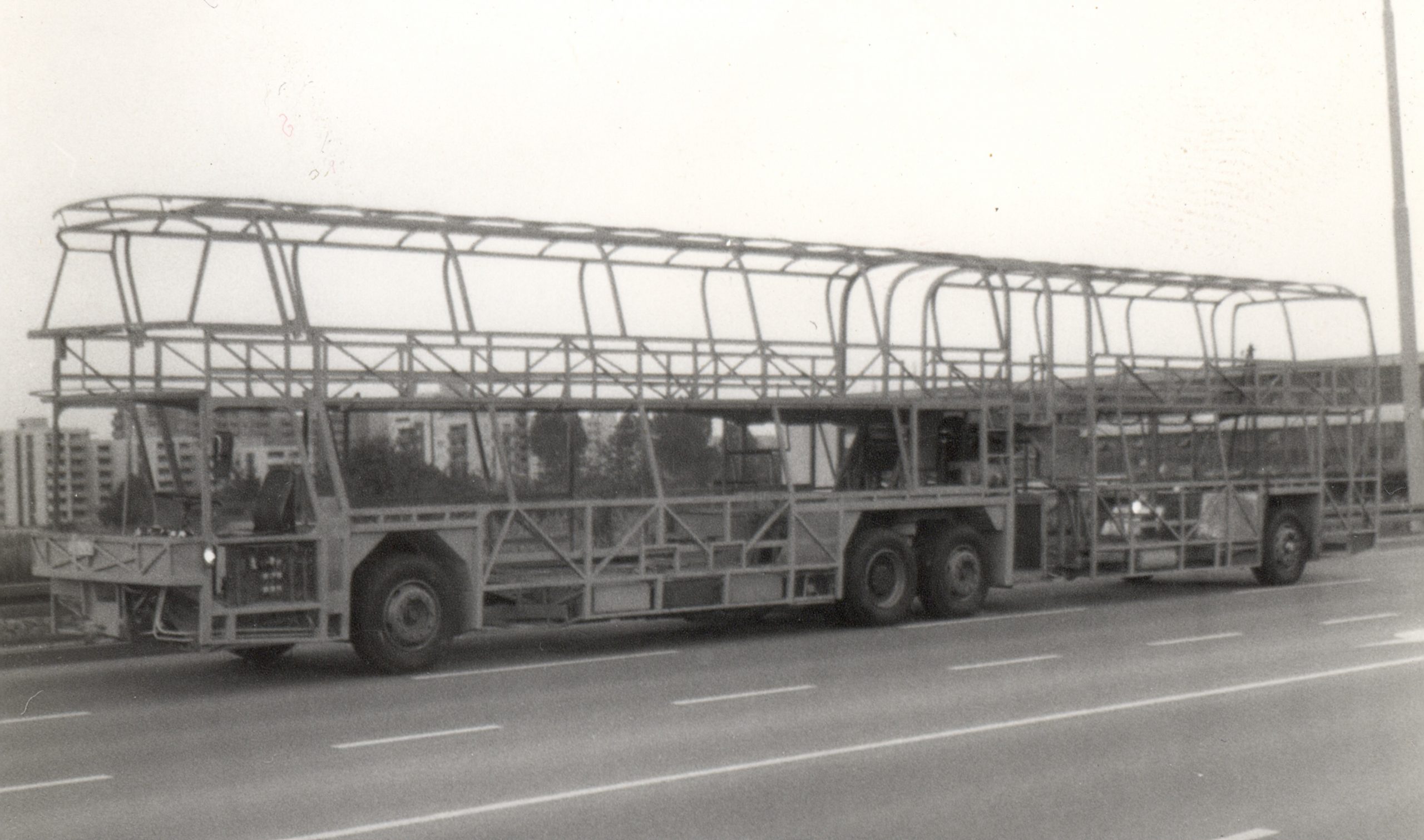
This new bus was called the Jumbocruiser, a name inspired by the popular term “jumbo jet” that described the Boeing 747. It was also given an alphanumeric name that seems meaningless, but isn’t. The launch Jumbocruiser was the N 138/4. The ‘N’ was for Neoplan, the ‘1’ identified it as a luxury coach, the ’38’ identified the rows of seating, and ‘4’ identified the four axles. The magazine notes that Neoplan didn’t have a test track, so when it came time to test the bus, Neoplan took a partially finished, skeletal version of the Jumbocruiser out onto public roads.
Omnibus Spiegel notes that the Jumbocruiser was the first bus to max out all of Germany’s size and weight limits. It measured 59 feet long, 8.2 feet wide, 13.1 feet tall, and had a gross weight of 61,729 pounds. Jumbocruiser buses featured independent front suspensions and powered only their second axles, with the third axle functioning as a tag axle and the fourth axle carrying the trailer.

Early versions of the Jumbocruiser were built a lot like early jumbo jets, where they weren’t just filled up with seats. The portion of the lower deck that was above the two center axles carried the baggage for the passengers. Things got really exciting in the trailer; even more baggage was stored in the lower level, and the trailer also had a bar, lounge, and kitchen. It’s hard to imagine this today, but that’s exactly how early widebody airliners used to be configured, too.
At launch, Neoplan said that the original Jumbocruser had seating for up to 144 passengers, which was reportedly the legal maximum for a bus with a crew of just one person. However, some were built with as few as 80 seats, and the empty spaces were filled with the aforementioned bar, lounge, and galley.

Omnibus Spiegel writes that part of the reason the Jumbocruiser was able to fit so many seats was due to its small 27-inch seat pitch. For comparison, a Spirit Airlines Airbus A320 has a seat pitch of 28 inches. So, while the Jumbocruiser was marketed as a luxury experience, passengers were likely the most comfortable being anywhere other than seated.
Power in the initial units came from the Mercedes-Benz OM404 19.1-liter V12 turbodiesel, which was good for 400 HP. That V12 punched power to that axle through a five-speed Allison automatic. In 1979, the Mercedes diesel was uprated to 420 HP.
This engine is installed in the rear of the main portion of the bus, which isn’t that novel. What was weird was the fact that, according to Omnibus Spiegel, the engine actually hung off of the back of the main section and a little bit into the articulated section.
Neoplan was able to engineer the bus this way because, unlike in a typical articulated bus, where the turntable is near the ground, the turntable of the Jumbocruiser was actually at the second level. Placing the turntable here reportedly gave the bus comfortable behavior when hitting bumps. It also meant that if you were a lower seat front passenger and you wanted to get to the bar in the rear, you had to climb the stairs to the second level, walk to the trailer, and then walk down a set of stairs to get to the bar.
The Jumbocruiser’s Small Market

Omnibus Spiegel notes that the Jumbocruiser wasn’t without its faults. Early examples suffered from a rough ride due to the use of solid axles. Operators also reportedly found that if enough of the male passengers went to the bar at the same time, the weight overloaded the trailer’s axle, which led to led to the eventual premature wearing out of the axle.
The Jumbocruiser also came with confusing engine options at times. In 1977, the Jumbocruiser was available with a Mercedes-Benz OM403 15.9-liter V10 320 HP diesel, which the magazine argues was underpowered for the sheer size and weight of the Jumbocruiser.
Neoplan would quickly run into headwinds as well. The Jumbocruiser’s massive seating capacity had the same problem as jumbo jets, in that they were only profitable when filled to the brim. Thus, only a handful of operators who thought they could fill the bus actually bought one.

Neoplan hoped to expand sales across Europe, but ran into legal issues. Omnibus Spiegel reports that France banned articulated buses in 1980. This ban wasn’t just on registrations, but impacted buses traveling through the country, too. This was a problem for Neoplan, as that meant it could not sell buses in the lucrative market in France. It also meant that existing buses could not go to France or efficiently reach Portugal or Spain. The buses could reach Italy via ferry, but this was uneconomical as well.
However, the biggest detriment to the rise of the Jumbocruiser was simply the prompt that saw it get built in the first place. The Jumbocruiser was made for a world where Europe didn’t really have low-cost airlines, and the Jumbocruiser was effectively made irrelevant once the airlines figured out low-cost models.
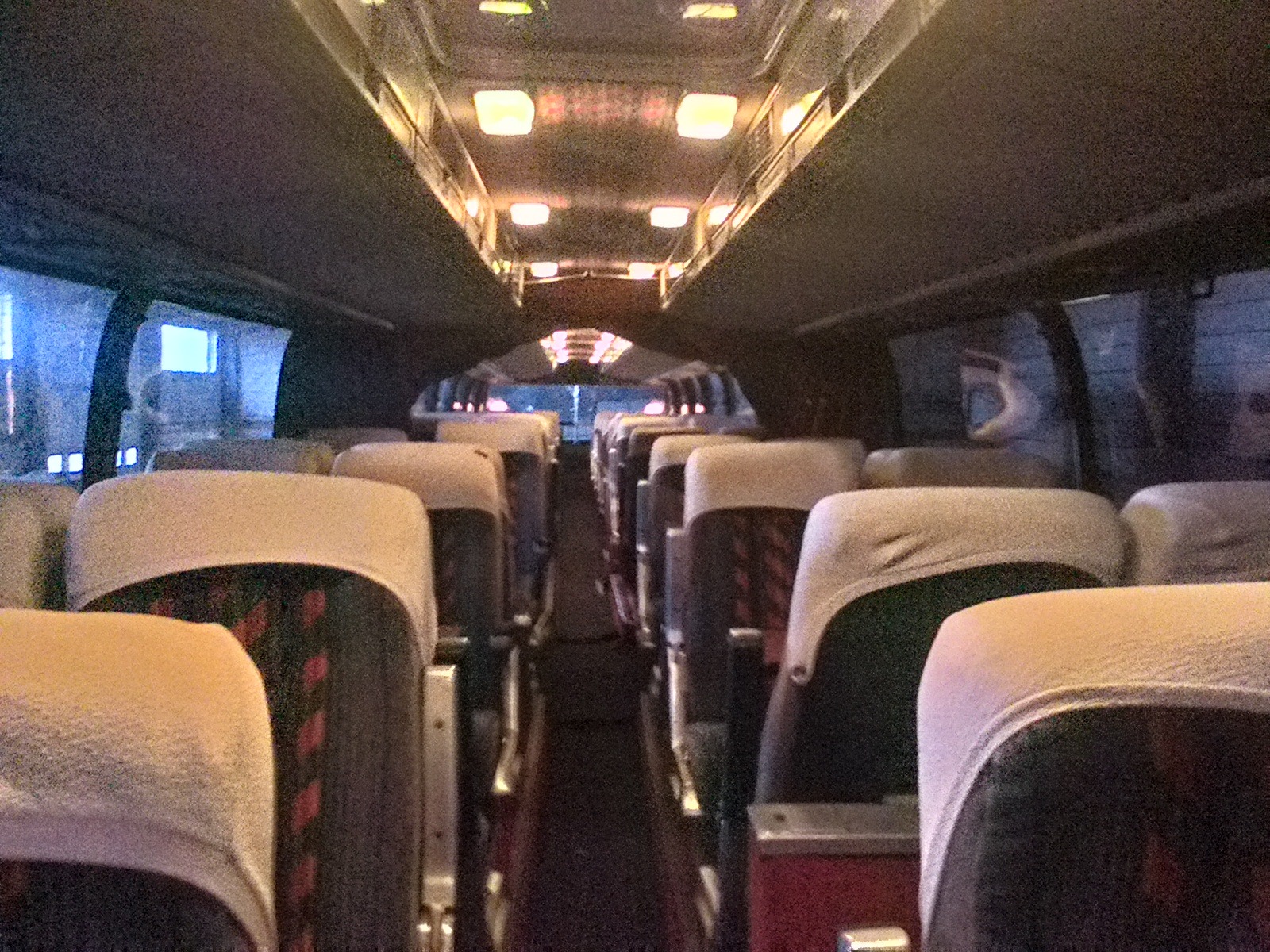
Sadly, this means that only 11 Jumbocruisers were built between 1975 and 1991. What’s interesting is that these buses aren’t all the same. As I noted earlier, one bus had as few as 80 seats to maximize comfort. Some others had around 110 seats to split the difference between luxury and efficiency. Allegedly, at least one Jumbocruiser was configured like the last Frontier flight you were on, and managed to cram 170 seats into the bus.
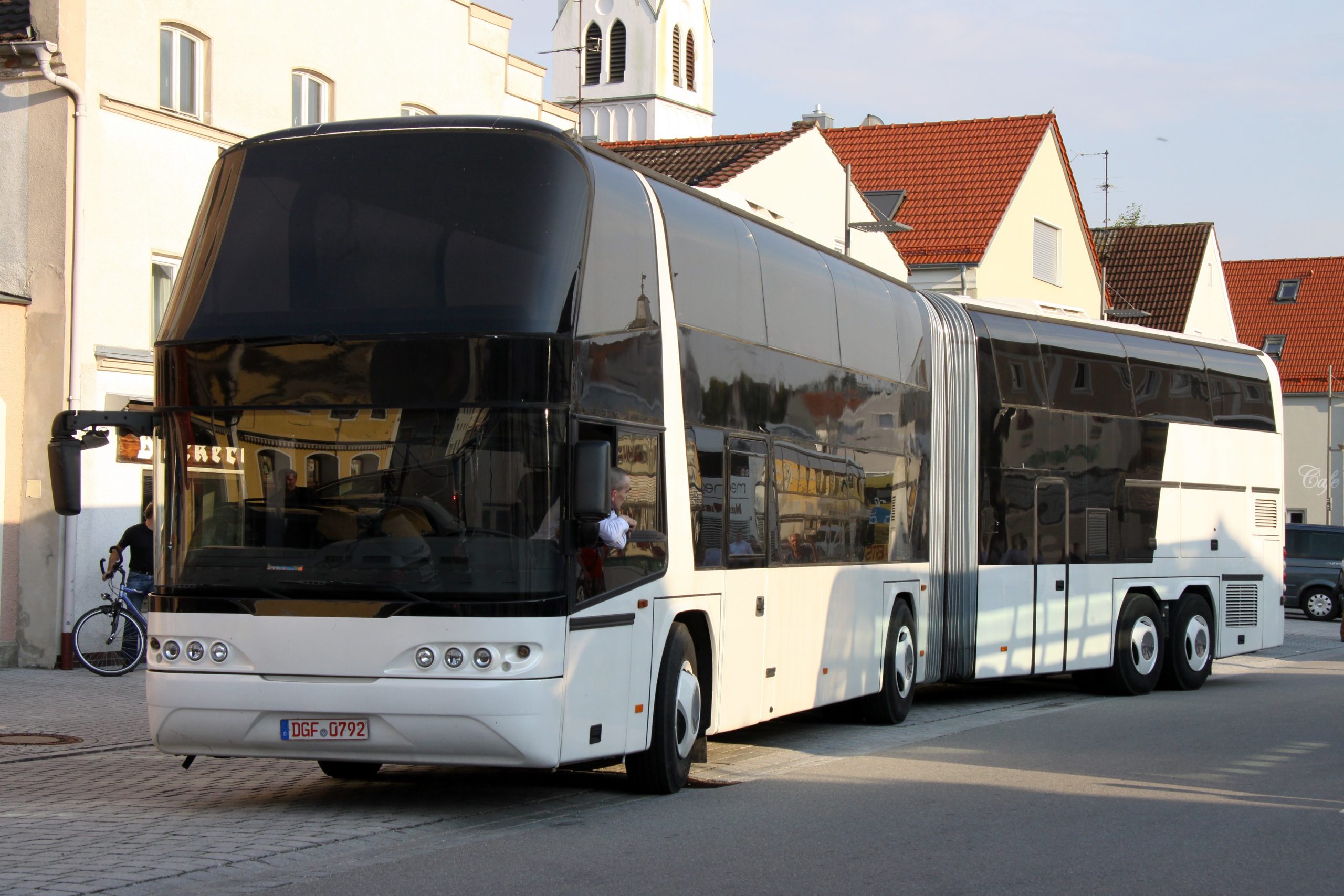
Omnibus Spiegel notes that the coach built in 1991 (pictured below) was ordered by a Bulgarian customer who demanded the engine be placed in the very rear of the bus in the trailer. Because of this, the bus has its drive axle in the rear. That’s actually not that weird, as many transit buses are built in a pusher configuration like this, where the front of the bus is actually the “trailer.” These buses use hydraulic systems to stabilize the bus and keep the rear end from pushing over the front.
Neoplan would take the lessons that it learned in the Jumbocruiser program to create other extremely odd buses, but those will be a story for another time. The Jumbocruiser was also the world’s largest bus for years, but it has since lost its crown. The AutoTram Extra Grand, a German 100-foot-long double-articulated, 256-passenger bus, is bigger.
As for the Jumbocruisers, it’s believed that around nine of them still exist. The very first Jumbocruiser was turned into a motorhome, at least two are in museums, and others are still driving around as promotional vehicles. Neoplan itself was acquired by MAN in 2008, and still makes buses.
The Neoplan Jumbocruiser goes down in bus history as not only the 20th century’s largest bus, but also one of the weirdest. It’s the bus that was the roadgoing equivalent of a Boeing 747, and it was built to solve a problem that was almost always going to be temporary. Yet, it’s also a fine example of just how crazy engineering can get when a company’s designers are allowed to go nuts. The Neoplan Jumbocruiser may no longer be the world’s largest bus, but it still holds a large spot in my heart.
Top graphic image: Neoplan Archiv Konrad Auwärter / Andreas Schneider





_interior_back_view.jpg)
