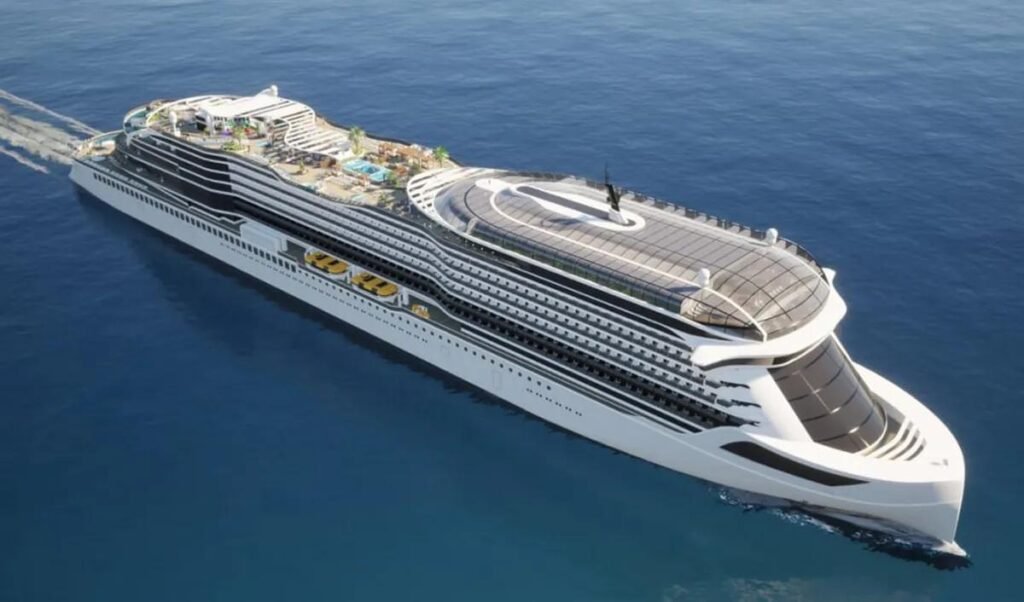
The cruise industry has spent years talking about decarbonization in abstract terms, often pushing timelines far enough into the future that they feel detached from the ships currently sailing. Now, German shipyard Meyer Werft is attempting to collapse that timeline with a concept that is framed less as a provocation and more as a practical blueprint. Called Vision, the project positions itself as the first fully battery-electric cruise ship above 80,000 gross tons, and more importantly, as something that could be built within this decade rather than imagined for the next one.
What makes Vision notable is not just the propulsion system but the size at which Meyer is attempting it. At roughly 275 meters (about 900 feet) in length and designed for 1,856 passengers, this is not a coastal ferry or an experimental yacht. It sits squarely in the mid-sized cruise segment, the kind of ship that defines mainstream itineraries across Europe. By anchoring the concept in that scale, Meyer is effectively saying that electrification is no longer confined to niche vessels but is approaching the commercial core of the cruise business. Furthermore, the company says it can deliver up to a 95% reduction in greenhouse gas emissions compared to conventional cruise ships, as pointed out by Cruise Industry News.

The company is also unusually direct about the limitations. Vision is not being pitched as a transatlantic liner. Instead, it is tailored for short and medium European routes at moderate speeds, with the understanding that longer crossings would require hybrid support or range-extending systems. That framing removes much of the skepticism that typically surrounds all-electric maritime concepts and replaces it with a more grounded narrative that starts in the Mediterranean and Baltic rather than the open Atlantic.

Underneath that positioning sits a staggering engineering challenge. A vessel of this size carries a substantial hotel load that can climb into tens of megawatts before propulsion is even considered. For a voyage such as Barcelona to Civitavecchia, a crossing of roughly 500 nautical miles, the total energy demand begins to scale into hundreds of megawatt-hours. Estimates suggest a system in the range of 400 to 600 megawatt-hours, placing the battery installation among the largest ever conceived for a passenger vessel.

That scale introduces a physical reality that is difficult to ignore. The battery pack alone could weigh as much as ten fully loaded Boeing 747 aircraft while storing enough energy to charge thousands of electric cars. In modular terms, this translates into thousands of battery units and several thousand tons of mass before accounting for cooling systems, structural integration, and power electronics. It is an industrial solution that begins to resemble a floating power plant as much as a cruise ship.

Yet the most visible transformation may not be the battery at all, but what its absence of emissions allows the ship to become. Without exhaust systems, funnels, or vertical shafts cutting through the vessel, the upper decks can be reimagined with uninterrupted sightlines and more usable space. The benefits extend inward, where the removal of conventional engines reduces vibration and noise, shifting the onboard experience closer to that of a high-end resort rather than a mechanical environment.

Meyer is also using the concept to rethink how space is used across the ship. Vision proposes weather-protected, fully glazed public areas and an indoor aqua park positioned lower in the vessel, a response to the realities of year-round European cruising. Even the cabins are being reconsidered, with convertible layouts designed to maintain comfort while improving spatial efficiency. These are not stylistic flourishes but commercial decisions that acknowledge the economics of operating a ship in varied climates.

Taken together, Vision reads less like a speculative leap and more like a calculated step into a constrained but viable future. It does not attempt to electrify every route or replace every ship overnight. Instead, it identifies a segment where the technology, infrastructure, and market demand can align. If that alignment holds, the first fully battery-electric cruise ship may not arrive as a radical disruption, but as a quietly inevitable evolution of how these vessels are built and experienced.