Looming on a screen above a room crammed full of top decision makers from rival airlines across the globe, Emirates President Tim Clark took aim and threw down the gauntlet. His target? The toilet.
“I’m working on en-suite bathrooms in first class,” he told CNN’s Richard Quest via video call at the Center for Aviation (CAPA) Airline Leader Summit in Berlin last month.
“I want everybody to hear that so everybody rushes out the door to find out how they can get bathrooms in first-class suites.”
Restroom refinements may sound like a trivial next frontier, but they’re a potentially pivotal battleground in a highly competitive luxury air travel arms race worth billions of dollars annually, as airlines wrestle to reel in highflyers with deep pockets.
High-end innovation can offer sky-high rewards. Business and first-class cabins generate roughly 15% of passenger revenue despite making up just 3% of passengers, according to trade group the International Air Transport Association (IATA).
Premium-class travel grew globally by 11.8% to 116.9 million passengers in 2024, a report published last year by the IATA said, outpacing the 11.5% rise in worldwide economy travel across the same period.
Air France rolled out its La Première first-class suite last April, offering flyers a 38-square-foot “personalized sanctuary” fit with a full-length bed and personal wardrobe. The same month, European rival Lufthansa launched the latest Allegris first-class cabin that it spent €2.5 billion ($2.8 billion) developing.

In the US sphere, Delta Air Lines’ new 44-seat first-class offering — more than double its typical 20 — is ready for takeoff this month for a limited time as the carrier awaits the delivery of its flatbed suites in 2028, which will replace them.
Yet with just one forward bathroom available among 44 passengers, Delta’s elite service has a relative lack of lavatories — an issue shared by every premium package bar one. Since 2015, Etihad Airways has arguably set the pace with The Residence, a three-room airborne apartment that, to date, features the only truly “private” bathroom in commercial aviation.
With space itself a premium commodity on aircraft (Emirates’ A380 first class, for example, has two shower suites and three lavatories between 14 seats), Clark’s plans for personal bathrooms might seem fanciful — were it not for the fact that one of his primary manufacturers has already begun scheming for their arrival.
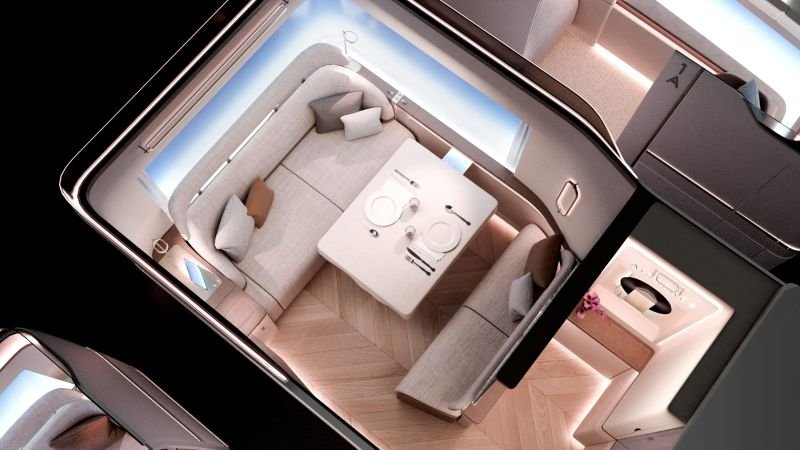
Just over a week before the CAPA summit, Airbus — one half of the aerospace industry duopoly, alongside Boeing — unveiled the concept for its next generation of first-class cabins coming to its flagship aircraft, the A350-1000.
Integral to the design was the master suite, a sweeping living area large enough for two passengers that features a double bed, dressing area, private bar and, yes, an en-suite bathroom.


It’s a reflection of a growing trend in first-class tastes, says Ingo Wuggetzer, Airbus head of cabin marketing, “absolute privacy.”
“Now everybody is going to suite arrangements with closed doors, high walls, complete suites,” Wuggetzer told CNN.
“I would love to fly in such an arrangement where you don’t have to go out and use the public toilet if you really want to have your privacy,” he added.
So, as Clark goaded, how would they fit in?
Airbus’ solution is to relocate key “monuments” — toilets, storage closets and the crew staircase — to a new “center module” opposite the cockpit door, freeing up maximum space for the master suite between two aisles in the middle of the cabin. It’s a reshuffle that, by virtue of the rerouted stairs, reduces crew foot traffic in first-class aisles, adding another layer of privacy.

Based on 18 months of discussions with major airlines and passengers, the concept is, Wuggetzer stresses, just that: a concept. While Airbus’ in-house design team “interpret” the requirements of first-class flyers, it is ultimately up to respective airlines to stamp their own bespoke identity on their visualizations.
“It’s about understanding the needs of the end user,” he explained. “It’s not us that are really building the final product. We are enabling it.”
As such, the possibilities for the master suite space are, effectively, limitless. From a sauna to an exercise zone or communal area, designed like a luxury lounge or networking hub in the sky, Wuggetzer can envision all manner of future uses.
Such visualizations of the future are a testament to Wuggetzer’s “absolute” faith in the long-term prosperity of first-class travel, amid some airlines scaling back top-tier offerings to instead beef up business-class seats.
“First class will not exist … at American Airlines for the simple reason that our customers aren’t buying it,” American’s former chief commercial officer Vasu Raja told CNN in 2022, with the airline steadily phasing out first-class seats in favor of “Flagship Suites.”

The number of first-class seats per plane is indeed dropping, said Wuggetzer but he insists this is intentional. Cutting down increases a sense of exclusivity that is key to airlines building their brand.
“What we see is that the first-class volume overall in the market is very stable,” he said.
“Like every car manufacturer, you always have a flagship, and this is attracting a lot of passengers, even if it’s not affordable (to many) … even if some airlines have a very high-end business class, they still invest in developing first class.”
To date, 10 customers have opted to feature first-class cabins in orders of the A350, Airbus says, and several more are in early talks to add them. Five carriers are currently in the “customization phase,” potentially considering implementing elements included in the concept — with the first to enter service around 2030.
“It is always good to reflect that we are not (just) doing nice renderings,” Wuggetzer said. “It’s about customers buying it and proving that this is valuable for them.”


