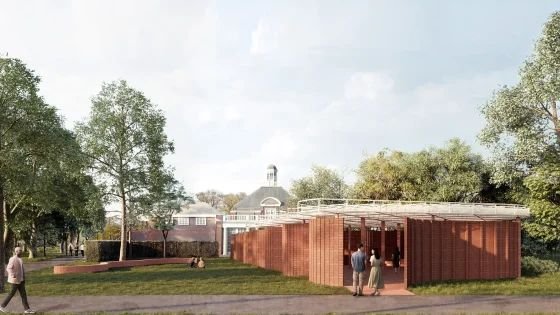
The Mexico City-based studio, founded by Isabel Abascal and Alessandro Arienzo in 2015, has designed the 25th temporary structure in the gallery’s ongoing series of annual architectural commissions at its home in Kensington Gardens, London.
LANZA Atelier is known for its ‘hands-on design methods’ and as a collaborative practice ‘rooted in the everyday and the informal, attentive to how technology, craft and spatial intelligence emerge in unexpected conditions’, often reinterpreting familiar forms and materials. The duo use hands-on methods such as drawing and model-making, and works globally.
Its design for the pavilion is inspired by the crinkle-crankle wall – a wavy structure that originated in ancient Egypt but was popular during the 18th century, particularly in East Anglia. The wall forms one side of the pavilion, with its curvilinear form providing stability through lateral support and being just a single brick wide, requiring fewer bricks than a straight wall.
Unveiling the scheme earlier this year, the gallery said: ‘The eponymous feature also subtly nods to the nearby Serpentine lake, named for its gentle curvature, evoking the form of a serpent.’
The main space has a translucent roof resting lightly on brick columns, ‘evoking a grove of trees’ to allow light and air into the pavilion, ‘softening the boundary between enclosure and openness’.
According to the gallery, LANZA Atelier chose brick as the primary material ‘to celebrate the distinctly English garden tradition’ and to echo the existing brick façade of the 1930s Serpentine South Gallery, which was once a tea pavilion.
LANZA Atelier has also designed the pavilion’s chairs and stools, made locally from sapele hardwood, continuing its practice of regarding furniture and architecture as part of the same design process.
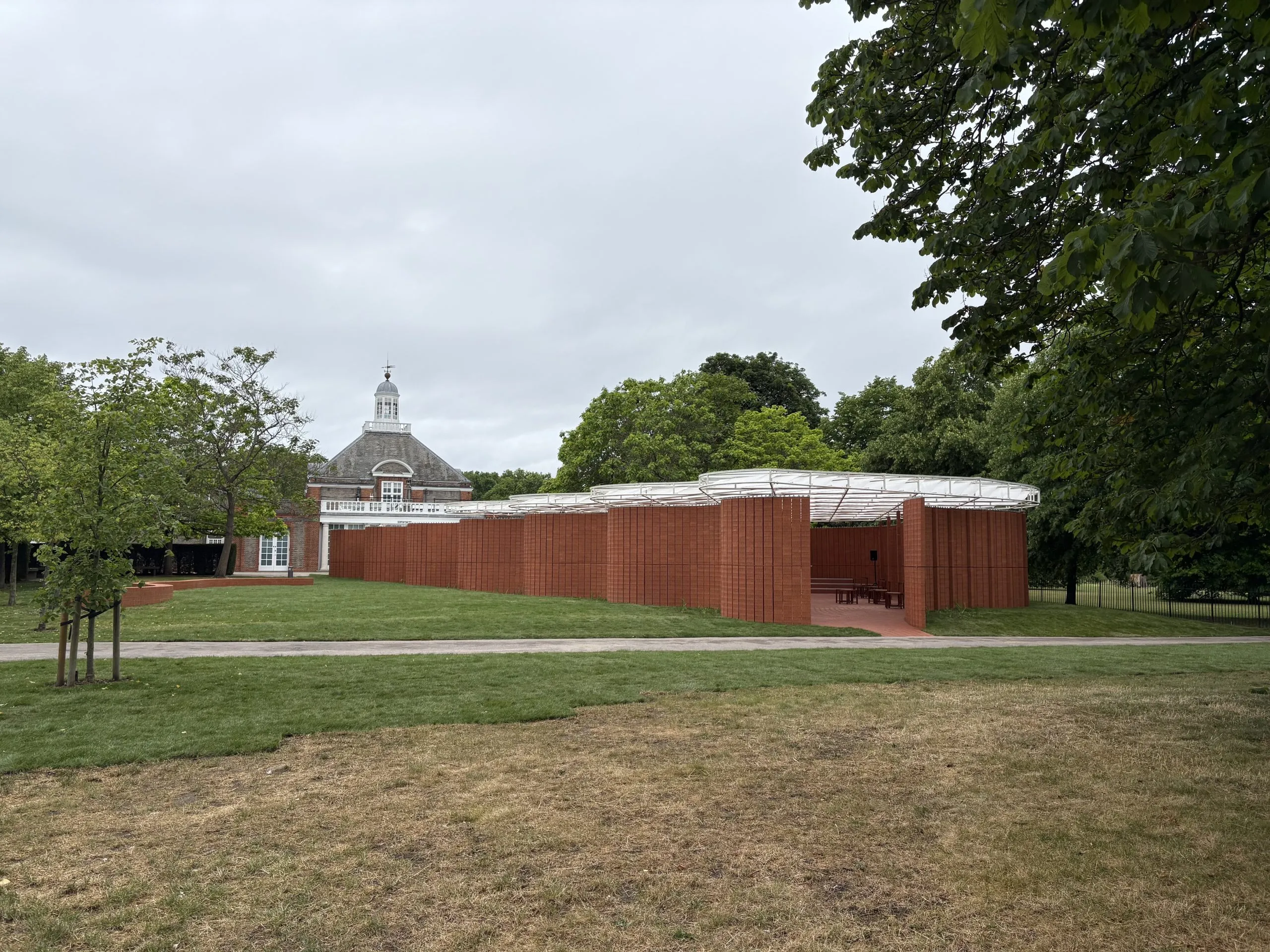
LANZA Atelier’s 2026 Serpentine Pavilion
Explaining its design approach, LANZA Atelier said the pavilion was ‘an evocation of the natural world, [taking] the form of a serpentine wall, conceived as a device that both reveals and withholds: shaping movement, modulating rhythm and framing thresholds of proximity, orientation, and pause.
‘Inspired by the figure of the serpent as a generative and protective force, we draw a parallel with England’s winding fruit walls, which are structures that temper climate, create shelter and enable growth. From this idea emerges a pavilion built of simple clay brick, foregrounding vernacular craft and the elemental capacity of architecture to bring people together.’
Serpentine chief executive Bettina Korek said: ‘For 25 years, the Serpentine Pavilion has been a leading global platform for architectural experimentation.
‘[It] offers a rare brief: to test ambitious ideas in an open, accessible setting. Conceived as a structure that extends beyond its walls, the pavilion connects architecture, landscape, and people. With LANZA Atelier, we strengthen cultural exchange with Mexico and reaffirm the pavilion as a free, civic space of connection, central to our summer and autumn programmes.’
The Serpentine’s programme began over 25 years ago in 2000 with a pavilion designed by Zaha Hadid. Initially, it gave international names, such as Frank Gehry and Jean Nouvel, the chance to build their first scheme in the UK. In recent years, the gallery has focused more on championing up-and-coming talent from around the globe (see full list of previous designers below).
Last summer’s scheme, Marina Tabassum’s ‘quietly dignified’ A Capsule in Time, featured a symmetrical timber-arched, semi-open structure in a capsule-like form. Archigram co-founder Peter Cook also designed a second pavilion to stand near the regular Serpentine pavilion, focused on play, and inspired by Zaha Hadid’s ‘pioneering spirit’.
LANZA Atelier’s pavilion opens this weekend (6 June) and remains open until 25 October. For the 12th year running, the programme has been supported by Goldman Sachs.
To mark it being the 25th pavilion and to celebrate the legacy of its inaugural architect, Zaha Hadid, a special collaboration between the Zaha Hadid Foundation and the Architectural Association will also take place.
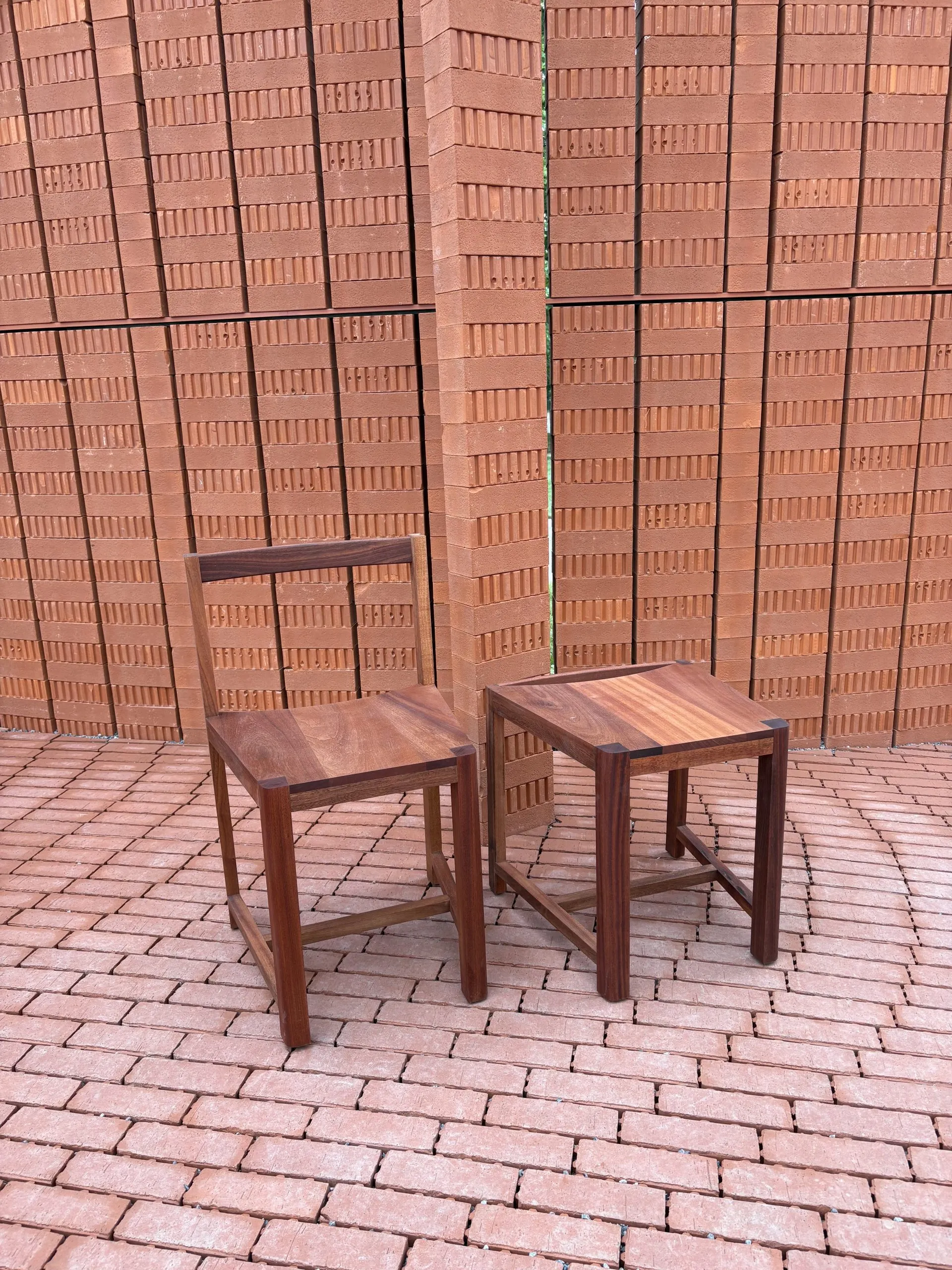
LANZA Atelier’s 2026 Serpentine Pavilion
Serpentine Pavilion history
- 2026 LANZA Atelier (Isabel Abascal and Alessandro Arienzo)
- 2025 Marina Tabassum
- 2024 Mass Studies
- 2023 Lina Ghotmeh
- 2022 Theaster Gates
- 2021 Counterspace
- 2019 Junya Ishigami
- 2018 Frida Escobedo
- 2017 Diébédo Francis Kéré
- 2016 BIG – Bjarke Ingels
- 2015 SelgasCano
- 2014 Smiljan Radic
- 2013 Sou Fujimoto
- 2012 Herzog & de Meuron and Ai Weiwei
- 2011 Peter Zumthor
- 2010 Jean Nouvel
- 2009 Kazuyo Sejima and Ryue Nishizawa, SANAA
- 2008 Frank Gehry
- 2007 Olafur Eliasson and Kjetil Thorsen
- 2006 Rem Koolhaas and Cecil Balmond with Arup
- 2005 Álvaro Siza and Eduardo Souto de Moura with Cecil Balmond, Arup
- 2004 MVRDV with Arup (unrealised)
- 2003 Oscar Niemeyer
- 2002 Toyo Ito and Cecil Balmond with Arup
- 2001 Daniel Libeskind with Arup
- 2000 Zaha Hadid


