
The year 2025 has been nothing short of transformative for Greek archaeology. From the skies of Crete to the depths of the Ionian Sea, a series of remarkable finds have forced historians to redraw the map of the ancient world.
These discoveries demonstrate that Greece’s soil and seas still hold secrets capable of upending established history.
Archaeological discoveries of 2025 in Greece
The mystery of the Minoan “labyrinth.”

The most breathtaking discovery of 2025 is undoubtedly the monumental circular complex of Papoura Hill, Crete. Unearthed at an altitude of 494 meters during the construction of the new Kastelli Airport, this 4,000-year-old architectural marvel has been hailed as the ‘Minoan Labyrinth’.
Winner of the 2025 Palmyra Award, this complex consists of eight concentric stone rings and a maze-like interior. Unlike the famous palaces of Knossos or Phaistos, this site was likely a communal ritual center. The 2025 excavations revealed vast quantities of animal bones and ritual vessels, suggesting it was a place of grand religious feasts dating back to 2000–1700 BC. It is a unique architectural form previously unknown to Minoan civilization.
Inscriptions explicitly bearing the name “Odysseus.”
On the island of Ithaca, the search for the legendary King of the Odyssey reached a fever pitch. Archaeologists identified a site containing tile fragments and inscriptions explicitly bearing the name “Odysseus.”
This discovery confirms the existence of a widespread “hero-cult” where ancient Greeks worshipped Odysseus as a historical and religious figure, bridging the gap between myth and archaeological reality.
The Palace of Pella opens
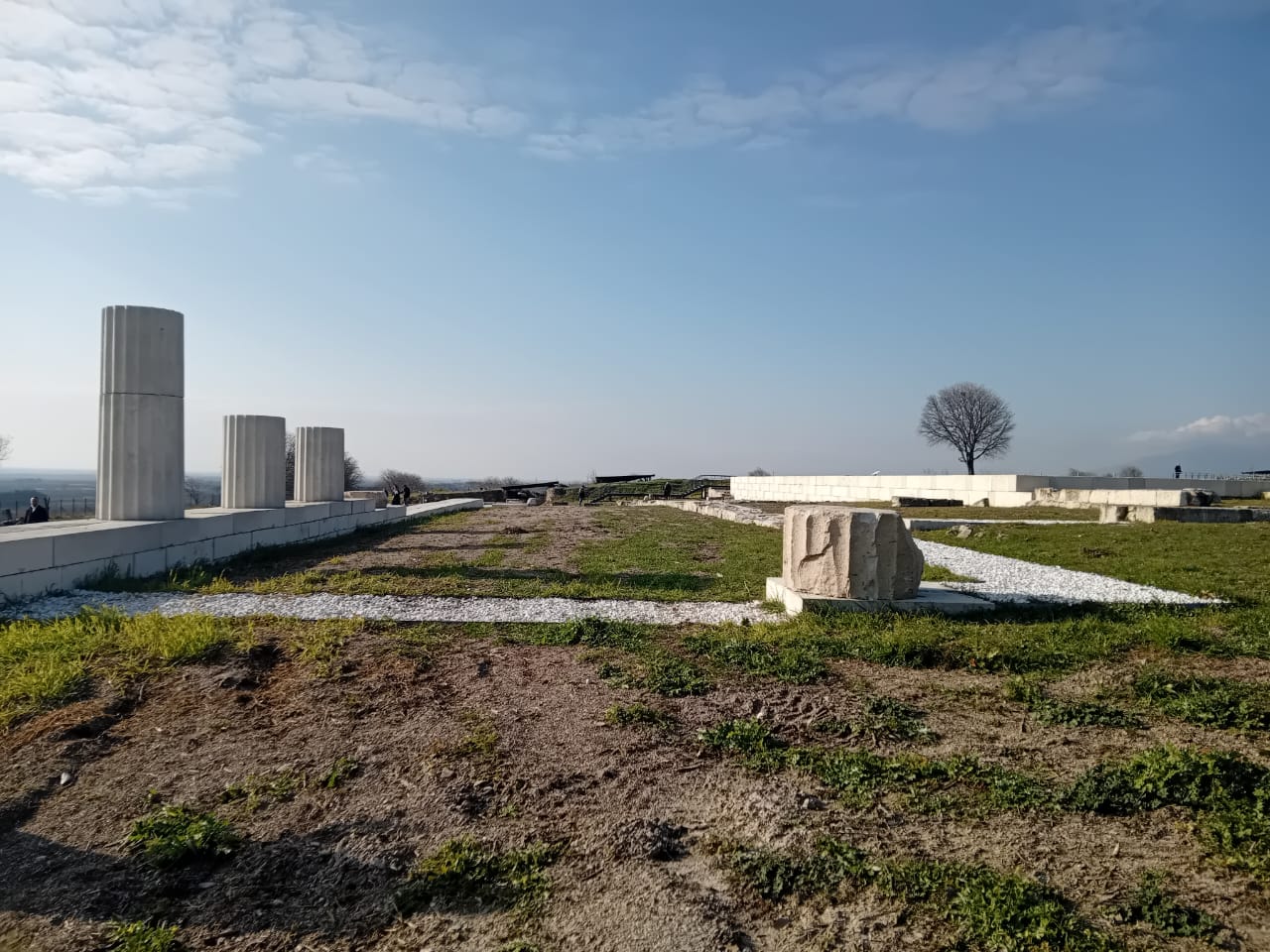
Meanwhile, in Northern Greece, the Palace of Pella—the birthplace of Alexander the Great—finally opened to the public in December 2025. To mark the occasion, the museum unveiled two newly restored Hellenistic marble statues that had been hidden in conservation for years, offering a fresh look at the artistic peak of the Macedonian court.
Secrets from the deep: The Antikythera breakthrough

Underwater archaeology saw its greatest triumph in decades at the Antikythera Wreck. In the final season of a five-year mission (concluding July 2025), divers achieved what researchers have dreamed of for over a century.
A significant section of the ship’s original wooden hull was recovered, confirming “shell-first” construction techniques. Also, a life-sized marble foot and leg were pulled from the seabed, believed to belong to one of the massive statues whose fragments (including a head of Heracles) were found in previous years.
Ten shipwrecks off Kasos Island
Ten shipwrecks found in the Kasos Island “Graveyard” were fully documented this year, revealing trade connections that stretched as far as Spain and North Africa as early as 3000 BC.
Redating an ancient catastrophe
A small piece of olive wood found in the volcanic ash of Thirasia in Santorini provided the “smoking gun” for Mediterranean chronology. Through advanced carbon dating in 2025, scientists have shifted the date of the cataclysmic Thera eruption to the early 16th century BC. This small adjustment is monumental, as it forces a recalibration of the timelines for the Egyptian New Kingdom and the Minoan collapse.
Archaeological discoveries of 2025 in the ancient Greek world
While the discoveries in Greece have been spectacular, the wider “Greek World” in Turkey and Egypt has also yielded incredible finds in 2025. These discoveries highlight the massive influence of Hellenistic culture across the Eastern Mediterranean.
Teos: The artistic guilds

In March 2025, archaeologists at the ancient Greek city of Teos (Izmir) made a breakthrough at the bouleuterion (city council building). They uncovered a stunning Hellenistic mosaic featuring fighting cupids (Eros figures). More importantly, they found a partially erased inscription that confirms Teos was the world headquarters for the Dionysian Artists—the most powerful guild of actors and musicians in the ancient world.
The paw prints of Heracleia
In January 2025, paw prints found on artifacts in the ancient Greek city of Heraclea (Herakleia) in today’s southwestern Turkey show that local inhabitants loved their animals. The excavations unearthed artifacts such as figurative mosaics, oil lamps, bricks with paw prints, and tombs containing animal skeletons buried beside humans, which are considered indicators of the love for animals and nature among the people who lived in Heraclea 2,000 years ago.
The sunken port of Taposiris Magna
In one of the most publicized events of the year, National Geographic Explorer Kathleen Martínez and Bob Ballard identified a submerged port off the coast of Taposiris Magna in Egypt.
Sunken Port Discovered at Taposiris Magna Temple Site, Alexandria. More details & photoshttps://t.co/Op0XCqnf6G #Egypt #Sunkenantiquities #Archaeology @yukinegy @archeohistories pic.twitter.com/Ri6fzRXMHT
— Luxor Times (@luxortimes) September 18, 2025
The site contains polished floors, massive columns, and Hellenistic-era anchors. This discovery strengthens the theory that this temple complex was a massive maritime hub—and potentially the site of Cleopatra VII’s long-lost tomb.
The Alexandria “sacred barge”
Archaeologists have uncovered a rare first-century Egyptian pleasure boat off Alexandria’s coast—matching a description written by Strabo over 2,000 years ago.#Alexandria #Strabo pic.twitter.com/HtWXZ3X9jA
— Tom Marvolo Riddle (@tom_riddle2025) December 8, 2025
Divers from the European Institute for Underwater Archaeology (IEASM) discovered a 35-meter luxury pleasure boat in the Bay of Alexandria. The vessel is covered in Greek graffiti and inscriptions. Archaeologists believe it may have been a “sacred barge” used by the Greco-Egyptian elite during the Navigium Isidis (a festival for the goddess Isis, who was worshipped by both Greeks and Egyptians).
Ostraca of the Abydos Dynasty
An Egyptian-American mission found 32 ostraca (pottery fragments used as paper) inscribed in both Demotic and Greek. These “ancient receipts” detail tax payments and trade, providing a rare window into how Greek administrators managed the Egyptian economy during the 3rd century BC.
Bone repository in Sicily
Archaeologists in the ancient Greek city of Gela (Greek: Γέλα), Sicily, have unearthed a well-preserved bone repository dating back to the early sixth century B.C. The discovery, made during excavation work, includes a large clay vessel repurposed as a funerary container for an infant. Human remains were still inside when it was found. Experts say the find provides crucial evidence of burial customs practised by Greek settlers in Gela more than 2,500 years ago.


