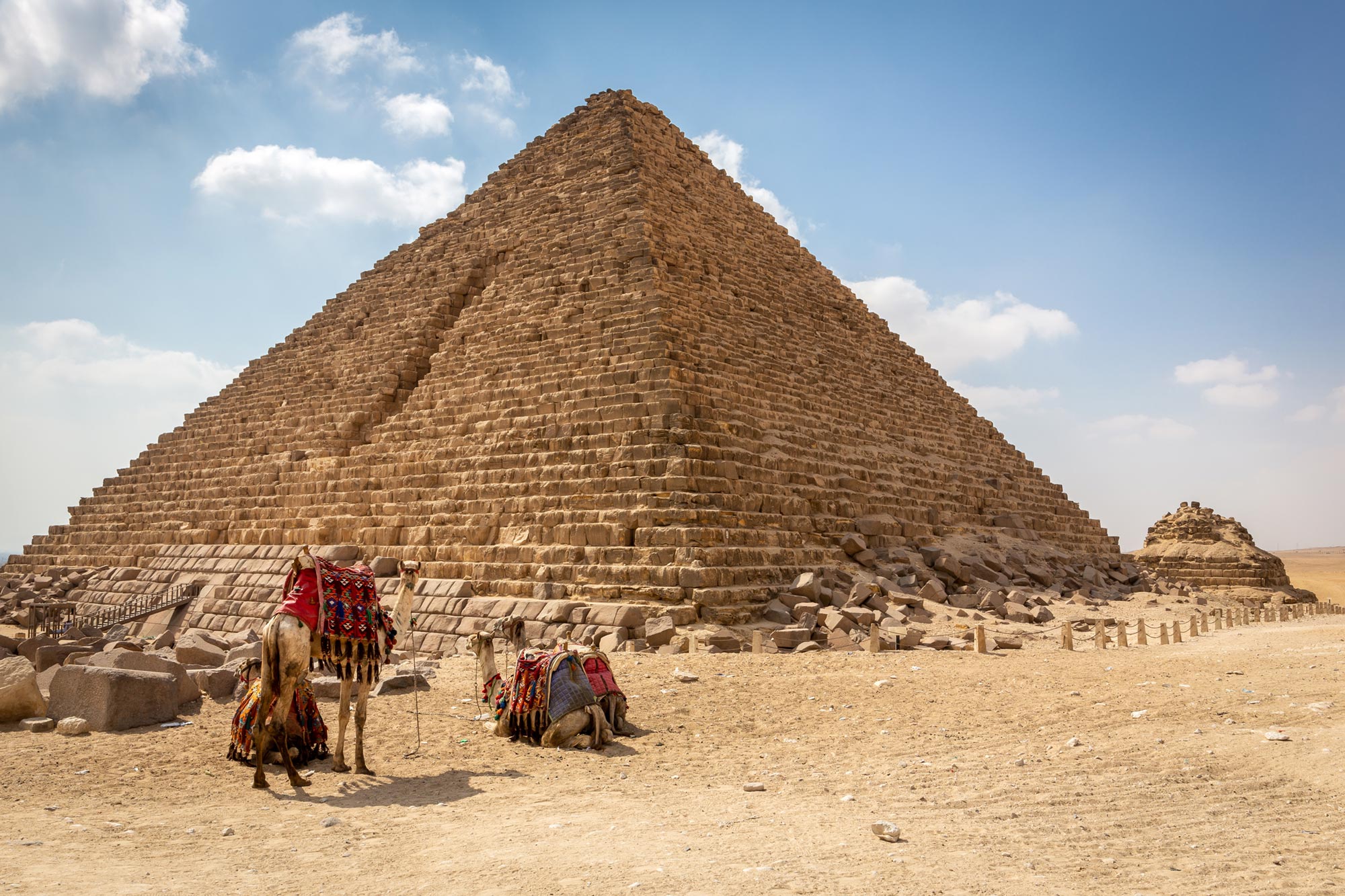
New imaging data uncovered two concealed voids in the Menkaure Pyramid, offering strong evidence for a potential second entrance.
Researchers from Cairo University and TUM working with the ScanPyramids project have uncovered two hidden air-filled spaces inside the third-largest pyramid at Giza. For years, archaeologists suspected that an additional entrance might exist on the eastern side of the Menkaure Pyramid, and the new findings offer the first scientific support for that idea. By using radar, ultrasound, and electrical resistivity tomography (ERT), the team confirmed the presence of two voids beneath the eastern exterior, strengthening the long-standing hypothesis.
The unusually polished granite blocks on the pyramid’s eastern face have puzzled experts for some time. This smooth section, about four meters tall and six meters wide, resembles the finish used at the pyramid’s known entrance on the north side. In 2019, researcher Stijn van den Hoven suggested that this distinctive stonework might mark the location of a second entrance.
Image Fusion of all measured data is decisive
A team from Cairo University and TUM reexamined the eastern face as part of the ScanPyramids mission and detected two anomalies behind the smoothed stone surface. Through non-destructive techniques that included georadar, ultrasound, and electrical resistivity tomography, they were able to pinpoint two air-filled cavities. This marks the first confirmed evidence of structural voids behind the polished eastern facade.
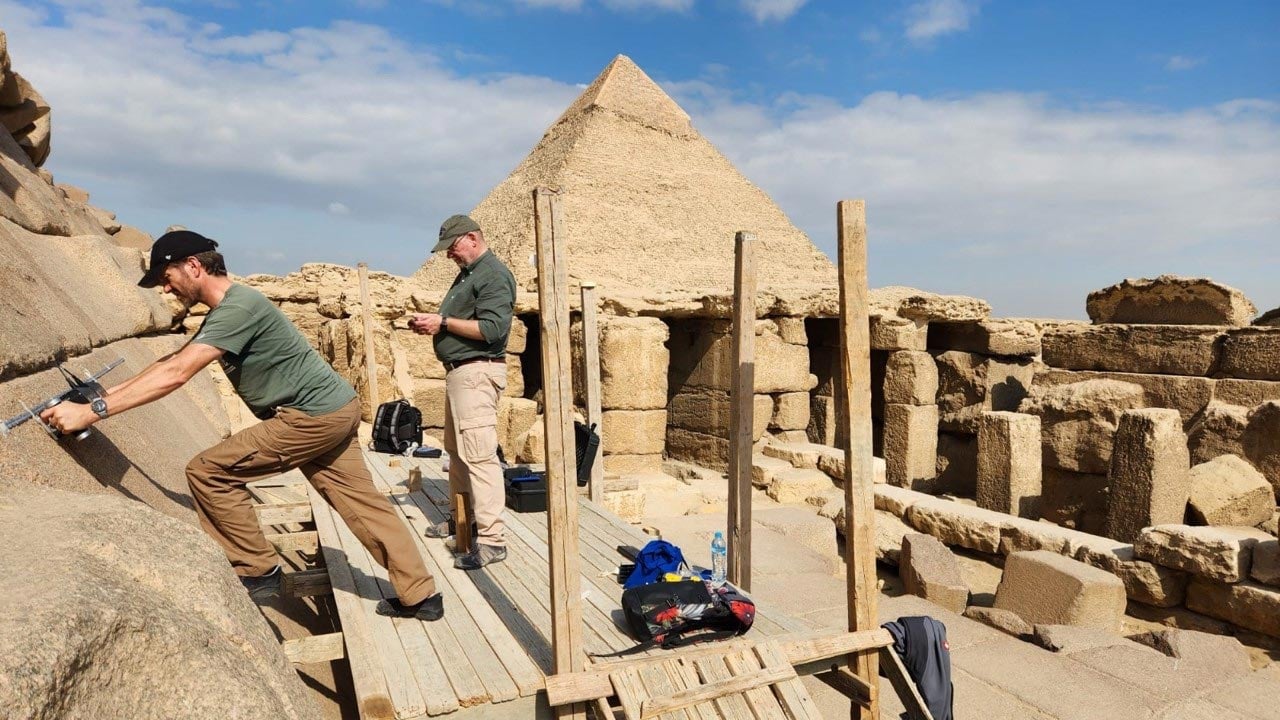
The two air-filled anomalies are located at a depth of 1.4 meters and 1.13 meters behind the outer facade, measuring 1 meter high by 1.5 meters wide and 0.9 meters by 0.7 meters respectively. Such a precise determination of the air-filled voids is only possible by combining all the measurement data. The Image Fusion method used for this was decisive in confirming the find.
“The hypothesis of an entrance is very plausible”
“Following the significant validation of a hidden corridor in the Pyramid of Cheops in 2023, ScanPyramids has once again succeeded in making an important finding in Giza. The testing methodology we developed allows very precise conclusions to be drawn about the nature of the pyramid’s interior without damaging the valuable structure. The hypothesis of another entrance is very plausible, and our results take us a big step closer to confirming it,” says Christian Grosse, Professor of Non-destructive Testing at TUM.
Reference: “Detection of two anomalies behind the Eastern face of the Menkaure Pyramid using a combination of non-destructive testing techniques” by Khalid Helal, Polina Pugacheva, Hussien Allam, Mohamed Fath-Elbab, Mohamed Sholqamy, Olga Popovych, Simon Schmid, Benedikt Maier, Amr Galal, Alejandro Ramirez, Johannes Rupfle, Khalid Taie, Menna Ali, Clarimma Sessa, Thomas Schumacher, Zahi Hawass, Mehdi Tayoubi, Christian U. Grosse, Hany Helal and Mohamed Elkarmoty, 25 April 2025, NDT & E International.
DOI: 10.1016/j.ndteint.2025.103331
Funding: The Science, Technology & Innovation Funding Authority (STDF), la Fondation Dassault Systèmes, NHK, TNG Technology Consulting, Mondaic AG. TUM was directly supported by TUM IGSSE and the DAAD (German Academic Exchange Service).
Never miss a breakthrough: Join the SciTechDaily newsletter.
Follow us on Google and Google News.