Homeownership can be stressful. Buying and managing a vacation property, perhaps even more so. Beyond the time and resources necessary to finance and maintain a second home, there’s the constant pressure to spend enough time there to justify the investment. But one Bay Area friend group seems to have solved these issues in one fell swoop by purchasing a vacation home together in Central California.
“We thought it would be super special to share a space and take on the joint burden, financial and logistical, of a second home together,” says Phil Levin, who purchased an 11-acre property in Big Sur with 15 of his friends through an LLC. Throughout the year, the group, along with their kids, pets, and guests, cycle in and out of the lot’s three dwellings—a three-bed home, two-bed cottage, and artist’s studio—coordinated with a shared Google Calendar.

A few of the owners gather at the main house around a table and chairs from West Elm.
“People will just put on the calendar when they’re going to be there, and then they’ll specify that they’re requesting the main house or three bedrooms, or whatever,” explains CeCe Gehrig, another one of the owners. Aside from the rare instance where a co-owner requests the entire space for a private family getaway or work off-site, she explains that there’s always an eagerness to share the space with other families, even pulling out air mattresses if necessary. That means the home rarely sits empty for extended periods of time.
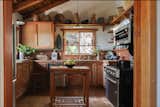
The Douglas fir cabinetry in the kitchen in the main house is original, built in 1982. So is the tile backsplash, the faucet, and the range. The island, a vintage oak table, was sourced from Facebook Marketplace by co-owner and designer CeCe Gehrig.
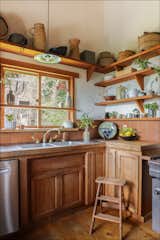
Open shelving displays vintage and antique Japanese pieces.
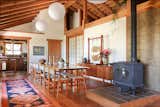
The dining table is made from two live-edge butcher block pieces; the table legs were sourced from Urban Ore in Berkeley. The vintage teak chairs are by BRDR.
The project traces its origins, like countless other experiments in offbeat West Coast living, to Burning Man, the weeklong event in the Nevada desert that is part art festival, part nature retreat, and part communal exercise in building a temporary utopia.
“A lot of the people originally involved in the project had been to Burning Man together before and helped build things before in that context,” says Katherine Campbell Hirst, another of the owners, who’s based in Brooklyn. About a decade ago, several co-owners started a camp at the festival that became an annual effort that involved building a snail-shaped art car and a pop-up garden oasis. From that experience of collaboration, “we knew that we could operate, manage a budget, make decisions as a group before we did it,” says Hirst.
Eventually, as the group continued to build their Burning Man camp together, started to vacation together, and in some cases signed apartment leases together, they started sending Zillow links to their group chat. “The WhatsApp thread was just posting cool things we saw on Zillow,” Gehrig remembers. “It was just sort of like, wouldn’t this be neat?” But a property that accommodated a large, community-focused group, it turns out, wasn’t exactly easy to do a search for. “There wasn’t really a category for a community house on Zillow. The typical homes and so many that we were looking at were very much set up for the nuclear family,” says Gehrig.
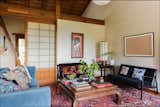
A floor plan of the main house hangs on the wall in the living room above one of two midcentury Italian sofas. The 8070 table lamp in the corner is by Arthur Jacobs for Modeline of California.
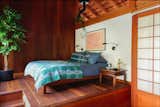
The main bedroom has a quilt and throw pillow by Neon Doves and framed elevation plans of the home hanging above the bed.
“The WhatsApp thread was just posting cool things we saw on Zillow. It was just sort of like, wouldn’t this be neat?”
—CeCe Gehrig, co-owner
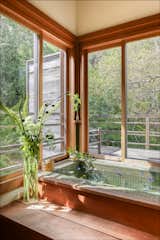
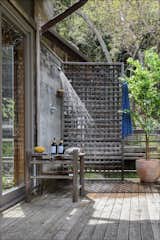
A soaking tub connects with an outdoor shower.
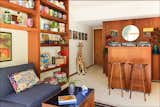
Gehrig and co added built-in shelving to a lounge area, complete with a midcentury Danish bar used as a DJ table and vintage teak stools to match.
They eventually settled on the Big Sur property, originally built in the 1970s by jazz musician Charles Lloyd and designed by his wife, Dorothy Darr. According to Lloyd’s website, he spent many of his Big Sur years performing across the West Coast alongside poets and bands including Charles Bukowski and The Beach Boys. As he saw greater success, his tours brought him to Japan, a global hotspot for jazz music. “I’m assuming, too, that heavily influenced his design aesthetic,” says Gehrig, pointing to the home’s minimalist, nature-inspired finishes. “There’s a lot of the principle of whatever exists in the outdoors, bring that to the indoor spaces,” which the Gehrig and her friends attempted to reflect with an emphasis on organic materials and solid colors—with a few statement pieces thrown in to satisfy some of the owners’ more maximalist tastes.
After purchasing the property in 2021, the biggest challenge was furnishing a home for a large group, and doing so within budget. “How do we find a dining table that’s big enough for all of us that is actually not wildly expensive?” says Gehrig, a designer with her own firm, CCG, who was charged with refreshing the interiors. After combing Craigslist, Facebook Marketplace, and secondhand shops around the Bay Area, Gehrig ultimately went a DIY route with live-edge wood slabs from Home Depot and table legs sourced from Etsy.
What enabled the group to take the project out of the group chat—and keeps it working well today without major conflicts—was the trust the friends built up over years of collaborating and cohabitating well. “What people think this looks like is a ton of meetings and a ton of votes and a ton of consensus,” says Levin. But unlike “people,” Levin has experience with making arrangements like this work. He’s the founder of Live Near Friends, which helps people buy and build housing next to friends and family, and whose experiments in cohousing extend to his primary residence, Radish Oakland, a community with 20 adults and 8 children living in 10 homes. (Levin is also a cofounder of Culdesac in Phoenix, billed as America’s first car-free neighborhood.) “When you have a close group of friends, they really trust each other. People just are naturally very good at doing the right thing without a lot of deliberation.”
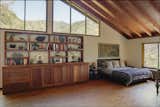
The studio unit has built-in shelving decorated with kokeshi dolls and ceramics. The wool blanket and throw pillows on the bed are by Neon Doves.
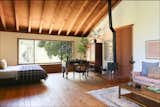
The studio has a woodburning stove accompanied by woodblock prints from Adachi Hanga.
In practice, that means much of the work of buying, decorating, and maintaining the Big Sur property has operated on what Levin calls a “do-ocracy.” He explains that owners “do-ocratically pick the things they feel strongly about.” Levin, for example, manages the finances, which included setting up the LLC with which he and his friends purchased the property, issuing shares based on owners’ initial contributions, and managing a capital fund for any renovations or maintenance. Gehrig, of course, took on design and decor, a task Levin should never be in charge of, he says.
For anyone currently having flashbacks to living with roommates who ignored the chore wheel and allowed dirty dishes to pile up and overflowing trash to fester—or maybe you were that roommate—Levin recognizes that certain tasks aren’t for everyone. “I know it sounds hard to believe, but they just sort of all get done,” he says. “When you go there, you’re just like, what needs to get done? And if you’re the person there, you do it because you’re there.”
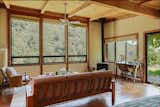
The cottage has a Finn Juhl 133 armchair and a blonde teak sofa by Asko.

A shed on the property was turned into an office.
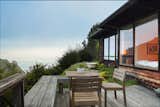
The cottage has built-in benches and its own view of the ocean.
Any bigger decisions about renovations, finances, or adding new members are reserved for an annual investor meeting, which takes place in person at the Big Sur property. The co-owners note, however, that these days, the gathering is more family reunion than business meeting, as the once-childless group has now expanded with seven kids amongst the 16 owners. That’s by design, to maximize quality time and minimize bureaucracy for co-owners already busy in their day-to-day lives managing families, jobs, and primary homes.
For Hirst, that emphasis on community rather than process is what makes the whole experiment worth it. “If any one of the couples involved in this owned the house on their own, it would be an insurmountable amount of work to do on top of having a family to have the property, to manage it, to maintain it, to look after it,” she says. “To divide that between everyone and then have all the joy, it’s so great.”
Related Reading: