For those eager to see the world, air travel is a necessity. And with commercial airlines operating out of 9,000 airports across the globe (according to Sentinel Aviation), there’s no shortage of options. Not every one of them is created equally; these are the worst airports you’ve ever traveled through, complete with long lines, confusing signs, and derelict interiors. There’s even at least one airport imposing a hug time limit. Nevertheless, one of the biggest ways airports can differ is how passengers are transported to the aircraft itself. While many utilize gangways, which are essentially bridges that extend from the terminal to the doors of the passenger jet, there are exceptions. Washington Dulles International Airport, for instance, utilizes “Mobile Lounges” – bus-like conveyances that take passengers from the terminal to the aircraft, sitting at more than 17 feet high.
However, in the 1980s, the country of Hungary experimented with equally strange vehicles from Ikarus, referred to as P.A.L.T (passenger and luggage together). Resembling a typical bus upon first inspection, these unique rides featured an extension which expanded diagonally, creating an interior set of stairs that could extend to an aircraft’s door. Basically, think of a set of airstairs incorporated into a bus. Ironically, this eliminated the need for airstairs altogether and could’ve potentially altered the boarding process forever.
The first model was introduced in 1982, could accommodate 150 people, required two drivers, and came equipped with an inline six-cylinder diesel. A much larger version was released by Ikarus in the years following, and that model was even set to bring travelers to their hotel. But the project ended in 1986, with none of the P.A.L.T. vehicles going into production.
Why don’t more airports use buses for passenger airline boarding?
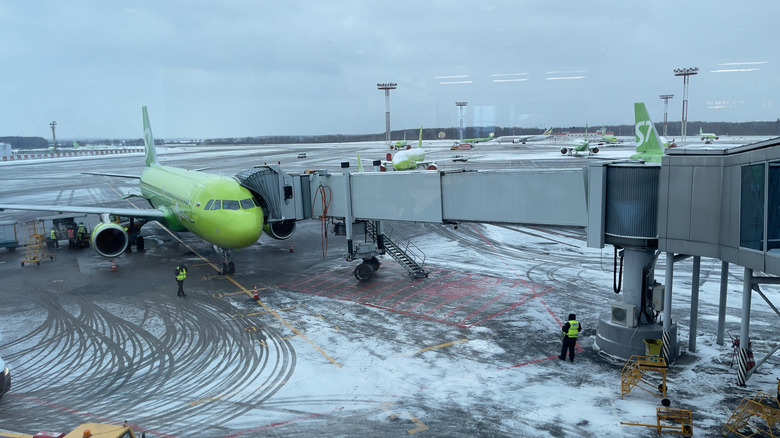
There are certain advantages to conveying passengers to their flight via a bus. For example, some budget airliners at large airports, such as Los Angeles International, still offer boarding by bus for the sake of operating costs. While airport boarding buses certainly aren’t cheap, according to Aviation Direct, installing an articulating gangway bridge can potentially run millions of dollars. In addition, not every model of aircraft can properly join with a bridge, either.
However, in terms of convenience, efficiency, and passenger comfort, terminal bridges have the advantage. In terms of the boarding experience, an enclosed gangway is the most direct means of getting on the aircraft, allowing you a short walk directly from the terminal into the jet. Inclement weather isn’t an issue, and there are fewer safety concerns when compared to bus boarding. Consider the report of a Florida man who crashed a Ford Mustang through an airport fence, which is a situation that could be far more dangerous for those boarding on the tarmac. In addition, bridges are easier for those unable to navigate stairs due to a disability or health-related issue.
While undoubtedly an interesting idea, the Ikarus P.A.L.T. buses are a footnote in European airport history. Though, the idea isn’t completely dead. The mobile lounge has been going strong at Dulles since 1962, continuing to provide a valuable service to passengers today.


