With the completion of the scaffolding installation phases in the Sistine Chapel, the extraordinary maintenance work on Michelangelo Buonarroti’s Last Judgment has begun. This project is made possible thanks to the generous contribution of the Florida Chapter of the Patrons of the Arts in the Vatican Museums .
The work is scheduled to be completed by Easter. Meanwhile, the Sistine Chapel continues to welcome worshippers and visitors, who find the scaffolding—installed by the Governor’s Directorate of Infrastructure and Services—covered by a canvas depicting the Last Judgment .
As Barbara Jatta, Director of Museums and Cultural Heritage, stated, “All phases of the intervention will be documented by the Vatican Museums Photographic Laboratory, creating a valuable record of the cleaning process which, by removing a light patina invisible to the naked eye, will restore Michelangelo’s colors to their full splendor. Some thirty years after the last conservation intervention, completed in 1994 under the supervision of Director General Carlo Pietrangeli and carried out by the head restorer of the Vatican Museums’ Laboratory for the Restoration of Paintings and Wood Materials, Gianluigi Colalucci, it will be possible to admire Michelangelo’s absolute masterpiece in all the power of his vision.”
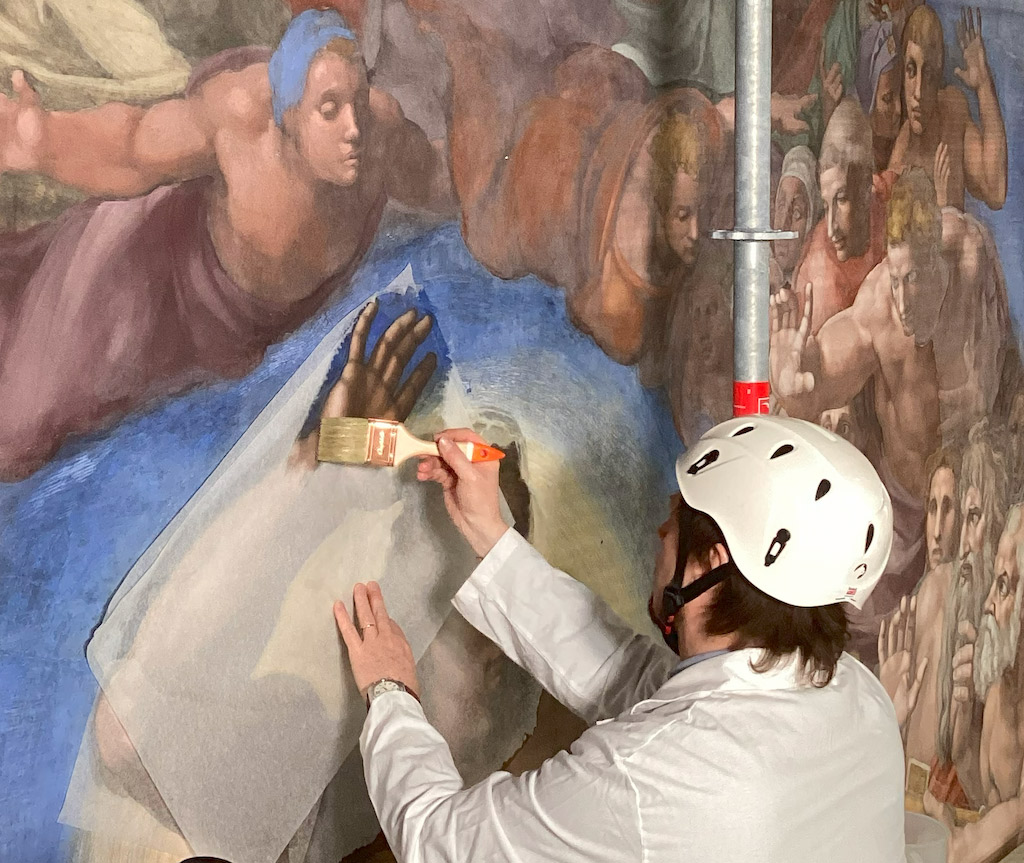
The restoration work is being carried out by the restorers of the Paintings and Wood Materials Restoration Laboratory at the Vatican Museums. Dr. Paolo Violini, head restorer of the Paintings and Wood Materials Restoration Laboratory, explained that the extraordinary maintenance was necessary due to “the presence of a widespread whitish glaze on the painted surface, which has diminished the chiaroscuro values and, consequently, altered the chromatic legibility of the fresco. The removal of this patina is being carried out through the controlled application, with a brush, of deionized water, interposed through a double layer of Japanese paper. The water allows for the complete dissolution of the deposits and foreign substances, revealing the original paint layer while fully respecting its authentic state of conservation.”
The intervention is preceded by rigorous preliminary scientific investigations, detailed photographic documentation, and a meticulous survey of the state of conservation of the work, aimed at acquiring data and verifying the compatibility of the operational procedures adopted.
The extraordinary maintenance intervention also involves the Scientific Research Office and the Conservator’s Office.
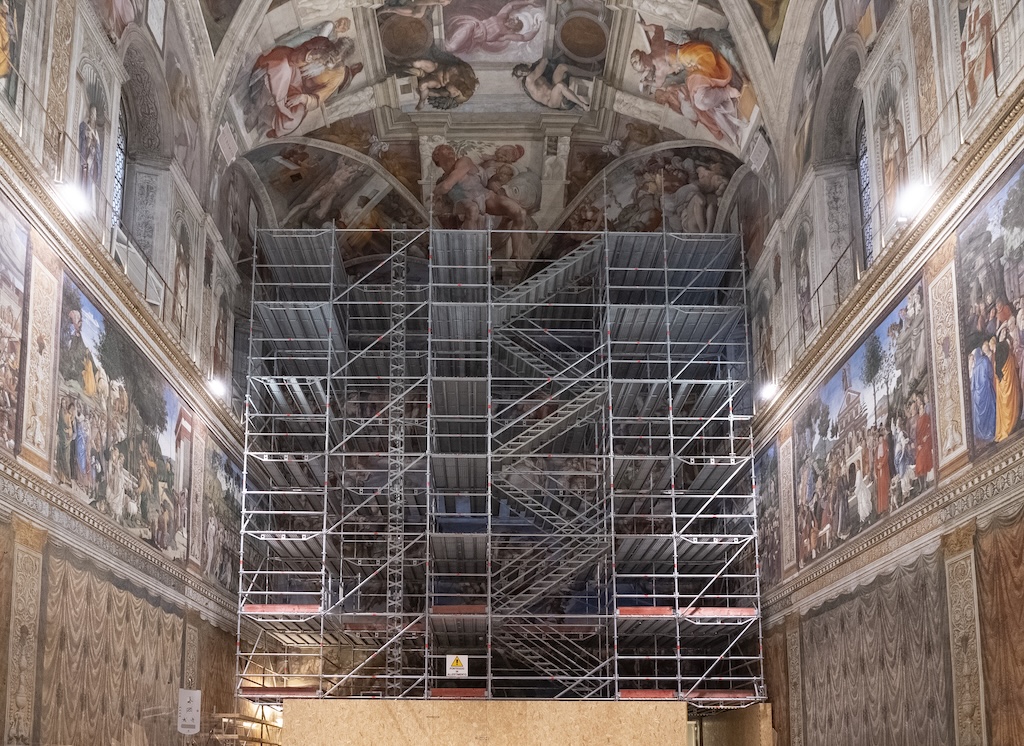
It is in these last weeks of February that, once the installation of the scaffolding in the Sistine Chapel was completed, the extraordinary maintenance of Michelangelo’s Last Judgment, long awaited by us with great anticipation, has begun.
Although the delicate cleaning of Michelangelo’s magnificent fresco has officially begun and is scheduled to conclude around Easter, Barbara Jatta, director of the Vatican Museums, has announced that the Sistine Chapel will continue to welcome worshippers and the numerous visitors throughout the restoration work. Access to this sacred space will therefore be guaranteed for the entire duration of the complex conservation project, which utilizes temporary scaffolding for the restoration of Michelangelo’s fresco depicting the Second Coming of Christ and the Last Judgment, which completely covers the altar wall of the Sistine Chapel.
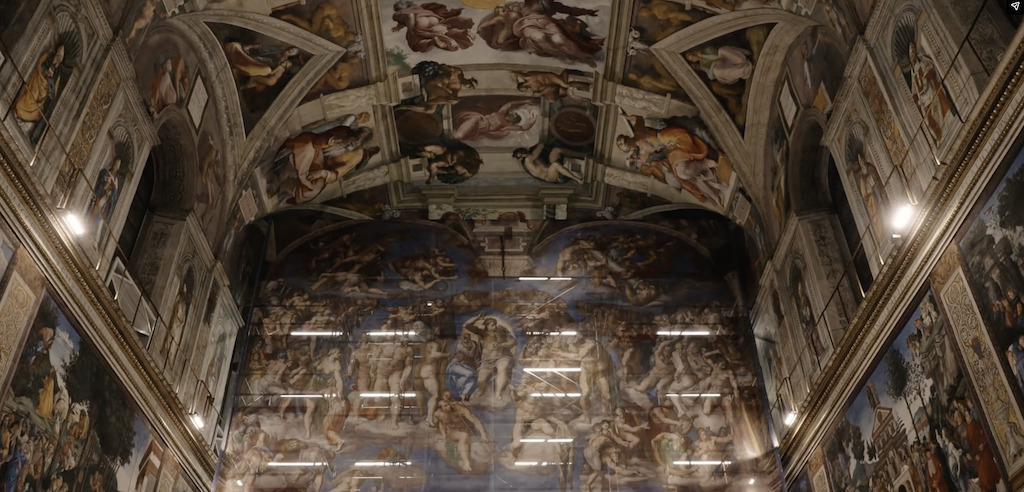
To allow visitors to at least imagine Michelangelo’s magnificent masterpiece hidden behind scaffolding, a canvas reproduction of The Last Judgment, enhanced by carefully designed lighting, conceals the restoration area and the work of the restorers. The complex installation of the intervention site was made possible by the expertise of the Directorate of Infrastructure and Services, headed by engineer Salvatore Farina for the Governorate of Vatican City State, and creates a memorable experience for those visiting the Sistine Chapel. This extraordinary conservation of The Last Judgment is supported by the Florida Chapter of the Patrons of the Arts in the Vatican Museums. Mary Viator, president of the Chapter, generously funded this project of paramount importance in recognition of its religious, artistic, and cultural significance.
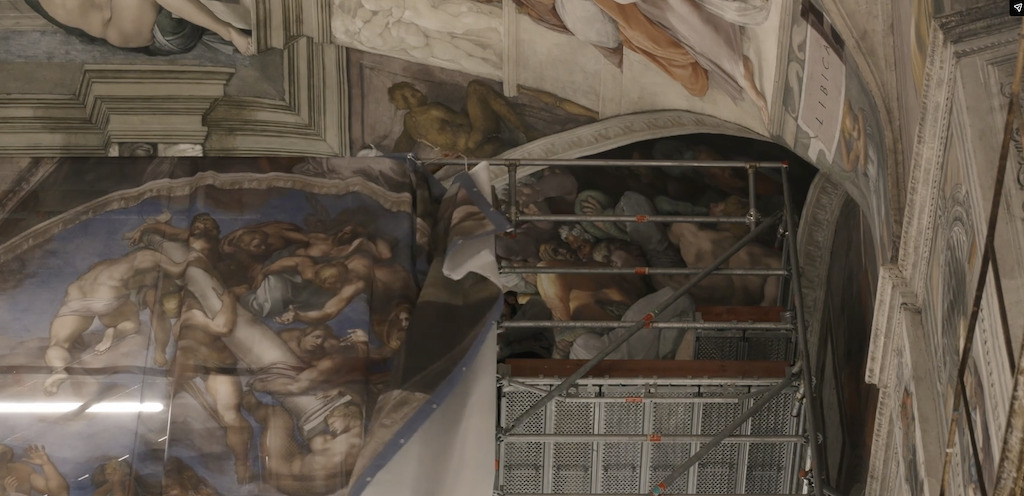
In presenting this significant initiative, the director of the Vatican Museums declared: “…All phases of the intervention will be documented by the Vatican Museums Photographic Laboratory, creating a valuable record of the cleaning process which, by removing a light patina imperceptible to the naked eye, will restore Michelangelo’s colors to their splendor. Almost thirty years after the last conservation intervention, completed in 1994 under the supervision of Director General Carlo Pietrangeli and carried out by the then head restorer of the Vatican Museums’ Laboratory for the Restoration of Paintings and Wood Materials, Gianluigi Colalucci, it will be possible to admire Michelangelo’s supreme work in all the power of his vision.”
In the Vatican Museums’ statement of February 23, 2026, which illustrates the relevance and methodology of this extraordinary intervention, several of the protagonists involved provided new details about its scope.
Fabrizio Biferali, curator of the Department of 15th and 16th Century Art, explained: “…the Last Judgment fresco was begun in 1536 under the pontificate of Paul III Farnese and completed in 1541. According to Ascanio Condivi’s Life of Michelangelo Buonarroti : “…When the fresco was finally unveiled, it was said that Paul III was so impressed that he fell to his knees imploring divine forgiveness on the last day.”

“The current intervention,” explains Paolo Violini, head restorer at the Painting and Wood Materials Restoration Laboratory, “was necessary due to the presence of a widespread whitish glaze on the painted surface, which has diminished the chiaroscuro values and, consequently, altered the chromatic legibility of the fresco. The removal of this patina is carried out through the controlled application, with a brush, of deionized water, interposed through a double layer of Japanese paper. The water allows for the complete solubilization of deposits and foreign substances, revealing the original paint layer while fully respecting its authentic state of conservation. The intervention is preceded by rigorous preliminary scientific research, detailed photographic documentation, and a precise assessment of the work’s state of conservation, aimed both at acquiring data and verifying the compatibility of the operational procedures adopted.”
The head of the Office of the Conservator, Marco Maggi, has publicly stated: “…starting in 2010, the Directorate of the Vatican Museums implemented the Ordinary Maintenance Plan for the Sistine Chapel… During the evenings of January and February, after the Museums close to the public, painting and marble restorers, diagnostic and conservation specialists, logistics operators, and technicians from the Museums and the Directorate of Infrastructure and Services take turns ensuring the preservation of the frescoes and decorative elements of the Chapel—through meticulous dust removal and rigorous autoptic and instrumental checks—and verifying the proper functioning of the climate control and lighting systems, which have been in operation since 2014 and are fundamental both for the stability of the environmental conditions and for the optimal enjoyment of the Sistine Chapel.”
Reflecting on the current need for intervention, Fabio Morresi, head of the Scientific Research Department, observes: “…we are once again able to closely examine Michelangelo’s work. Over the years, we have been constantly monitoring the paint layer and have been able to confirm, in addition to a slight deposition of particulate matter, some localized bleaching phenomena. These phenomena were immediately analyzed to precisely define their nature and, therefore, the cause of their appearance. A series of exhaustive scientific analyses allowed us to correctly identify the molecular composition of this substance, namely, calcium lactate. This salt is found stratified only in the outermost layer of the paint and is highly soluble in water. This physicochemical characteristic facilitates its removal, ensuring minimal interaction with the underlying pigments.”
The importance of Michelangelo’s Last Judgment cannot be underestimated. Today, after numerous studies and analyses, the installation of special scaffolding near the Last Judgment wall will allow our restorers to carry out, under completely safe conditions and with the Sistine Chapel open to the public, an extraordinary maintenance intervention on the entire painted surface, making it possible for future generations to continue admiring one of the most significant masterpieces of the world’s artistic heritage.
Monsignor Terence Hogan, Coordinator of the Office of Relations with the Patrons of the Arts in the Vatican Museums
A conversation with Paolo Violini, Head Restorer of the Painting and Wood Materials Restoration Laboratory of the Vatican Museums
Rediscovering Michelangelo’s fresco in all its expressive power is an extraordinary experience that lasts forever. This is the opinion of Paolo Violini, Head Restorer at the Laboratory for the Restoration of Paintings and Wood Materials, as he recounts his work in the Sistine Chapel on the occasion of the extraordinary conservation of Michelangelo Buonarroti’s Last Judgment .
This intervention involves professionals and technicians from various departments of the Vatican Museums, including twenty restorers from the Painting Restoration Laboratory, organized into four teams that take turns working on the scaffolding. They are joined by specialists from the Directorate of the Department of 15th- and 16th-Century Art, qualified technicians from the Scientific Research Office, as well as staff from the Conservator’s Office and the Photographic Laboratory. Also crucial is the contribution of the Directorate of Infrastructure and Services of the Governorate, responsible for the scaffolding installation and climate control system, along with the invaluable financial support of the Florida Chapter of the Patrons of the Arts in the Vatican Museums.
What were the main reasons that made the extraordinary maintenance necessary?
The main reason was undoubtedly the observation of a widespread whitish haze on the painted surface, caused by the deposition of microparticles of foreign substances carried by air currents. Over time, this phenomenon had diminished the chiaroscuro contrasts and obscured the original colors of the fresco.
Was it a planned intervention or an urgent action due to specific criticalities?
The intervention was planned and is part of the overall preventive maintenance program for the entire decorative complex of the Sistine Chapel, aimed at safeguarding the fresco surfaces through the systematic removal of deposits that accumulate over time. The operations, which began approximately twenty years ago and have thus far been carried out exclusively at night using mobile platforms, have gradually affected the walls with Michelangelo’s lunettes, the series of Popes, and the large 15th-century scenes with the lower draperies. Until now, the Last Judgment wall had been excluded , as it would have required the erection of permanent scaffolding.
What environmental factors (humidity, dust, tourist flows) have the greatest impact on the conservation of the work?
A certain amount of dust that naturally settles on wall surfaces can be considered physiological over the years. In addition, especially on the Judgment wall , a whitish deposit forms, resulting from a combination of factors: humidity and air currents, temperature, and anthropogenic factors. When these elements converge in certain proportions, they contribute to the formation of this type of surface sediment.

What were the main problems detected in the fresco before the intervention?
Thanks to its extraordinary execution technique, the Last Judgment remains in an excellent state of preservation, the result of the extensive restoration carried out between 1990 and 1994 by Gianluigi Colalucci’s team at the Vatican Museums’ Painting Restoration Laboratory, under the direction of Carlo Pietrangeli and Fabrizio Mancinelli. This was confirmed in the initial tests conducted approximately a year ago on certain areas of the painted wall: the removal of the whitish patina allowed the fresco to be rediscovered intact in its original colors. Furthermore, Michelangelo’s unique approach—the construction of a slightly inclined wall with an upper projection of about 40 centimeters—has contributed to its good preservation by limiting the dust accumulation typical of vertical walls.
What materials and techniques are used for cleaning?
Fortunately, the white veil proved to be completely soluble and could be removed by simply applying deionized water with a brush, on a double layer of Japanese paper used as a support.
Has the intervention planned for the use of innovative technologies (laser, multispectral imaging, etc.)?
The current intervention is relatively simple and therefore does not require the use of particularly innovative technologies. However, the restorers’ work is preceded by rigorous preliminary scientific research, detailed photographic documentation, and a precise assessment of the artwork’s state of conservation in order to acquire data and verify the compatibility of the adopted operating procedures. Advanced technologies are used for these analyses, such as high-resolution infrared imaging, colorimetric measurements before and after extractions, FT-IR and Raman surface analysis using portable instrumentation, and ion chromatography of the extraction water. Microsamples have also been taken for scanning electron microscopy (SEM) analysis of the painted surfaces.
What is the guiding principle in maintaining a work of such high historical and spiritual value?
The fundamental principle in the field of art restoration is the constant search for the best possible balance between the work’s historical significance and its aesthetic value. This is a broad concept, open to diverse interpretations, which must always be properly grounded in the contributions of the various professionals involved in critical decisions: art historians, restorers, and experts in cultural heritage assessment. It is a complex field, encompassing technical aspects, theoretical reflections on the discipline, and art history and criticism.
In the Vatican sphere, the recovery of the intrinsic meaning of the artwork takes on particular importance; that is, the intangible value constituted by the message that the artist—or the patron—intended to convey through its creation, always in relation to the specific historical context. Critical decisions, including those of an aesthetic nature related to restoration work, must therefore be geared toward safeguarding and restoring these values, which have often served as a fundamental vehicle of doctrine and teaching for the faithful.
Finally, the application of a preventive maintenance program is essential, especially in the case of large cycles of mural painting such as the Sistine Chapel or the Raphael Rooms, indispensable to guarantee the correct conservation of the restored works, mainly through forms of indirect protection, such as the control of environmental parameters and the prevention of potentially harmful conditions.
Is there a plan for regular maintenance in the future?
Of course. We will continue to monitor the microclimate of the Sistine Chapel and systematically proceed with the annual plan to dust all painted surfaces.
How many professional specialties have participated?
As for the Painting Restoration Laboratory, twenty restorers work there, divided into four teams that take turns daily on the scaffolding, so that everyone can enjoy the extraordinary opportunity to come face to face with Michelangelo’s fresco, a rare and unique experience. I was fortunate enough to be present on the scaffolding during the restoration thirty years ago, and I can assure you that the emotion of rediscovering Michelangelo’s fresco in all its expressive power is something that stays with you and is never forgotten. In
addition to the restorers, the team includes the Director of the Department of 15th and 16th Century Art, specialists from the Scientific Research Office, staff from the Conservator’s Office, and personnel from the Photographic Laboratory. The Directorate of Infrastructure and Services is responsible for managing the climate control system.
How has the presence of visitors been managed during the works?
The scaffolding only covers the Last Judgment wall and, thanks to a gallery that runs through it, allows visitors to access the Chapel as well. The public can view a faithful reproduction of the painted wall on a canvas that covers the structure. All scaffolding assembly was carried out after closing time, so the Sistine Chapel has remained open to the public at all times.
How might climate change affect fresh food preservation?
By their very nature and physical structure, frescoes—especially when located indoors—should not be particularly affected by climate change. However, we have observed that the general increase in temperatures, coupled with the rise in humidity in areas with large concentrations of people, can promote the formation of compounds in indoor environments that cause the whitish patinas that must be removed from frescoes. Therefore, the constant regulation of air conditioning and ventilation systems is especially necessary, based on ambient thermo-hygrometric parameters that are changing more rapidly and significantly. Furthermore, indirectly, violent rainfall events, induced by climate change and becoming increasingly frequent, can damage roofs and walls, with the consequent water infiltration and irreversible damage, even to interior decorated surfaces.